
Promo Code for Fluffy Favourites — RTP Structure, Volatility and Wagering Explained
Why a Promo Code Changes the Session — Not the Mathematics
A quick reality check on what a promo changes
This snapshot separates session mechanics from game mathematics, so the bonus feels clearer rather than louder.
| Element | Changes with promo | Remains constant |
|---|---|---|
| Exposure length | Yes | — |
| RTP per spin | — | Yes |
| Volatility model | — | Yes |
| Feature probability per spin | — | Yes |
I have spent much of my academic career examining how gamblers interpret value, probability and risk. One of the most persistent misunderstandings I encounter concerns promotional offers. Players routinely assume that a promo code enhances their chances of winning. It does not. What it changes is the architecture of the session itself.
When applied to Fluffy Favourites, a promo code does not alter the random number generator, the volatility model or the underlying return to player configuration. Each spin remains statistically independent. The probability of triggering free games, activating the Toy Claw feature or landing any particular symbol combination is mathematically identical whether a player is wagering with deposited funds or promotional balance.
Yet the experience feels different. That difference is not imaginary. It arises from altered exposure.
Exposure is the number of spins a player can sustain before funds are exhausted. A promo code typically extends this exposure. It may do so by matching a deposit, by awarding free spins, or by combining both. In structural terms, this extension increases the opportunity to encounter variance across a broader range of outcomes. It does not improve odds; it modifies duration.
Fluffy Favourites is designed with moderate volatility and a steady cadence of small line wins. These characteristics create a rhythm that is particularly sensitive to session length. A short session can feel abrupt and unforgiving. A longer session, by contrast, often feels smoother and more balanced. That perception shift is frequently misinterpreted as generosity.
The central thesis of this analysis is straightforward. A promo code does not improve expectation. It reshapes the temporal profile of the session. In doing so, it alters how volatility is perceived, how risk is tolerated and how outcomes are interpreted.
Understanding this distinction is essential before engaging with any promotional offer attached to the game.
What a Fluffy Favourites Promo Code Actually Changes
Why longer exposure feels calmer
As spin volume grows, short-run volatility deviation tends to narrow. This does not improve the odds; it changes how variance is experienced across time.
Reading tip: the line becomes calmer as exposure increases, but the underlying edge remains unchanged. The visual shows perception smoothing, not improved probability.
To understand the structural impact of a promo code, one must begin with what remains constant.
The mathematics of Fluffy Favourites are fixed within each configured return environment. The symbol distribution, feature trigger frequency and volatility parameters are predetermined by the game’s design and certification. No promotional mechanism can override this architecture. If a player spins at 20 pence using deposited funds, and another spins at the same stake using bonus funds, the statistical properties per spin are identical.
What changes is the depth of the session.
Consider a simple example. A player deposits £20 at 20 pence per spin. Ignoring interim wins, that balance theoretically allows for 100 spins. If a 100 per cent matched bonus is applied, the available balance becomes £40. Exposure doubles. The probability of triggering a feature on any single spin remains constant, but the probability of encountering at least one feature across the entire session increases because there are more attempts.
This is not an improvement in odds per spin. It is an expansion of sample size.
Longer sessions tend to produce a broader spread of outcomes. In moderate volatility games such as Fluffy Favourites, this can mean more frequent small wins, occasional feature triggers and a distribution of results that appears less extreme. Players often describe this as the game “settling” or “playing more fairly”. From a statistical standpoint, what they are observing is the smoothing effect that occurs as sample size increases.
Short sessions exaggerate volatility. A handful of losing spins can dominate perception. Conversely, a single feature in a compressed session can create the illusion of high generosity. Extended sessions dilute these extremes across a greater number of events.
A promo code therefore functions as a session multiplier. It stretches the timeline over which variance unfolds. This stretching has psychological consequences. Players feel less pressure when the balance appears deeper. They may interpret extended play as evidence of skill or improved timing. In reality, they are simply observing probability expressed over a larger number of trials.
There is also an important behavioural dimension. Increased exposure can encourage stake stability. When funds are limited, players are more prone to escalating stakes in an attempt to accelerate outcomes. With a larger promotional balance, there is often less immediate urgency. The game’s natural rhythm can unfold at its intended pace. Again, this can be misread as structural generosity.
The promo code changes the contour of risk across time. It does not change the mathematical expectation embedded within each spin.
RTP Configurations and Why Promotional Traffic Sometimes Feels Different
Another dimension frequently overlooked by players concerns return to player configurations.
Fluffy Favourites, like many modern slots, can be deployed in different RTP settings depending on the operator’s contractual arrangement. For illustrative purposes, one environment may operate at 95 per cent RTP while another may operate at 93 per cent. The volatility model may remain similar, but the long-term expected return differs marginally.
Promotional campaigns are typically linked to specific operators. When a player uses a promo code, they are entering a particular casino ecosystem, not an abstract mathematical environment. If that operator utilises a lower RTP configuration, the long-term expectation is slightly reduced relative to a higher configuration elsewhere.
This distinction is subtle yet significant. Players may attribute perceived differences in outcomes to the promo code itself. In fact, the code merely directs them to a platform where a particular configuration is active.
It is also worth noting that short-term sessions are insufficient to detect RTP differences reliably. The gap between 95 per cent and 93 per cent emerges over a very large number of spins. In the context of a modest promotional balance, variance will overshadow this distinction. Nevertheless, from a structural perspective, understanding configuration differences is essential.
Why, then, might promotional play feel distinct?
First, promotional traffic often coincides with onboarding. New players may be unfamiliar with the game’s pacing. Moderate volatility combined with small frequent wins can create a strong first impression. When this is experienced through a bonus lens, the perception of generosity may be amplified.
Second, certain variants of the game are designed with promotional campaigns in mind. These builds may be favoured by operators for free spin packages because their moderate volatility reduces the likelihood of extreme outcomes during onboarding. This is not manipulation; it is commercial pragmatism. A stable volatility profile is more predictable for marketing budgets.
Third, wagering requirements introduce a structured obligation to continue spinning beyond the initial bonus amount. This extended exposure can create the impression that the game is “active” or “responsive”. In truth, the player is simply engaging with a larger volume of spins.
In behavioural terms, promotional engagement often occurs under conditions of heightened attention. The player is consciously aware that they are using a bonus. This awareness can sharpen memory of wins and near misses. Cognitive biases, such as confirmation bias and the availability heuristic, become more pronounced. A memorable feature triggered during free spins may disproportionately shape overall evaluation of the session.
From a purely mathematical standpoint, the promo code is neutral. From a psychological standpoint, it is catalytic.
The key is to separate these layers. The spin remains governed by random number generation. The volatility remains embedded within the design. The RTP remains determined by configuration. The promotional mechanism modifies exposure and perception, not probability.
Deposit Match Versus Free Spins — Two Very Different Risk Architectures
Same slot, two bonus formats
Both options extend exposure, but they shape variance and decision pressure in different ways. This split view keeps the distinction clear.
Deposit match
Integrated sessionExposure density
Spread across a longer session with flexible pacing.
Variance distribution
Diluted over time, which often feels calmer as spins accumulate.
Stake flexibility
Player-led within the operator’s limits while wagering is active.
Emotional intensity
Lower peaks per moment, but longer exposure can deepen commitment.
Free spins
Bounded burstExposure density
Concentrated into a fixed run, often with a locked stake.
Variance distribution
Compressed, so single events can dominate the narrative.
Stake flexibility
Usually restricted, which reduces control but clarifies cost per spin.
Emotional intensity
Higher peaks per moment because the window is short and framed as “free”.
Promotional offers are often grouped together under the generic label of “bonus”. From a structural perspective, however, a matched deposit and a package of free spins are fundamentally different risk environments. Although both extend exposure, they do so in distinct ways.
A deposit match integrates directly into the player’s existing bankroll. If a player deposits £30 and receives a 100 per cent match, the available balance becomes £60. The bonus funds and the cash funds may be separated for accounting purposes, yet the player experiences them as a combined pool. Each spin draws from the total balance according to stake selection. Wins are credited into that same pool, subject to wagering conditions.
The critical point is that volatility is integrated across the entire session. Losses and gains accumulate fluidly. The player retains control over stake size within permitted limits. The session unfolds continuously.
Free spins operate differently. They create a bounded variance burst. A player may receive, for example, 50 spins at a fixed stake of 20 pence. These spins are typically locked at a predetermined wager. The volatility expressed during this phase is compressed into a limited and pre-structured window.
From a statistical standpoint, both formats maintain identical per-spin probability. The difference lies in distribution density. In a deposit match, variance is distributed across a potentially extended, flexible timeline. In a free spin package, variance is concentrated into a finite sequence.
This concentration has psychological consequences. During free spins, players often report heightened anticipation. Each spin is framed as “free”, even though its expected value remains negative relative to long-term RTP. The absence of immediate personal expenditure reduces perceived risk. Yet volatility does not diminish. If a free spin sequence produces modest returns, disappointment may arise more sharply than during cash play, because the expectation of generosity was elevated.
Deposit matches, by contrast, tend to feel more stable. The balance appears larger. Losses are absorbed over more spins. The pacing of Fluffy Favourites – with its frequent small line wins – may create the impression of sustained activity. This can foster a sense of progression, even when the overall trajectory remains negative.
There is also a difference in control illusion. During deposit-based play, the player can adjust stakes dynamically. This flexibility can create a perception of strategic influence. During free spins, stake size is fixed. Control is removed. The outcome feels predetermined within the allotted spins.
In both cases, the mathematics remain neutral. What changes is the architecture through which variance is expressed. A deposit match expands the canvas on which volatility unfolds. Free spins condense that volatility into a framed sequence. Understanding this distinction prevents the common error of assuming that one format is inherently safer than the other.
Neither reduces risk. Each reorganises it.
Wagering Requirements as a Volatility Multiplier
Translating wagering into actual spin volume
| Bonus | Wagering | Total required turnover | Approx spins (20p) |
|---|---|---|---|
| £20 | 30× | £600 | 3000 |
Promotional funds are rarely free in an unconditional sense. They are typically subject to wagering requirements. These requirements specify how many times the bonus amount, or sometimes the combined bonus and deposit, must be staked before withdrawal is permitted.
From a behavioural perspective, wagering requirements introduce compulsion into the session structure. From a statistical perspective, they enforce extended exposure.
Suppose a player receives a £20 bonus with a wagering requirement of 30 times the bonus. This necessitates £600 in total staked spins before the bonus becomes withdrawable. At 20 pence per spin, this equates to 3,000 spins. Such a volume far exceeds what many players would ordinarily engage with in a casual session.
The requirement therefore multiplies volatility expression. The longer the mandated exposure, the greater the opportunity for variance to dominate outcomes. Even in moderate volatility games such as Fluffy Favourites, extended spin counts increase the probability of encountering both positive and negative swings.
It is important to clarify that extended exposure does not favour the player in expectation. The house edge embedded within RTP persists across every spin. As spin count increases, the realised return tends to gravitate towards the configured mean. Over a sufficiently large number of spins, deviation narrows. However, this convergence does not imply profit; it reflects statistical stabilisation around a negative expectation.
Players frequently underestimate the scale of wagering requirements. The figures appear abstract. Thirty times a £20 bonus sounds manageable. Yet when translated into spin volume, the magnitude becomes clearer. This miscalculation can lead to frustration if the balance declines before requirements are met.
There is also an emotional dimension. When wagering is incomplete, players may perceive funds as inaccessible. This perception can influence risk-taking behaviour. Some increase stakes in an attempt to accelerate progress through wagering thresholds. Such escalation amplifies volatility per spin without reducing total wagering volume proportionally.
In moderate volatility environments, the steady cadence of small wins can create a misleading sense of sustainability during wagering. Because Fluffy Favourites frequently returns modest amounts, the balance may fluctuate around a stable midpoint for a time. This plateau can encourage continued engagement. Eventually, however, variance asserts itself.
From a structural viewpoint, wagering requirements transform a bonus from a simple exposure extension into a prolonged volatility multiplier. The player is not merely playing longer; they are compelled to play longer under predefined conditions.
Understanding the arithmetic behind wagering is therefore essential. The requirement defines the minimum exposure necessary before withdrawal is permitted. It does not alter the probability model. It extends the timeline over which that model operates.
The Psychology of “Free” in a Moderate Volatility Slot
The word “free” carries disproportionate psychological weight. In laboratory and field research alike, the perception of zero cost significantly alters decision-making. In gambling contexts, this effect is magnified.
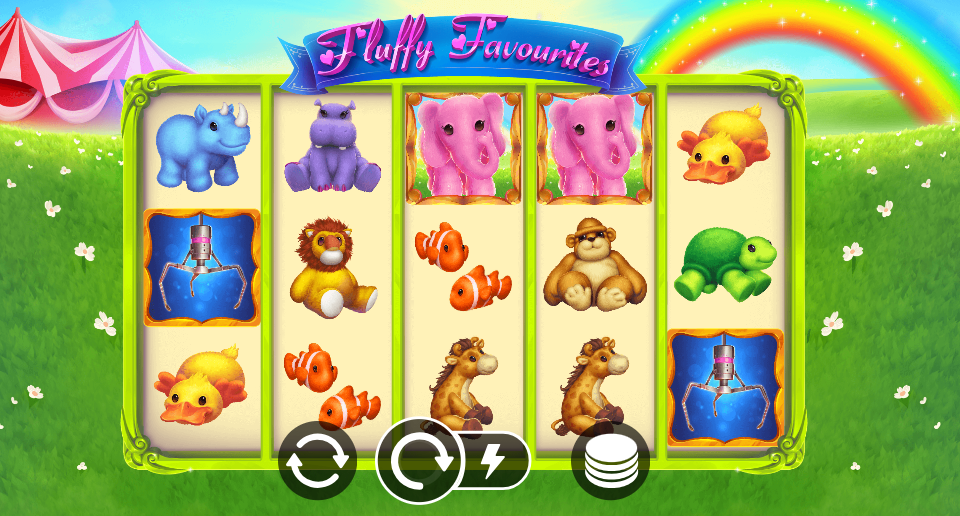
Fluffy Favourites is characterised by a gentle aesthetic, moderate volatility and frequent small wins. These attributes produce a soft experiential texture. Losses are often interspersed with minor returns. The game feels active. Symbols are colourful and familiar. The atmosphere is non-threatening.
When free spins are layered onto this structure, the sense of safety may increase further. Players often report feeling that they are playing “with the house’s money”. This framing reduces immediate loss aversion. Spins that would otherwise feel risky are reinterpreted as opportunity.
However, volatility does not soften in response to perception. If a free spin sequence yields minimal returns, disappointment can be acute. The contrast between expectation and outcome intensifies emotional response.
Near-miss effects are particularly relevant. In moderate volatility games, near-feature outcomes – for example, two scatters appearing without a third – are relatively frequent. During promotional play, such near misses may be encoded more vividly in memory. The player is primed to expect something additional because the session itself is framed as special.
Expiry pressure compounds this dynamic. Promotional offers often operate within limited time windows. The awareness that a bonus will lapse can create urgency. Urgency tends to reduce deliberation. Stakes may be increased, session duration extended and risk tolerance elevated.
There is also a reinforcement loop at work. If a player triggers a feature during free spins and experiences a moderate win, that event may anchor future expectations. Subsequent sessions without bonuses may feel comparatively muted, even though the mathematics are unchanged. The promotional context has recalibrated subjective baseline.
It is critical to distinguish between emotional amplification and structural generosity. The former arises from framing, urgency and cognitive bias. The latter would require alteration of probability or expectation. Promotional offers influence the former; they do not alter the latter.
In moderate volatility environments such as Fluffy Favourites, the interplay between frequent minor reinforcement and promotional framing can be particularly potent. The session feels alive. Wins occur regularly enough to sustain engagement. The bonus label enhances perceived value.
Recognising these psychological mechanisms does not negate enjoyment. It provides clarity. A player who understands that the feeling of advantage arises from extended exposure and cognitive framing, rather than improved odds, is better positioned to evaluate risk rationally.
Promotional Builds and Campaign Engineering — Why Some Versions Fit Bonuses So Well
Not all slot deployments are identical in practical terms, even when they share a common mathematical backbone. Operators make strategic decisions about which titles to feature in onboarding campaigns, which to attach to free spin packages, and which to position prominently within promotional funnels.
Fluffy Favourites occupies a particular niche in this landscape. Its moderate volatility, steady rhythm of small wins and recognisable aesthetic make it commercially attractive for campaigns designed to introduce new players to a platform. This suitability is not accidental. It emerges from structural characteristics.
From an operator’s perspective, extreme volatility slots are unpredictable in promotional contexts. A small free spin package on a highly volatile game could generate disproportionately large wins, creating marketing cost variance. Conversely, very low volatility titles may feel unremarkable and fail to engage new users. Moderate volatility offers a middle ground. It provides visible activity without extreme payout volatility in short sequences.
This balance makes Fluffy Favourites a pragmatic choice for free spin campaigns. When players use a promo code and receive spins on such a title, the experience tends to be eventful without being chaotic. The rhythm reinforces engagement. Small wins punctuate losing streaks. Features are accessible but not guaranteed.
In some cases, variants of a game are configured specifically for promotional distribution. These builds operate within the same conceptual design but are optimised for marketing alignment. The optimisation does not necessarily imply altered volatility in a dramatic sense. Rather, it ensures that the game’s pacing, bonus frequency and payout structure fit comfortably within free spin packages or welcome bundles.
For the player, the distinction between core and campaign-aligned versions may be invisible. The symbols, layout and mechanics appear familiar. Yet the context of use differs. A title encountered through a promotional entry point is experienced under heightened awareness. Expectations are elevated. The session is framed as exceptional.
This framing has behavioural implications. Promotional play often occurs at the beginning of a player’s relationship with an operator. Early experiences can anchor long-term perceptions. If the initial exposure to Fluffy Favourites through a promo code yields moderate entertainment and intermittent wins, the player may generalise that impression to subsequent cash play.
From a structural standpoint, the promo code functions as an access mechanism into a carefully curated environment. The mathematics remain governed by probability. However, the surrounding ecosystem – welcome messaging, bonus tracking, wagering indicators – shapes interpretation.
It is therefore misleading to attribute perceived differences in outcome directly to the promotional mechanism. More often, the differences arise from context, expectation and session length. The spin remains random. The framing changes.
Understanding this distinction allows players to disentangle environmental cues from mathematical reality.
Risk Compression and Risk Expansion in Bonus Sessions
How the same variance feels different
Short bonus windows concentrate volatility into a tight sequence. Longer wagering sessions distribute the same variance across more spins, which often feels calmer in the moment.
Short bonus
High density varianceLong wagering session
Distributed variancePromotional sessions alter not only duration but also the shape of perceived risk across time. Two opposing phenomena can occur: compression and expansion.
Risk compression occurs when volatility is concentrated into a short promotional window. Consider a small free spin package of 20 spins. Within that narrow sequence, outcomes may cluster at extremes. A single feature may account for a large proportion of total return. Alternatively, the entire sequence may yield minimal value.
Because the number of spins is limited, each event carries disproportionate narrative weight. One significant win can represent 40 or 50 per cent of the session’s total outcome. The emotional amplitude is heightened.
Risk expansion occurs in matched deposit scenarios with substantial wagering requirements. Here, volatility unfolds across a prolonged timeline. Gains and losses are distributed more evenly. Extreme swings may still occur, but they are diluted within a larger volume of spins.
In expansion contexts, players may experience what I describe as narrative smoothing. The session feels coherent. There is a sense of progression. Even when the overall balance declines gradually, the extended sequence of small wins and intermittent features can create a perception of activity and fairness.
Neither compression nor expansion alters expectation. Both reorganise how variance is encountered.
In compressed sessions, players are more likely to remember salient events. A strong bonus within a small free spin package may generate disproportionate optimism. In expanded sessions, players may underestimate cumulative loss because it unfolds incrementally across many spins.
Moderate volatility titles accentuate these dynamics. Fluffy Favourites frequently returns modest amounts. In compressed free spin sequences, these small returns may feel inconsequential unless accompanied by a feature. In expanded deposit sessions, the same small returns can create the impression of sustained resilience.
The crucial analytical point is this: promotional architecture influences the density with which variance is experienced. Density affects perception. Perception influences behaviour. Mathematics remains constant.
When players report that a bonus session felt “safer” or “more volatile”, they are often describing density effects rather than structural changes in probability.
Recognising density distortion is a step towards more accurate risk appraisal.
When a Promo Code Becomes Riskier Than Playing Without One
Where the bonus can quietly raise risk
A promo does not alter probability, but it can amplify exposure and behaviour. These mechanisms summarise how additional structure may increase overall risk.
Exposure multiplier
Extended spin volume increases total contact with variance across the session.
Stake escalation
Bonus balances may encourage higher stakes, accelerating volatility per spin.
Emotional commitment bias
Time invested in wagering can create pressure to continue beyond rational limits.
Profit lock-in illusion
Conditional winnings may feel secured, even though continued play can reverse them.
It may seem counterintuitive to suggest that a bonus can increase risk. After all, additional funds appear to provide a cushion. However, under certain conditions, promotional engagement can amplify behavioural risk relative to straightforward cash play.
The first mechanism is overexposure. Wagering requirements compel extended spin volume. If a player would ordinarily limit themselves to 150 spins but is now required to complete the equivalent of 2,000 spins to unlock withdrawal, exposure multiplies. Each additional spin carries negative expectation in aggregate. The longer the mandated engagement, the greater the cumulative expected loss.
The second mechanism is stake distortion. Promotional balances can feel less tangible than deposited funds. This reduced salience may encourage higher stake selection. A player might rationalise that increasing from 20 pence to 40 pence per spin is acceptable because the funds are “bonus”. Yet higher stakes increase volatility per spin, accelerating balance fluctuation.
The third mechanism is emotional commitment bias. Once a player has invested time into fulfilling wagering conditions, the desire to avoid “wasting” that effort can intensify. This sunk cost effect may lead to continued play beyond initial intention, even if the balance has diminished significantly.
The fourth mechanism involves profit lock-in illusions. If a player achieves a moderate win during a bonus session but has not completed wagering, that profit remains conditional. The requirement to continue spinning introduces the possibility that accumulated gains will erode before withdrawal is permitted. In attempting to secure profits, players may inadvertently expose themselves to further variance.
In moderate volatility environments, these mechanisms can operate subtly. Because losses may unfold gradually rather than dramatically, the escalation of risk is less conspicuous. The session feels extended, active and potentially recoverable.
It is important to emphasise that promotional offers are not inherently predatory. They are commercial tools. However, their structure can interact with cognitive biases in ways that elevate behavioural risk.
Playing without a bonus imposes a natural stopping point. Once deposited funds are exhausted or a predefined limit is reached, the session concludes. With a bonus attached, the endpoint is defined not by personal intention but by wagering completion. This shift in control is significant.
A rational evaluation of promotional value must therefore include not only potential upside but also structural obligations and behavioural tendencies.
Practical Structural Considerations Before Using a Promo Code
Before entering any promotional arrangement connected to Fluffy Favourites, a player benefits from analysing structure rather than focusing on headline value. Promotional marketing typically highlights percentages and free spin quantities. These figures are superficially appealing. The more consequential variables are embedded in the terms.
The first consideration is the wagering multiple. The headline bonus amount is less informative than the total required turnover. A £25 bonus with a 40x wagering requirement represents £1,000 in mandatory stakes. At 20 pence per spin, this equates to 5,000 spins. Even in a moderate volatility environment, such volume ensures extensive exposure to negative expectation.
The second consideration is stake limitation. Many bonuses impose maximum bet caps while wagering is active. These caps are not arbitrary. They are designed to prevent players from using high volatility escalation to complete wagering rapidly. From a risk perspective, stake caps can function as protective mechanisms. However, they also constrain autonomy.
The third consideration is contribution weighting. In some promotional frameworks, not all games contribute equally towards wagering. If Fluffy Favourites contributes 100 per cent, the entire stake amount counts towards turnover. If it contributes less, effective wagering volume increases. Understanding this weighting prevents miscalculation.
The fourth consideration is expiry period. Time constraints can alter behavioural tempo. A seven-day window may be adequate for measured engagement. A 48-hour window may generate urgency. Urgency influences decision quality. When time pressure intersects with volatility, risk tolerance can shift upward.
The fifth consideration concerns RTP configuration transparency. While short-term variance masks small RTP differences, long-term expectation is shaped by configuration. Engaging with an operator offering a marginally higher RTP environment is statistically preferable, even if the difference manifests gradually.
Finally, players should consider personal behavioural patterns. Do extended sessions increase impulsivity? Does the label “bonus” reduce perceived risk? Does the presence of wagering encourage stake escalation? These questions are not moral judgements. They are self-assessment tools.
A promo code is not inherently beneficial or detrimental. Its value depends on structure, context and individual behaviour. Evaluating it through a probabilistic lens allows for informed decision-making.
FAQ
Does a promo code increase the RTP of Fluffy Favourites?
No. RTP is determined by the configured return environment of the game. A promo code does not alter the mathematical expectation per spin.
Are free spins safer than a matched deposit?
Neither format reduces volatility. Free spins compress variance into a defined sequence. Matched deposits expand exposure across a broader timeline. Risk is reorganised, not reduced.
Can a bonus session guarantee a feature trigger?
No. Each spin remains statistically independent. Extended exposure increases the probability of encountering a feature over time, but no outcome is assured.
Is completing wagering always disadvantageous?
Wagering enforces extended exposure. Over very large spin counts, realised returns tend to approach configured RTP. Since RTP is below 100 per cent, expectation remains negative. The disadvantage lies in cumulative exposure rather than in altered per-spin probability.
Why does promotional play often feel more generous?
Extended sessions can smooth volatility perception. In addition, cognitive framing effects, such as the perception of “free” funds, amplify positive interpretation of outcomes.
Exposure, Illusion and the Structural Reality of Promotional Play
Throughout this analysis, I have returned to a central principle: probability is indifferent to framing. Whether a spin is funded by deposited money or by promotional credit, the random number generator does not discriminate. Volatility, symbol distribution and RTP operate independently of marketing narratives.
Yet the human mind does not process gambling through purely mathematical channels. We interpret sessions as stories. We identify patterns in short sequences. We assign meaning to clusters of wins and losses. Promotional codes alter the conditions under which these narratives unfold.
By extending exposure, a promo code increases the number of events that can be interpreted. By compressing variance into free spin packages, it intensifies emotional response. By imposing wagering requirements, it transforms voluntary play into structured obligation. None of these mechanisms modify expectation. All of them modify experience.
Fluffy Favourites, with its moderate volatility and steady cadence of small wins, is particularly sensitive to exposure effects. In brief sessions, outcomes can appear abrupt. In extended sessions, variance may feel more evenly distributed. The game seems calmer, more predictable. This perception arises from density smoothing rather than mathematical generosity.
The most common misconception surrounding promotional play is that additional funds equate to improved chances. In reality, additional funds equate to additional spins. Additional spins increase opportunity for both positive and negative variance. Over sufficiently long sequences, realised returns tend towards configured RTP. Since that RTP remains below parity, extended play does not eliminate disadvantage.
This does not render promotional engagement irrational. Entertainment has subjective value. Extended sessions can provide enjoyment and a sense of continuity. The key distinction lies between entertainment value and statistical advantage.
A promo code is best understood as a session engineering tool. It reshapes duration, pacing and perceived stability. It does not confer edge. It does not override volatility. It does not transform expectation.
In my research and public commentary, I have consistently emphasised that informed gambling begins with structural literacy. Understanding how exposure, wagering and volatility interact equips players to interpret outcomes accurately. Promotional frameworks are neither magical nor malicious. They are commercial structures layered onto probabilistic systems.
When approached with clarity, a promo code can be evaluated for what it truly represents: an alteration in session architecture. When approached with misconception, it can be misread as a shortcut to advantage.
The mathematics of Fluffy Favourites remain constant. The experience of playing it, however, is profoundly shaped by context. A promotional code changes the context. It changes the length and texture of engagement. It changes perception.
It does not change the odds.