
Glossary of Fluffy Favourites: RTP, Volatility, Bonus Features and Core Slot Terminology Explained
Why Terminology Determines Perception in Fluffy Favourites
When players engage with a slot such as Fluffy Favourites, they rarely consider that they are entering a structured language environment. Yet the experience is mediated almost entirely through terminology. Words such as volatility, RTP, free spins, retrigger and multiplier do not merely describe the game; they frame how it is understood. The difference between perception and structure begins with vocabulary.
Fluffy Favourites occupies a distinctive position within the online slot landscape. Its aesthetic design is intentionally gentle. Pastel tones, animated pets and a light musical backdrop combine to produce emotional reassurance. This atmosphere subtly implies safety. However, mathematics is not influenced by visual tone. Probability operates independently of theme. A slot that appears comforting can still exhibit pronounced variance and concentrated payout distribution.
This glossary is not intended as a simplistic alphabetical list of definitions. Instead, it functions as a structural decoder. Each term examined here carries three layers: its formal mathematical meaning, the manner in which it appears within the Fluffy Favourites interface, and the most common ways in which it is misunderstood by players. Without addressing all three dimensions, interpretation remains incomplete.
Terminology within slot gaming often carries intuitive weight. The word “bonus” implies gain. The phrase “medium volatility” suggests moderation. “Free spins” implies absence of risk. Yet these interpretations frequently diverge from statistical reality. The language of gambling products is precise in technical documentation but elastic in marketing discourse. Understanding that distinction is essential.
The purpose of this glossary is therefore corrective rather than promotional. It clarifies how return to player functions across long-term samples rather than short sessions. It explains why differing RTP percentages may coexist across casinos without affecting immediate experience. It disentangles perceived choice from mathematical determination within pick-based features. Most importantly, it demonstrates that comprehension of terminology reduces cognitive distortion.
Fluffy Favourites offers an instructive example precisely because it feels transparent. Its five-reel layout is conventional. Its payline structure is fixed. Its bonus mechanics are clearly signposted. There are no elaborate cascading reels or expanding symbol grids. Yet simplicity in presentation does not eliminate complexity in probability distribution. Indeed, simplicity may intensify misunderstanding because players assume familiarity equates to predictability.
Language shapes expectation before the first spin occurs. A player who reads that a slot has “frequent wins” may interpret this as evidence of low risk. A player who sees the word “retrigger” may imagine compounding advantage. These interpretations are natural, but they are not always accurate. Clarifying terminology is not an exercise in scepticism; it is an exercise in precision.
In the sections that follow, I examine the structural foundations of the Fluffy Favourites series before addressing the core mathematical terms that govern its behaviour. The objective is not to diminish enjoyment but to align perception with architecture. When vocabulary is understood in its correct context, engagement becomes more informed and expectation more realistic.
The Structural DNA of the Fluffy Favourites Series
Series Blueprint at a Glance
A compact structural snapshot of how Fluffy Favourites is built: the layout you see, the betting frame it uses, and the feature set the maths is organised around.
| Element | Fluffy Favourites structure |
|---|---|
| Reels | 5 |
| Rows | 3 |
| Paylines | Fixed |
| Volatility | Medium / Medium-High (version dependent) |
| Feature types | Free Spins, Pick Bonus |
| RNG | Independent per spin |
This snapshot anchors the glossary: it separates what is structurally fixed (layout, paylines, RNG independence) from what may vary by build (the volatility label and RTP configuration).
Swipe horizontally if neededBefore analysing specific terms, it is necessary to situate Fluffy Favourites within its structural framework. The game operates on a five-reel, three-row configuration with a fixed set of paylines. This is one of the most recognisable slot layouts in contemporary online gambling. The apparent familiarity of this structure often leads players to underestimate its behavioural nuance.
Fixed paylines mean that every possible winning line is automatically active on each spin. The player does not choose how many lines to activate; the total stake covers them all. This simplifies decision-making. There is no strategic adjustment of line quantity to manage exposure. However, simplification does not reduce volatility. It merely standardises stake allocation.
The base game rhythm in Fluffy Favourites is characterised by intermittent small wins interspersed with less frequent feature triggers. Because line wins occur with reasonable regularity, sessions may feel animated and responsive. Yet this animation can mask the fact that many small wins are below the total stake. The presence of celebratory sound effects does not necessarily correspond to net gain.
At a structural level, symbol weighting determines payout distribution. High-value symbols appear less frequently than low-value ones. Scatter symbols, which trigger bonus features, have their own weighting parameters. These parameters are invisible to the player but central to understanding volatility. The emotional experience of anticipation is shaped by this hidden architecture.
The series includes multiple iterations, including original releases and remastered versions. Remastered editions typically refine graphical clarity, animation smoothness and interface usability. Such revisions may alter perception by enhancing responsiveness and visual fluidity. However, unless reel configuration or symbol weighting is modified, the underlying probability model remains constant.
In some broader adaptations of the Fluffy concept, alternative reel structures or expanded mechanics have been introduced. Where structural changes occur, volatility classification may also shift. It is therefore important to distinguish between cosmetic updates and genuine mathematical redesign. Not all new versions constitute new probability frameworks.
The five-by-three layout also influences interpretative behaviour. Because paylines are visually mapped across reels, players often trace patterns and anticipate alignment. This visual mapping encourages pattern recognition, even though outcomes are determined by independent random number generation. The interface invites narrative interpretation, while the mathematics remains indifferent to narrative.
Another structural feature relevant to terminology is the relationship between base game and feature game. In Fluffy Favourites, bonus features are not isolated mini-games detached from the primary distribution model. They are integrated variance events. Entry into a feature redistributes potential return across a concentrated series of spins or picks. The expectation remains bounded by overall RTP.
Understanding this integration is critical. Players sometimes conceptualise the bonus as an external reward layered on top of the base game. In probabilistic terms, it is an embedded component of the same distribution curve. Its dramatic presentation does not exempt it from mathematical constraint.
The structural DNA of Fluffy Favourites is therefore defined by conventional reel geometry, fixed paylines, weighted symbol distribution and integrated feature architecture. Its simplicity of form makes it accessible. Its probability model ensures that accessibility does not equate to predictability. The glossary that follows will unpack the terms that describe this architecture and the common interpretative errors associated with them.
Core Mathematical Terms Every Player Encounters
Why RTP Becomes Visible Only With Volume
This line illustrates a simple idea: the fewer spins you play, the wider the deviation can be. As the sample grows, outcomes tend to cluster closer to the theoretical return.
The point is not that outcomes become predictable, but that they become statistically interpretable. A short session can sit anywhere on the distribution, which is why 50 spins cannot validate RTP claims.
- 10 spins: extreme deviation
- 100 spins: still unstable
- 10,000 spins: convergence begins
The first layer of any serious glossary must address the mathematical vocabulary that governs slot behaviour. These are not decorative terms. They describe statistical architecture. In the case of Fluffy Favourites, misunderstanding them leads directly to distorted expectation.
Return to Player, or RTP, is perhaps the most frequently cited and least understood figure in online gambling. RTP represents the theoretical percentage of total stakes that a slot is expected to return to players over an extended period. It is calculated across an enormous number of spins, typically in the millions. It is not a session forecast.
Within Fluffy Favourites, RTP may be presented in the information panel or on casino listings. It may vary slightly between operators due to certified configuration options. What remains constant is its theoretical nature. A player engaging in one hundred spins is not interacting with RTP in any meaningful statistical sense. Deviation from the stated percentage in short samples is not anomalous; it is inevitable.
The most persistent misinterpretation of RTP is temporal compression. Players assume that because RTP is expressed as a percentage, it should approximate that percentage within a single visit. In reality, RTP functions as a long-term gradient. Short-term outcomes may sit significantly above or below it. The distribution only stabilises across large datasets.
Volatility is the second central term. Volatility describes how returns are distributed over time. A high volatility slot produces fewer but potentially larger wins. A low volatility slot produces more frequent but smaller returns. Medium volatility exists across a range rather than as a fixed category.
Fluffy Favourites is often described as medium to high volatility depending on version and configuration. Its frequent small wins can create the impression of moderation. However, volatility classification depends on the weighting of higher value outcomes and the concentration of return within bonus features. A game can provide regular minor line wins while still concentrating a significant proportion of theoretical return within less frequent events.
A common error is to equate volatility with risk in an absolute sense. Volatility does not alter the house edge. It alters how that edge manifests across time. High volatility increases short-term variance. It does not increase mathematical disadvantage. Conversely, low volatility does not remove risk; it distributes outcomes more evenly.
Hit frequency is often conflated with volatility. Hit frequency measures how often a spin produces any win, regardless of size. In Fluffy Favourites, the presence of frequent small line wins contributes to a perception of engagement. Yet many of these wins may be lower than the total stake. A spin that returns a portion of the wager is still a net loss if the payout does not exceed the stake.
The distinction between visual reinforcement and financial outcome is crucial. Slots are designed to celebrate wins, even modest ones. Sound effects and animation can exaggerate the psychological impact of small returns. Hit frequency therefore influences emotional rhythm more than economic performance.
Variance is closely related to volatility but refers more precisely to the statistical measure of dispersion from expected return. In practical terms, variance explains why two players engaging with the same slot under identical conditions may experience dramatically different short-term results. Fluffy Favourites, like all RNG-based slots, produces independent outcomes. Each spin stands alone within the distribution model.
The Random Number Generator, or RNG, is the mechanism that determines each outcome. It operates continuously, generating sequences of numbers that correspond to reel positions. Crucially, it does not remember previous results. There is no compensation for losing streaks and no dampening of winning sequences. The belief in momentum or due outcomes is a narrative overlay applied by the player, not a feature of the system.
Short-run expectation differs fundamentally from long-run expectation. In short samples, extreme deviation is statistically ordinary. In long samples, convergence towards RTP becomes observable. Players frequently infer patterns from short-run behaviour. Such inference is understandable but mathematically unsupported.
When these mathematical terms are understood in isolation, they appear straightforward. The complexity emerges in how they interact. RTP defines theoretical return across vast samples. Volatility describes the distribution rhythm of that return. Hit frequency shapes perception without altering expectation. Variance explains deviation. The RNG enforces independence. Together, they form the invisible structure underlying Fluffy Favourites.
Layout and Wagering Language Explained
Line Win vs Total Bet in Context
A line win may trigger animation and sound, yet the true outcome depends on how it compares to the full stake placed on the spin.
| Scenario | Total Bet | Line Win | Net Result |
|---|---|---|---|
| Spin A | £1.00 | £0.40 | −£0.60 |
| Spin B | £1.00 | £1.20 | +£0.20 |
Beyond pure mathematics, a second category of terminology concerns layout and wagering mechanics. These terms appear constantly within the interface and directly shape player interaction. Their apparent simplicity often conceals structural implications.
Paylines are predefined symbol paths across the reels that determine winning combinations. In Fluffy Favourites, paylines are fixed. Every spin activates the full set of lines automatically. This means the player’s total bet covers all potential line combinations.
The visual representation of paylines encourages pattern recognition. Lines zigzag across reels, forming distinct shapes. Players often track these shapes mentally, anticipating alignment. However, paylines do not influence probability. They merely define how symbol combinations are evaluated once the RNG has determined reel positions.
The distinction between fixed and adjustable paylines is relevant. Some slots allow players to select how many lines to activate, thereby adjusting total stake distribution. Fluffy Favourites typically removes this choice. The result is streamlined wagering. There is no decision regarding line quantity. All lines are always active.
This simplification can produce a subtle illusion of consistency. Because the bet structure does not change across spins, players may perceive the experience as stable. Yet stability of interface does not equate to stability of outcome. Volatility remains governed by symbol weighting and feature probability, not by line flexibility.
Total bet is another frequently misunderstood term. Total bet refers to the entire amount staked per spin, encompassing all paylines. Players sometimes focus on line win amounts without considering their relationship to total stake. A win on a single line may appear satisfying in isolation but may represent only a fraction of the total wager.
Understanding total bet is especially important when multipliers are involved. A multiplier increases a qualifying win by a defined factor. In Fluffy Favourites, multipliers may apply during bonus features or under specific conditions. However, a multiplier amplifies the base win amount determined by symbol values and paylines. It does not multiply the entire session balance or alter probability weighting.
Coin value and stake level terminology can also generate confusion. Although modern online slots rarely display physical coin concepts in the traditional sense, the interface may still reference stake increments. Increasing stake scales potential returns proportionally but does not improve odds of triggering a feature. Probability per spin remains constant across stake sizes.
The belief that higher stakes improve feature frequency persists among players. This belief arises from conflating scale with probability. A higher stake produces larger potential payouts because values are multiplied by a greater base amount. It does not increase the likelihood of specific symbol combinations appearing.
Win per line versus total win is another subtle distinction. A slot may display individual line wins before aggregating them into a total. The animation of separate line wins can create a sense of accumulation. Yet the economic outcome is determined solely by the total win relative to the total bet.
In Fluffy Favourites, the layout and wagering language contributes to clarity of interaction. The absence of complex reel modifiers or cascading mechanics simplifies visual interpretation. However, clarity of layout does not eliminate cognitive bias. Even in a conventional five-reel structure, players construct narratives around patterns, streaks and perceived proximity to features.
Understanding layout terminology prevents overinterpretation. Paylines define evaluation routes. Total bet defines exposure per spin. Multipliers scale payout amounts but do not influence probability. Stake size alters magnitude, not frequency. When these concepts are properly aligned, the interface becomes transparent rather than suggestive.
Feature-Specific Terms in Fluffy Favourites
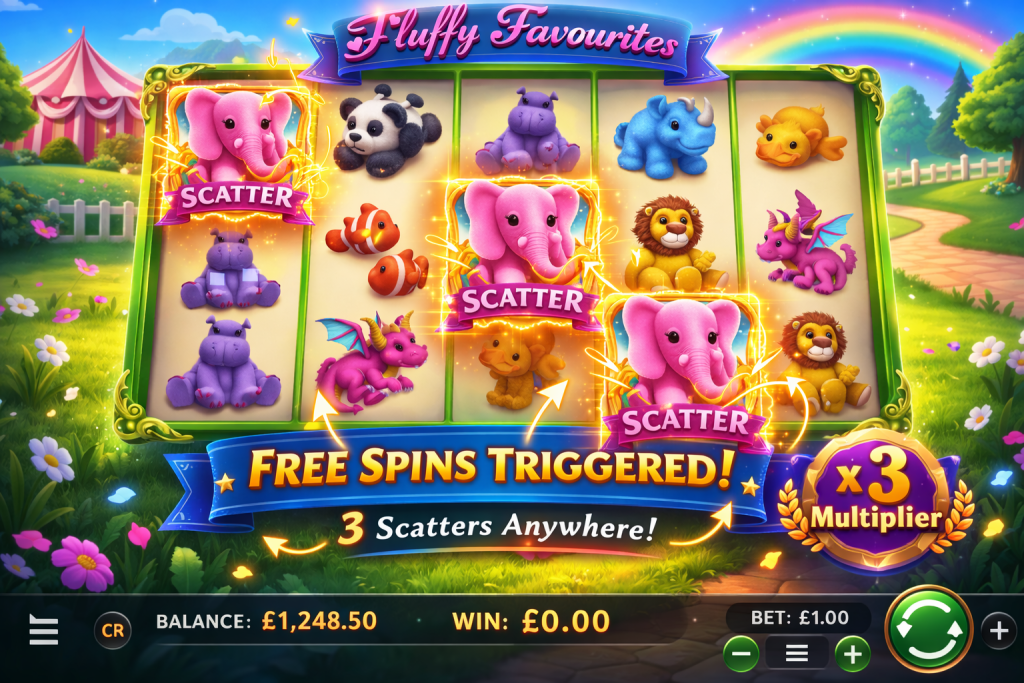
While general mathematical terminology applies across most slots, Fluffy Favourites contains feature language that deserves specific clarification. These terms shape expectation more strongly than any abstract percentage ever could. They are visually dramatic, emotionally charged and frequently misunderstood.
Scatter is the foundational feature-trigger term. A scatter symbol activates bonus functionality when a required number appears, typically three or more, anywhere on the reels. The word anywhere is not decorative. It means that alignment along a payline is unnecessary. Position independence distinguishes scatter logic from line win logic.
In Fluffy Favourites, the appearance of two scatter symbols often produces heightened anticipation for a third. Visually, this feels like proximity to a bonus. Mathematically, two scatters represent a completed outcome with no predictive value. The probability of a third symbol on the next spin is unchanged by the prior configuration. Confusion arises when visual closeness is mistaken for statistical momentum.
Free spins are awarded when the scatter condition is satisfied. These spins are described as free because no additional stake is deducted once the feature begins. However, the entry into free spins was financed by previous wagers. From a distribution perspective, free spins are not external rewards; they are variance events embedded within the slot’s overall return structure.
During free spins, enhanced payout conditions may apply. These may include multipliers or modified symbol values. The dramatic shift in presentation — altered background, celebratory audio cues, on-screen counters — signals importance. Yet the expected return of the feature remains bounded by the overall RTP. The feature redistributes variance into a condensed sequence. It does not generate independent expectation beyond the game’s mathematical framework.
Retrigger is a term that intensifies excitement. When additional scatter symbols appear during free spins, further spins may be awarded. The possibility of extension creates the sensation of escalating opportunity. Players often interpret retriggers as evidence of a hot phase or favourable cycle. In reality, retrigger probability is predefined and applied independently on each qualifying spin within the feature.
The Toy Claw Pick Bonus introduces a different psychological dynamic. In this feature, players select objects from a display to reveal prizes. The interaction appears participatory. Selection implies agency. However, in RNG-based systems, the outcome is determined at the moment the feature is triggered. The act of choosing does not influence expected value; it merely reveals preassigned results in a chosen sequence.
This distinction between interactivity and influence is central to understanding pick features. The interface encourages the perception of control, yet the probability model remains unaffected by choice. Recognising this does not diminish entertainment; it clarifies structure.
Tripled wins or similar multiplier language during features further amplifies expectation. A phrase such as “wins are tripled” suggests dramatic amplification. In practical terms, the multiplier applies to qualifying win amounts within defined parameters. If the base win is modest, tripling it may still produce a moderate outcome. Language emphasises multiplication; mathematics constrains magnitude.
Bonus round entry logic is often assumed to be dynamic. Players sometimes believe that extended base game play increases the likelihood of feature activation. This belief stems from pattern recognition and emotional fatigue. In fact, each spin is independent. The probability of triggering a bonus does not increase because it has not occurred recently. Absence does not accumulate entitlement.
Feature terminology in Fluffy Favourites is powerful precisely because it is simple. There are no labyrinthine bonus trees or cascading chains. The clarity of free spins and pick bonuses enhances emotional salience. However, emotional salience must not be mistaken for structural deviation from probability law.
Psychological Distortion Terms Embedded in the Interface
Return Distribution Across Time
The bell curve illustrates how outcomes cluster around the expected return over large samples, while short sessions may land in the extreme tails.
Beyond formal terminology, certain concepts describe how players interpret outcomes. These are not official game terms but behavioural realities that arise through interaction with slot mechanics. Fluffy Favourites provides a clear example of how presentation can amplify cognitive distortion.
The near-miss effect occurs when the reels display two required scatter symbols and the third appears just above or below the payline position. Visually, it feels as though success was narrowly missed. Neurological research demonstrates that near misses can stimulate responses similar to partial wins. Yet within the probability model, a near miss is simply a non-trigger outcome. It does not increase the likelihood of future activation.
Losses disguised as wins represent another distortion. When a small win is less than the total stake, the net outcome of the spin is negative. However, celebratory sound effects and animation may accompany the result. In Fluffy Favourites, frequent small line wins create rhythmic reinforcement. Players may recall these moments as successes even when balance declines gradually.
Illusion of control is particularly relevant in pick-based bonuses. The act of selecting toys in the Toy Claw feature feels consequential. Humans are predisposed to attribute outcomes to personal decisions. When a selected item reveals a high prize, the choice appears validated. When it reveals a low prize, regret may arise. Both reactions assume influence that does not exist within the predetermined structure.
Narrative bias emerges when players construct stories about session progression. A cluster of small wins may be interpreted as building towards a large event. A sequence of losses may be described as preparation for recovery. These narratives impose causal interpretation on independent events. The RNG does not support such continuity.
The compression effect is most visible in short sessions. A bonus triggered within ten spins may lead the player to classify the slot as generous. A prolonged absence of features in a similar sample may produce the opposite conclusion. Short samples compress variance into emotionally intense clusters. Only extended play reveals distribution balance.
Density amplification describes how the emotional weight of a feature changes relative to session length. In a brief session, a single bonus may represent a large proportion of total engagement. In a longer session, the same bonus becomes proportionally smaller within overall experience. The mathematics of the feature is identical in both cases. The interpretative weight differs.
Fluffy Favourites’ aesthetic softness interacts with these distortions in subtle ways. Gentle animation reduces perceived severity of losses. Bright visuals sustain engagement even during neutral outcomes. The interface does not deceive; it frames experience. Understanding this framing is essential for realistic interpretation.
Psychological distortion does not imply malfunction. It reflects human cognitive tendencies interacting with random systems. By naming these tendencies, we reduce their influence. The objective is not to eliminate emotional engagement but to align it with structural awareness.
RTP Confusion and Version Differences Across Casinos
One of the most persistent sources of confusion surrounding Fluffy Favourites concerns reported RTP percentages across different casinos. Players frequently encounter slightly varying figures and assume inconsistency in fairness or hidden alteration during play. In reality, the explanation is procedural rather than conspiratorial.
Slot developers often supply operators with multiple certified RTP configurations. Each configuration is independently tested and approved within regulatory frameworks. An operator selects one of these certified models when integrating the game. This selection affects the theoretical long-term return percentage but does not alter the fundamental structure of volatility or feature behaviour in a way that is perceptible during short sessions.
For example, a configuration that differs by one or two percentage points in RTP will not manifest as a visibly different experience across a brief sequence of spins. Variance in short-run play can easily exceed that difference. A player engaging with fifty or one hundred spins cannot reliably determine which RTP configuration is active. Only extensive statistical tracking would reveal divergence from long-term expectation.
Remastered versions of Fluffy Favourites introduce another layer of interpretative uncertainty. Enhanced graphics, smoother animations and refined audio can create the impression of a redesigned game. Visual improvement is often subconsciously associated with mechanical improvement. Yet aesthetic modification does not necessarily imply alteration of reel weighting or feature probability.
It is essential to distinguish between presentation updates and structural redesign. Unless the reel format, symbol distribution or payout table is explicitly changed, the underlying probability architecture remains intact. A remastered edition may feel more fluid or responsive, but mathematical behaviour is preserved unless documented otherwise.
Another common misunderstanding involves the belief that casinos dynamically adjust RTP during periods of heavy activity or player loss. Certified slot systems do not operate on adaptive adjustment mechanisms. The RNG produces independent outcomes according to predefined probability tables. There is no responsive recalibration based on individual play history.
Understanding RTP configuration and version differentiation eliminates unnecessary suspicion. Theoretical percentage defines long-term behaviour across enormous samples. Short-term experience is governed by variance. Cosmetic updates affect perception. Mathematics remains bound to certified design.
How to Read Fluffy Favourites Without Misreading It
Interpreting Fluffy Favourites accurately requires discipline in separating emotional response from structural reality. The first principle is temporal awareness. A session of twenty or thirty spins does not reveal volatility classification in any meaningful statistical sense. Even a bonus triggered early does not signal generosity. It reflects position within a distribution curve.
The second principle concerns scale. Increasing stake amplifies payout magnitude but does not enhance trigger probability. Feature activation is independent of wager size. The temptation to interpret larger bets as increasing chance stems from conflating value with frequency. Frequency remains constant.
The third principle involves contextualising small wins. Frequent minor returns can create an impression of momentum. However, the correct reference point is total bet. A win that does not exceed the stake contributes to gradual erosion despite celebratory presentation. Recognising this prevents emotional miscalculation.
The fourth principle addresses independence. Each spin is generated by the RNG without memory. Streaks of losses do not accumulate probability of compensation. Clusters of wins do not generate sustained momentum. Narrative coherence is imposed by the human mind, not by the system.
Finally, it is necessary to understand that bonus features are variance concentrators rather than external gifts. Free spins redistribute potential return into condensed sequences. Pick bonuses reveal predetermined outcomes through interactive display. Multipliers scale existing win values. None of these elements alter the fundamental expectation established by RTP and volatility parameters.
To read Fluffy Favourites correctly is not to eliminate enjoyment. It is to replace assumption with awareness. The game’s clarity of layout supports such awareness. Its five-reel structure and fixed paylines simplify interpretation once terminology is properly understood.
FAQ
Language, Structure and the Mathematics Behind the Mascots
Fluffy Favourites illustrates a fundamental truth about modern slot design: presentation and probability coexist without dependence. Thematic softness does not soften mathematical distribution. Animated pets do not moderate variance. The laws governing return operate independently of aesthetic framing.
Throughout this glossary, I have examined terminology not as ornament but as architecture. Words such as RTP and volatility describe statistical frameworks that extend far beyond individual sessions. Terms such as free spins and retrigger designate variance events embedded within the same probability model. Phrases such as multiplier and pick bonus generate emotional intensity while remaining bounded by predetermined expectation.
Misinterpretation arises when intuitive language is treated as literal promise. A bonus feels like reward. A near miss feels like progress. A retrigger feels like momentum. These interpretations are natural, but they are narrative constructs layered upon independent random events. Recognising this does not diminish engagement; it clarifies it.
The relationship between mathematics and perception is particularly visible in Fluffy Favourites because of its accessible structure. The five-reel layout appears transparent. Fixed paylines simplify interaction. Feature triggers are clearly signposted. Yet beneath this clarity lies the same probabilistic complexity present in more visually elaborate titles. Simplicity of interface does not equate to simplicity of distribution.
Understanding terminology transforms engagement from reactive to informed. RTP becomes a long-term theoretical measure rather than a session guarantee. Volatility becomes a descriptor of distribution rhythm rather than an indicator of safety. Pick features become presentation devices rather than mechanisms of control. Short-run deviation becomes statistically ordinary rather than anomalous.
Ultimately, clarity of language enables clarity of expectation. Each spin remains independent, governed by the Random Number Generator. Return converges only across extended samples. Emotional intensity reflects design choices in animation and pacing, not alteration of probability.
The mascots of Fluffy Favourites invite comfort. The mathematics beneath them demands precision. When vocabulary is properly understood, the apparent contradiction dissolves. What remains is a slot defined not by illusion but by structure — transparent in design, consistent in probability and interpretable through informed language.