
Compared Fluffy Favourites: When Familiar Games Stop Playing the Same
A Calm Look Beneath the Plush Surface: Why This Comparison Exists
I have been analysing slot games for long enough to recognise a familiar pattern. A game launches, it performs well, and sooner or later it becomes a “series”. What begins as a single, self-contained design evolves into multiple versions that look similar on the surface but behave very differently once you spend real time with them. This is exactly what has happened with Fluffy Favourites.
From the outside, the Fluffy Favourites titles appear friendly, even disarming. Soft colours, cartoon animals, playful sound design. For many players, that aesthetic creates an expectation of simplicity and consistency. The assumption is that each version is essentially the same game wearing a slightly different outfit. In practice, that assumption causes confusion, frustration, and often misplaced expectations.
The purpose of this comparison is not to rank the games, crown a winner, or suggest that one version is objectively superior to another. That kind of framing rarely helps players understand what they are actually playing. Instead, this page exists to slow things down and examine the structure of the Fluffy Favourites series in a way that reflects how these games truly function over time.
When players search for comparisons, they are usually reacting to a mismatch between expectation and experience. Perhaps the original Fluffy Favourites felt steady and familiar, while the Megaways version felt volatile and unpredictable. Perhaps the Wild Win edition appeared similar but produced a very different rhythm of play. These differences are not accidental. They are the result of deliberate design choices that affect mechanics, pacing, risk distribution, and long-term behaviour.
A comparison, done properly, should clarify those choices. It should explain why two games that share symbols, themes, and branding can feel fundamentally different once the reels start spinning. It should also respect the intelligence of the reader by avoiding exaggerated claims and superficial advice. Slot games are systems, not promises, and they deserve to be discussed as such.
Throughout this page, I will focus on how each version of Fluffy Favourites is built, how it behaves in extended play, and what type of experience it naturally produces. The aim is not to tell you what to play, but to help you recognise which structure aligns with your own preferences and tolerance for risk. If you understand how a game is designed, you are far less likely to be surprised by how it behaves.
This comparison is written for players who value clarity over hype and structure over slogans. If you are looking for certainty or guarantees, you will not find them here. What you will find is a careful breakdown of how the Fluffy Favourites series works, and why its versions should not be treated as interchangeable simply because they share a name and a set of familiar faces.
The Shared DNA of Fluffy Favourites: Understanding the Series Identity
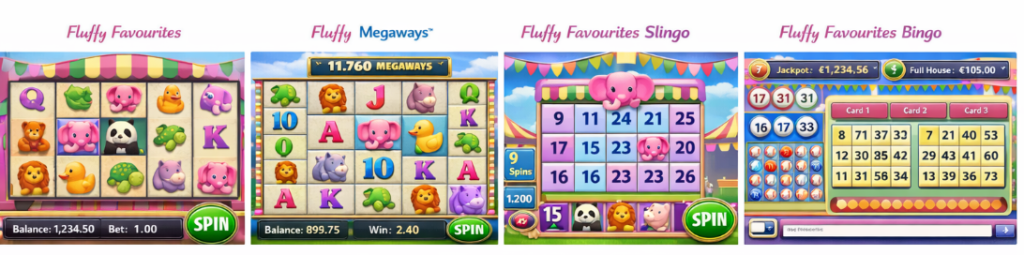
Before individual versions can be meaningfully compared, it is essential to understand what unites them. The Fluffy Favourites series is not a random collection of animal-themed slots. It is built around a clearly defined identity that persists across all its iterations, even as mechanics and formats change.
At the visual level, the identity is obvious. The series relies on soft, high-contrast colours, rounded symbol design, and a cast of friendly animal characters that recur across versions. This creates immediate recognition and continuity. A player moving from one Fluffy Favourites title to another never feels lost in an unfamiliar visual language. That sense of familiarity is intentional, and it plays an important psychological role in encouraging players to try different versions within the same family.
Beneath the artwork, however, the shared identity is more subtle. All Fluffy Favourites games are built around a relatively straightforward base game structure, even when advanced systems like Megaways are introduced. There is no heavy narrative progression, no layered feature unlocks, and no long-term meta systems. Each spin is designed to be understood in isolation, with outcomes resolved quickly and clearly. This keeps the experience accessible, regardless of the mathematical complexity operating behind the scenes.
Another unifying element is the role of recognisable bonus triggers. Free spins, pick-and-win style features, and prominent wild symbols appear consistently throughout the series. While the exact behaviour of these features changes between versions, their presence establishes a common expectation: this is a slot where bonus play matters, and where a significant portion of the experience is concentrated outside the base game.
The series also shares a particular approach to volatility. None of the Fluffy Favourites titles are designed as ultra-low risk, high-frequency grinders. Even the more restrained versions incorporate enough variance to create tension and contrast between quiet periods and moments of activity. At the same time, the games avoid the extreme, punishing volatility seen in some modern designs. The result is a risk profile that feels controlled but never entirely predictable.
Perhaps the most important aspect of the series identity is how it balances approachability with depth. On first contact, a Fluffy Favourites game feels simple. The rules are easy to grasp, the symbols are readable, and the interface is clean. Over longer sessions, however, patterns begin to emerge. Players notice how often bonuses appear, how wins cluster, and how different mechanics influence the flow of play. This layered experience is what allows multiple versions to coexist without rendering each other redundant.
Understanding this shared foundation is crucial. Without it, comparisons become superficial, focusing only on surface features or headline numbers. With it, the differences between versions can be seen for what they really are: variations on a common framework, each emphasising different aspects of risk, reward, and pacing.
In the sections that follow, this foundation will remain constant. What changes is how each version interprets it. By keeping the core identity in view, it becomes much easier to understand why the Fluffy Favourites series feels cohesive as a whole, yet fragmented in experience when individual titles are played back to back.
Same Name, Different Machines: Mapping the Versions Clearly
| Version | Reel format | Pay system | Core feature focus | Overall pacing |
|---|---|---|---|---|
| Fluffy Favourites (Original) Baseline structure for the series | Fixed reel layout | Paylines | Clearly separated bonus events within a stable and predictable base game | Steady and readable; variance unfolds gradually |
| Fluffy Favourites Wild Win Sharper emphasis on symbol behaviour | Fixed reel layout | Paylines | Wild symbols act as the main drivers of short, high-impact moments | Uneven and episodic; quiet phases followed by spikes |
| Fluffy Favourites Megaways Variable reels and cascading structure | Variable reel heights | Ways to win | Cascades and multipliers reshape both base play and bonus behaviour | Dense and fast-feeling; volatility becomes more visible |
At a glance, the Fluffy Favourites games appear to sit neatly under one umbrella. The branding is consistent, the symbols are familiar, and the overall tone barely shifts from one version to another. This surface-level similarity is precisely why a clear overview is necessary before any deeper analysis begins. Without it, players often assume they are moving between minor variations, when in reality they are stepping into games with meaningfully different internal structures.
The original Fluffy Favourites represents the baseline. It is built on a traditional reel-and-payline format, designed to be immediately legible to players who are comfortable with classic slot mechanics. The grid is fixed, the paylines are predefined, and the relationship between symbols and outcomes is relatively stable from spin to spin. This version establishes the core identity of the series: approachable, bonus-driven, and visually light, but underpinned by a risk profile that can still surprise over time.
Fluffy Favourites Wild Win takes that foundation and subtly alters its emphasis. While it retains a familiar reel structure, it shifts attention toward wild symbol behaviour and its impact on both the base game and bonus rounds. The result is a game that feels recognisable but slightly more reactive. Outcomes hinge more noticeably on specific symbol interactions, and sessions tend to be shaped by shorter bursts of activity rather than evenly distributed returns. For some players, this creates a sense of momentum; for others, it introduces volatility that feels less predictable than the original.
Fluffy Favourites Megaways marks the most significant departure. Although it preserves the same characters and general presentation, it replaces fixed paylines with a variable ways-to-win system. This single change has wide-reaching consequences. Reel heights fluctuate, win calculations become more complex, and the rhythm of play accelerates. Cascading wins and multipliers add layers of potential that simply do not exist in the earlier versions. The game no longer relies on steady accumulation but on sudden shifts in outcome intensity.
What matters here is not which version is newer or more technically advanced, but how each one frames the player’s experience. The original offers stability and familiarity. Wild Win introduces targeted bursts of impact. Megaways embraces fluctuation and scale. They are connected by theme, not by behaviour, and treating them as interchangeable leads to misplaced expectations.
By clearly identifying what each version is designed to do, the comparison can move forward on solid ground. The next step is to examine how these design choices translate into actual mechanics, and how those mechanics influence what happens on the reels.
Under the Hood: How Core Mechanics Shape Each Game
Fixed paylines
How wins are counted
Matching symbols land on predefined lines across a stable reel layout.
Why it feels steadier
The outcome space stays bounded, so sessions develop a predictable rhythm.
Where the excitement sits
Feature rounds act as clear “events”, rather than constant escalation.
Wild-influenced structure
How wins are counted
Paylines still apply, but outcome impact hinges more often on wild behaviour.
What changes the feel
Spins can look quiet until a wild-led moment reshapes the result quickly.
Why it feels episodic
Variance clusters into bursts, creating sharper contrasts across a session.
Variable ways + cascades
How wins are counted
A ways-to-win system recalculates possibilities as reel heights vary each spin.
Why it feels faster
Cascades turn one action into a sequence, so outcomes feel denser.
Why it feels less stable
A wider outcome range becomes visible even in short sessions, with sharper swings.
A quick visual for how the win logic changes
Fixed layout
Stable reel shape, lines decide the count
Once the versions are clearly separated, the mechanical differences become impossible to ignore. These differences are not cosmetic adjustments; they define how each game operates at a fundamental level and determine the type of experience a player is likely to encounter over extended play.
In the original Fluffy Favourites, the fixed reel structure creates a controlled environment. Each spin resolves within a narrow range of possible outcomes, and wins are calculated through clearly defined paylines. This encourages a measured pace. Players can quickly develop an intuitive sense of how often wins occur and what constitutes a meaningful result. The mechanics support consistency, even when volatility asserts itself during bonus play.
Wild Win modifies this balance by increasing the influence of specific symbols. Wilds are no longer just supportive elements but active drivers of outcome variability. Their placement and frequency have a disproportionate effect on results, especially in moments where multiple wild interactions occur in quick succession. Mechanically, this introduces a sharper contrast between quiet spins and impactful ones. The base game becomes more episodic, with periods of relative calm punctuated by short-lived spikes.
Megaways, by contrast, restructures the entire calculation model. Variable reel heights mean that no two spins share the same potential outcome range. The number of ways to win expands and contracts constantly, and cascading mechanics ensure that a single spin can evolve into a sequence of outcomes. This fundamentally alters how players perceive risk. Wins feel less discrete and more fluid, often building through chains rather than arriving as isolated events.
Another key mechanical distinction lies in how wins are distributed. Fixed-payline games tend to produce outcomes that are easier to contextualise. A win either lands or it does not. In a ways-based system, especially one with cascades and multipliers, outcomes can feel less binary. Small wins stack, disappear, and transform into larger sequences, blurring the line between base play and bonus-style excitement.
These mechanical frameworks also influence decision-making, even when no explicit choices are offered. In the original version, longer sessions feel manageable because variance unfolds slowly. In Megaways, the same session can feel more intense, as volatility asserts itself more visibly and more often. Neither approach is inherently better, but they cater to different tolerances for fluctuation and uncertainty.
Understanding these core mechanics is essential because they shape everything that follows: bonus behaviour, pacing, perceived value, and long-term engagement. Without this mechanical context, discussions about RTP, volatility, or maximum win figures lack meaning. With it, those numbers begin to tell a coherent story rather than standing alone as abstract statistics.
In the next sections, this mechanical groundwork will allow us to explore how mathematical parameters and bonus systems interact with these designs, and why similar-looking games can feel so different once real play begins.
Numbers With Consequences: RTP, Volatility and the Reality of Risk
A conceptual view of how variance tends to reveal itself over time — no percentages, no scales.
Discussions about RTP and volatility are often reduced to shorthand. A percentage here, a label there, and the assumption that the meaning is self-evident. In practice, these figures only become useful when they are understood in relation to the structure of the game they describe. Within the Fluffy Favourites series, the same broad numerical ranges are expressed in very different ways, and those differences matter far more than the headline values themselves.
Return to Player, taken in isolation, suggests a long-term average that unfolds over thousands or millions of spins. In the original Fluffy Favourites, this long-term logic aligns relatively well with short-term experience. The fixed reel set and predictable paylines create a stable framework in which returns are distributed gradually. While downswings still occur, they tend to develop at a pace that allows players to contextualise them. The game feels steady, even when it is not being generous.
Volatility in this context manifests as variation in bonus impact rather than constant instability. The base game absorbs much of the risk, smoothing out extremes. When a bonus arrives, it has the space to feel meaningful without completely redefining the session. This balance is why some players describe the original version as forgiving, even when the mathematics do not strictly support that impression.
Wild Win alters this balance subtly but decisively. The RTP remains within a familiar range, yet volatility becomes more situational. Outcomes hinge on the behaviour of a smaller number of high-influence symbols. As a result, returns can cluster more tightly around specific moments. A session may feel flat until a wild-driven interaction suddenly shifts the balance. From a statistical perspective, nothing unusual is happening. From a player’s perspective, however, the game feels more reactive and less evenly paced.
Megaways takes this divergence further. Here, RTP operates within a system designed to amplify variance. Variable reel heights expand the outcome space on every spin, and cascading mechanics allow wins to compound or collapse rapidly. Volatility becomes highly visible. Even short sessions can contain sharp swings, both positive and negative. The mathematics are no harsher than in other versions, but they are expressed more aggressively.
What is crucial to understand is that volatility is not simply a measure of risk, but of rhythm. In Megaways, the rhythm is erratic by design. Players are exposed to a wider range of possible outcomes in a shorter period of time. For some, this creates excitement and engagement. For others, it introduces fatigue or frustration. Neither response is incorrect; both are predictable consequences of the structure.
When comparing these games, it is a mistake to treat RTP and volatility as abstract benchmarks. They are better understood as descriptors of how tension is distributed across time. The original spreads it thinly. Wild Win concentrates it around specific triggers. Megaways compresses it into bursts. Recognising this helps players align expectations with experience, rather than chasing numbers that mean little without context.
Bonus Design in Practice: How Features Actually Behave
The route is the same in every version — what changes is the intensity once you step into the bonus phase.
Original
Bonus profileWild Win
Bonus profileMegaways
Bonus profileBonus features are often presented as highlights, but in reality they are structural components that carry much of a game’s mathematical weight. In the Fluffy Favourites series, bonuses are not optional embellishments. They are central to how each version delivers value, manages risk, and shapes player perception over extended play.
In the original game, free spins and pick-style bonuses are clearly separated from the base experience. They arrive as distinct events, with defined entry points and outcomes. This separation gives the base game room to breathe. Players can settle into a steady rhythm, knowing that bonus rounds function as occasional departures rather than constant interruptions. When they do arrive, they feel contained and legible. You enter, play them out, and return to the main game with a clear sense of what just happened.
Wild Win adjusts this dynamic by increasing the influence of bonus-adjacent behaviour within the base game itself. Wild symbols begin to blur the line between normal play and feature-driven outcomes. While free spins still exist as a formal bonus, much of the excitement is pulled forward into regular spins. This creates a more episodic experience. Instead of long stretches of accumulation punctuated by bonuses, sessions are defined by shorter cycles of anticipation and release.
Megaways transforms bonus play into an extension of the core mechanic rather than a departure from it. Free spins are no longer a distinct mode with separate rules, but an intensification of systems already present in the base game. Cascades, multipliers, and variable reel heights interact continuously, making it harder to draw a clear boundary between normal and bonus play. The effect is a constant sense of escalation. Even outside of formal bonus rounds, spins can feel bonus-like in their potential.
This difference has important implications for pacing. In the original game, bonuses act as milestones. In Wild Win, they act as accelerators. In Megaways, they act as amplifiers. Each approach produces a different psychological response. Milestones reward patience. Accelerators reward timing. Amplifiers reward tolerance for fluctuation.
Another often overlooked aspect is bonus retrigger behaviour. In simpler structures, retriggers extend excitement without dramatically altering risk exposure. In more complex systems, retriggers can compound volatility quickly. Megaways bonuses, in particular, can escalate rapidly, producing sessions that feel wildly successful or abruptly disappointing with little middle ground. This is not a flaw, but a consequence of the design.
Understanding how bonuses behave, rather than simply what they promise, is essential when comparing these games. Features do not exist in isolation. They interact with reel structure, win calculation, and volatility to create a coherent, if sometimes demanding, experience. Players who appreciate this interaction are better equipped to choose a version that suits their temperament, rather than being drawn in by surface similarities or headline claims.
In the next stage of the comparison, these mechanical and mathematical foundations will allow us to examine pacing and game feel more closely, moving from how the games are built to how they are actually experienced over time.
The Tempo of Play: How Each Version Feels Over Time
Pacing is one of the least discussed yet most influential aspects of slot design. It is not defined by any single parameter, but by the interaction of mechanics, volatility, and feature frequency over extended play. Within the Fluffy Favourites series, pacing is where the differences between versions become most tangible, even for players who are not consciously analysing the game.
The original Fluffy Favourites establishes a measured, almost conversational tempo. Spins resolve cleanly, wins are clearly defined, and the space between notable events allows players to settle into a rhythm. There is time to absorb outcomes without feeling rushed or overwhelmed. This pacing encourages longer sessions, not because the game is generous, but because it is predictable in how it reveals its variance. Tension builds slowly and dissipates just as gradually.
Wild Win introduces a more uneven cadence. While the underlying spin speed remains familiar, the distribution of impact shifts. Quiet stretches feel longer, and moments of activity arrive more abruptly. This creates a start-and-stop sensation, where attention spikes around key symbol interactions and then drops back into anticipation. For some players, this intermittent pacing heightens engagement. For others, it disrupts the sense of flow that characterised the original.
Megaways operates on a different temporal logic altogether. The variability of reel heights and the presence of cascades compress time. A single spin can unfold into a sequence of events, blurring the boundary between individual actions. This creates an illusion of momentum, where outcomes appear to stack rapidly, even when the net result is modest. Sessions feel denser, more intense, and often shorter, simply because the game demands more cognitive and emotional attention.
This accelerated pacing has consequences. In Megaways, fatigue can set in more quickly, not due to complexity, but due to constant stimulation. The game rarely settles. There is always another potential cascade, another multiplier, another shift in reel configuration. For players who enjoy sustained tension, this is a feature. For those who prefer space and breathing room, it can feel relentless.
What is important to recognise is that pacing is not a matter of quality, but of compatibility. A player accustomed to the steady flow of the original may find Megaways overwhelming. A player drawn to rapid escalation may find the original subdued. Understanding this helps reframe personal preference as alignment rather than judgement. Each version delivers its experience honestly; it simply does so on a different temporal scale.
Maximum Wins and Long-Term Potential: Setting Expectations Correctly
This visual shows ceiling scale only. A taller bar means a higher theoretical top end — it does not imply a better hit rate or higher likelihood.
Scale ≠ probabilityMaximum win figures occupy a curious place in slot discourse. They are frequently cited, rarely contextualised, and often misunderstood. In the Fluffy Favourites series, the differences in advertised maximum wins reflect underlying structural choices rather than straightforward differences in generosity.
In the original game, the maximum win is constrained by fixed paylines and limited symbol interaction. This creates a ceiling that is theoretically reachable but statistically distant. More importantly, it frames expectations. Players understand, often intuitively, that large wins will arrive through defined bonus outcomes rather than explosive base game sequences. The potential is present, but it unfolds within narrow boundaries.
Wild Win adjusts this potential by increasing the influence of specific symbols without fundamentally expanding the outcome space. Maximum wins rise, but not dramatically. What changes is the pathway. High-impact moments become more dependent on precise interactions rather than sustained accumulation. This makes large outcomes feel sharper and more sudden, even if their absolute size remains comparable.
Megaways represents a clear shift in philosophy. The variable ways-to-win system dramatically expands the theoretical outcome space, allowing for much larger maximum wins. Cascades and multipliers create the possibility of exponential growth within a single spin sequence. This is where the headline figures become eye-catching, and where misunderstandings often begin.
A higher maximum win does not imply a higher likelihood of achieving it. In fact, the opposite is often true. Expanding the outcome space increases variance, pushing extreme results further into the tail of the distribution. What Megaways offers is not accessibility, but scale. It allows for outcomes that are simply not possible in fixed-line formats, while simultaneously making them rarer.
For long-term play, this distinction is crucial. Players chasing the idea of a maximum win may gravitate toward Megaways without fully appreciating the volatility required to sustain that potential. Others may prefer the bounded nature of the original, where expectations are lower but outcomes feel more proportionate to time invested.
Setting expectations correctly means understanding maximum wins as design signals, not promises. They indicate what a system is capable of under ideal conditions, not what it is likely to deliver in ordinary play. When viewed through this lens, the differences between Fluffy Favourites versions become clearer and more honest. Each game defines its own limits, and those limits shape not only what can happen, but how players experience the journey toward it.
Matching the Game to the Player: Style, Tolerance and Intent
Use this as a self-check. It highlights which version typically aligns with a playing style — it is not a recommendation or a promise of results.
Match, not advice| Player profile | Original | Wild Win | Megaways |
|---|---|---|---|
| Prefers long sessions Enjoys a steadier rhythm and slower variance. | Strong match | Depends | Less typical |
| Tolerates variance Comfortable with visible swings and uneven outcomes. | Moderate | Good fit | Strong match |
| Bonus-focused play Plays mainly for feature rounds and escalation moments. | Works | Good fit | Strong match |
| Casual, low-attention play Prefers simple decisions and clear outcomes. | Strong match | Depends | Less typical |
| Likes constant motion Enjoys cascades, rapid sequences, and frequent shifts. | Less typical | Somewhat | Strong match |
One of the most persistent mistakes players make when choosing between similar-looking slots is assuming that preference is driven by theme or feature count. In reality, long-term satisfaction is far more closely tied to how a game aligns with a player’s temperament, session goals, and tolerance for uncertainty. The Fluffy Favourites series is a clear example of this principle in action.
The original Fluffy Favourites tends to suit players who value continuity. Its structure rewards patience and familiarity. Sessions unfold in a way that allows players to remain oriented, even during less productive stretches. There is a sense of proportionality between time invested and emotional return. Wins and losses accumulate gradually, making it easier to disengage without feeling either elated or frustrated. This version naturally appeals to those who play for extended periods and prefer a calmer, more readable experience.
Wild Win occupies a middle ground. It introduces sharper contrasts without abandoning the core structure entirely. This makes it appealing to players who enjoy moments of intensity but do not want to commit fully to highly volatile systems. It suits shorter, more focused sessions, where attention is directed toward specific triggers rather than overall balance. For some, this creates a satisfying sense of anticipation. For others, it may feel uneven. The key is recognising whether that episodic rhythm enhances or disrupts personal enjoyment.
Megaways, by design, caters to players who are comfortable with rapid fluctuation. It demands engagement and rewards emotional resilience. Sessions are rarely neutral. They tend to feel either energising or draining, often within a relatively short timeframe. This makes the format attractive to players who seek excitement and are willing to accept extended dry spells in exchange for the possibility of sudden escalation. It is less forgiving of casual or distracted play, as its pace and variability require sustained attention.
What matters here is not experience level, but alignment. An experienced player can dislike Megaways just as easily as a newcomer can enjoy it. Conversely, simplicity does not imply a lack of depth. The original game can remain engaging precisely because it allows patterns to emerge slowly, revealing structure over time rather than through constant stimulation.
Choosing the right version is therefore less about strategy and more about self-awareness. Understanding how you respond to volatility, pacing, and uncertainty will do more to improve your experience than any feature comparison. The Fluffy Favourites series offers multiple interpretations of the same identity. The most suitable one is the one that fits the way you actually play, not the way you think you should.
Clearing the Fog: Common Assumptions That Don’t Hold Up
Whenever a slot series expands, a set of assumptions tends to follow. These assumptions spread quickly, reinforced by surface similarities and simplified explanations. The Fluffy Favourites series is no exception, and addressing these misunderstandings is essential for a fair comparison.
One common belief is that newer versions are inherently better. This assumes that added mechanics automatically improve the experience. In reality, additional systems simply shift emphasis. Megaways does not improve on the original; it reinterprets it. For players who value stability, that reinterpretation may feel like a step away rather than a step forward.
Another frequent assumption is that shared symbols imply shared behaviour. Seeing the same characters across versions creates the impression that outcomes will feel familiar. While visual recognition is consistent, the mathematical context in which those symbols operate changes dramatically. A symbol that feels impactful in a fixed-payline environment may behave very differently in a ways-based system, even if its appearance and nominal value are unchanged.
There is also a tendency to equate higher volatility with higher enjoyment. Volatility increases contrast, not satisfaction. For some players, that contrast heightens engagement. For others, it erodes it. Enjoyment depends on how well a game’s risk profile matches a player’s expectations and emotional tolerance, not on how extreme its swings are.
Finally, RTP is often treated as a deciding factor. While it provides useful long-term information, it does not describe short-term experience, nor does it capture how returns are distributed. Two games with similar RTP can feel entirely different to play, particularly when their mechanics and pacing diverge.
By setting aside these assumptions, the comparison becomes clearer and more honest. The Fluffy Favourites series does not present a linear progression from simple to advanced, or from weaker to stronger. Instead, it offers parallel interpretations of the same core idea. Understanding that distinction allows players to approach each version on its own terms, without carrying expectations that the game was never designed to meet.
Practical Questions Players Actually Ask
Is Fluffy Favourites the same game across all versions?
Is Fluffy Favourites the same game across all versions?
No. The theme and symbols are shared, but the underlying mechanics, pacing, and volatility differ significantly.
Does Megaways automatically mean higher chances of winning?
Does Megaways automatically mean higher chances of winning?
No. Megaways increases variability and outcome range, not consistency or likelihood.
Are bonuses more important than the base game in this series?
Are bonuses more important than the base game in this series?
Yes. In all versions, a large part of the experience and variance is concentrated in bonus play, though it behaves differently each time.
Can I expect similar results if I switch between versions?
Can I expect similar results if I switch between versions?
Not realistically. Each version distributes risk and rewards in a distinct way.
Seeing the Whole Picture: What This Comparison Really Shows
Looking at the Fluffy Favourites series as a whole, it becomes clear that the shared branding hides more than it reveals. These games are not variations of the same machine; they are different interpretations of a single concept, each shaped by deliberate design priorities. Understanding this is far more useful than memorising statistics or chasing surface features.
The original Fluffy Favourites establishes a controlled environment. Its structure favours clarity, predictable pacing, and a gradual unfolding of variance. Over time, it teaches the player how it behaves. Sessions feel readable, even when outcomes are unfavourable, because the game communicates its rhythm consistently. This is a design that values balance over spectacle.
Wild Win shifts that balance without abandoning it. By increasing the influence of specific symbols and moments, it introduces sharper contrasts into play. The game feels less even, more episodic, and more dependent on timing. This does not make it more aggressive or more rewarding by default; it makes it more situational. For players who enjoy moments of intensity without constant pressure, this version occupies a narrow but meaningful space within the series.
Megaways represents a structural reimagining rather than an upgrade. By expanding the outcome space and accelerating pacing, it transforms how risk is perceived. Volatility becomes more visible, swings arrive faster, and sessions feel compressed. This format rewards tolerance for fluctuation and demands attention. It does not replace earlier versions; it offers an alternative experience that prioritises scale and momentum over stability.
What this comparison ultimately highlights is the importance of alignment. Enjoyment does not come from choosing the version with the biggest numbers or the most complex mechanics. It comes from choosing the structure that matches how a player engages with uncertainty, time, and emotional swings. When that alignment is missing, even well-designed games can feel unsatisfying.
The Fluffy Favourites series succeeds not because its versions compete with each other, but because they coexist. Each one explores a different balance between familiarity and risk, simplicity and intensity. Seen through this lens, comparison is not about deciding which game is best, but about understanding why none of them is meant to be universal.
That understanding is what turns a branded series into a meaningful choice rather than a confusing one.