
80p on Fluffy Favourites: How Much Exposure Does It Really Buy?
The Minimum Stake Defines the Session Length
80p changes shape once the minimum stake changes
The same deposit can translate into a different number of independent spins. That single difference alters the exposure window and the level of volatility compression.
| Minimum Stake | Spins at 80p | Exposure Window | Compression Level |
|---|---|---|---|
|
£0.20
Minimum stake
£0.20 |
4 spins
Spins at 80p
4 spins
|
Narrow
Exposure window
Narrow
|
High
Compression level
High
|
|
£0.25
Minimum stake
£0.25 |
3 spins
Spins at 80p
3 spins
|
Very Narrow
Exposure window
Very Narrow
|
Extreme
Compression level
Extreme
|
An eighty-pence deposit does not possess meaning in isolation. Its practical significance emerges only when it is measured against the minimum permitted stake. In most widely available configurations of Fluffy Favourites, the minimum stake is set at £0.20. In certain variants, it rises to £0.25. The numerical difference appears minor, yet structurally it alters the session architecture.
At a £0.20 minimum stake, eighty pence purchases four spins. Four independent outcomes, each governed by the same probability distribution. At a £0.25 minimum stake, the same balance provides three spins, leaving a small remainder unusable. This reduction from four to three attempts compresses exposure by twenty-five per cent.
In independent random systems, the number of trials determines exposure opportunity. The probability of triggering any specific configuration remains constant per spin. It does not increase because the player has observed previous outcomes, nor does it adjust because the balance is limited. Therefore, fewer spins translate directly into reduced probability reach. Not altered probability, but reduced reach.
This distinction is essential. Many players conceptualise a deposit as “time to play”. In reality, it is “opportunity to encounter distribution”. Four spins do not create duration in any meaningful analytical sense. They create four statistical samples. Three spins create three.
In longer sessions, exposure accumulates gradually. Losses, small wins and occasional features interact across dozens of events. In a micro-deposit scenario, accumulation does not occur. The session resolves before rhythm can develop. The minimum stake, therefore, becomes the primary structural variable. It defines whether the player receives a narrow window or an even narrower one.
It is also important to recognise that stake size does not influence the underlying probability engine. Increasing or decreasing the bet adjusts payout scale, not trigger likelihood. Consequently, an eighty-pence deposit is not structurally “weaker” than a larger one. It is simply shorter. The limitation is not intensity but duration.
The difference between three and four spins may appear negligible in casual conversation. In statistical terms, however, it materially constrains the potential to encounter threshold events. When volatility is embedded within infrequent but impactful outcomes, each additional trial meaningfully increases exposure capacity. Removing one reduces it proportionally.
Thus, before considering bonuses, multipliers or thematic design, one must first accept that the minimum stake governs the entire architecture of an eighty-pence session. Without this understanding, any interpretation of results becomes speculative.
Four Spins Are Not a Session
Variance smoothing needs distance
Short samples remain dominated by volatility. As spin count increases, outcomes begin to reflect the distribution more consistently.
The term “session” implies continuity. It suggests a sequence long enough for fluctuation to reveal pattern. Four spins do not satisfy that criterion. They represent a fragment, not a sequence.
Fluffy Favourites, in common volatility classifications, is not a low-variance product. While its visual presentation is soft and approachable, the payout distribution can be uneven. Larger wins are typically embedded within specific configurations rather than dispersed evenly across all spins. This structural reality becomes more pronounced when exposure is restricted.
Variance smoothing occurs only through repetition. Over extended play, losses and wins alternate in unpredictable order, yet collectively approximate the theoretical distribution. In four spins, smoothing cannot occur. The distribution remains raw and unfiltered.
If four spins produce no return, the experience feels abrupt. If one produces a moderate win, the experience feels dramatic. In neither case has the volatility profile changed. The player has simply observed a concentrated expression of randomness within a narrow sample.
This concentration creates amplification. Each spin carries disproportionate psychological weight because there is no broader context to moderate it. In longer sessions, individual losses become part of a sequence. In micro-sessions, they feel conclusive.
From a probability standpoint, the distinction is clear. A single spin offers one opportunity for any given event to occur. Four spins offer four opportunities. Yet four remains insufficient to approximate expectation. The theoretical return to player is defined across millions of trials. Four do not approach that scale.
The misconception arises when players interpret immediate outcomes as representative. A cluster of low-value line wins may create the impression of generosity. Four losses may generate the perception of rigidity. Both interpretations rely on minimal evidence.
Four spins are not a condensed version of a normal session. They are an isolated sample. The absence of continuity means that pacing, feature frequency and distribution shape cannot be meaningfully evaluated. The player observes behaviour without observing structure.
Understanding this distinction reframes the eighty-pence deposit. It is not a trial designed to reveal how the slot behaves over time. It is an encounter with four independent expressions of its probability model.
Exposure Window Versus Perceived Playtime
The final structural element of an eighty-pence deposit concerns perception. Playtime and exposure are not identical. A player may spend several minutes across four spins, particularly if observing symbol animations or evaluating outcomes. This duration can create the impression of participation. Yet participation does not equate to statistical depth.
Exposure window refers to the number of independent probability events encountered. Perceived playtime refers to subjective duration. In micro-deposits, perceived playtime may exceed exposure depth. The player feels engaged, but the statistical surface remains narrow.
This gap between perception and structure becomes especially relevant in visually engaging slots such as Fluffy Favourites. Thematic design can create a sense of continuity even when mechanical repetition is minimal. The experience feels cohesive, yet from a distribution standpoint it is sparse.
The emotional impact of a small win illustrates this dynamic clearly. Suppose a £0.20 stake spin returns £0.80. The balance has doubled. In proportional terms, this appears transformative. However, from a distribution perspective, it is one moderate outcome within a four-trial sample. Its apparent magnitude is amplified by the small initial balance.
Similarly, a complete loss of eighty pence across four spins may feel abrupt or severe. Structurally, it represents four negative samples within a variance model that permits such sequences. Without repetition, the player cannot observe how often that pattern emerges across broader play.
The key insight is that exposure capacity determines informational value. Four spins provide limited information. They reveal how reels spin, how symbols align, and how payouts are calculated. They do not reveal frequency distributions or long-term behaviour.
An eighty-pence deposit, therefore, occupies a specific analytical category. It is neither trivial nor substantial. It is a micro-window. It allows observation without permitting evaluation. It creates engagement without enabling pattern recognition.
In summary, the structural reality of eighty pence in Fluffy Favourites is defined by three constraints: minimum stake, spin capacity and exposure compression. Whether the session comprises three or four spins, it remains statistically narrow. The slot’s volatility remains unchanged. What changes is the breadth of interaction with that volatility.
Only after acknowledging these constraints can one meaningfully analyse features, thresholds and psychological effects. Without this foundation, interpretation becomes narrative rather than structural.
Independent Spins and the Near-Miss Illusion
Near-misses feel like progress, but nothing carries forward
Each spin resolves independently. Scatter counts do not accumulate between spins, even when the screen makes it feel close.
0 scatters
No threshold pressure is created. The next spin starts from zero.
1–2 scatters
Perceived progress increases, but probability does not.
3+ scatters
A feature triggers. This is a threshold event, not an accumulated build.
Having established that an eighty-pence deposit typically provides three or four spins, the next structural question concerns what those spins actually represent in volatility terms. Fluffy Favourites operates under an independent random number generator system. Every spin is self-contained. No outcome influences the next. No pattern accumulates. No visible progression alters underlying probability.
This independence is frequently misunderstood, particularly in games that use threshold-based bonus triggers. When a player observes one or two scatter symbols on a single spin, it can create the impression of proximity to a feature. The mind interprets partial completion as forward movement. Mechanically, however, that spin has already resolved. It contributes nothing to future probability.
Near-misses are therefore perceptual events, not statistical signals. If a spin produces two scatters and a third symbol lands just outside a payline or on a non-contributing reel position, the emotional response may be heightened. Yet the next spin begins from zero. The distribution resets entirely.
In longer sessions, this dynamic is less distorting because repetition dilutes individual impressions. One near-miss becomes part of a sequence. In a four-spin window, however, each event occupies a larger proportion of total exposure. A single near-miss may constitute twenty-five per cent of the entire session. Its emotional intensity increases because the context is narrow.
Volatility compression intensifies this effect. When variance expresses itself across only three or four trials, any deviation from expectation appears magnified. Two losing spins in succession represent half the session. One moderate win represents a significant percentage of total exposure. The structural neutrality of independence becomes psychologically charged.
It is crucial to emphasise that independence does not imply randomness without structure. The distribution model remains mathematically defined. Certain outcomes are rarer than others. Certain configurations yield higher returns. However, independence ensures that observing one outcome does not shift the probability of the next.
In the context of an eighty-pence deposit, this means that perceived momentum has no mechanical basis. A losing spin does not increase the likelihood of a winning one. A near-miss does not increase the likelihood of a bonus. Each spin is isolated. The compression of exposure simply reduces the number of times the model is sampled.
Understanding independence removes the illusion of progression. What remains is pure exposure density. Three or four attempts at encountering a distribution that is designed to express itself over far larger sequences.
Free Spins as a Threshold Event
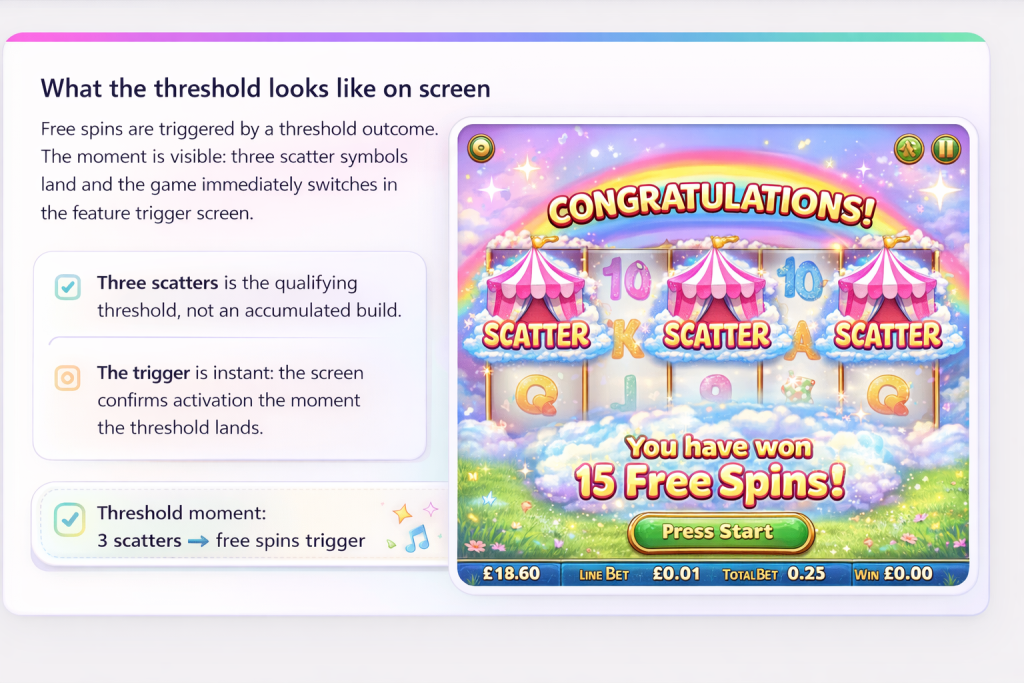
Free spins in Fluffy Favourites are typically activated by landing three or more designated symbols. This threshold creates a binary structure: the feature either triggers or it does not. There is no incremental accumulation across spins. Each attempt is a discrete test against the same qualifying condition.
In volatility terms, free spins function as concentration points. They gather potential variance into a defined sub-sequence. Within that feature, multipliers or enhanced payout conditions may apply. Retriggers may extend the bonus round. The effect is not to alter long-term expectation but to condense variance into a visible burst.
When the deposit is eighty pence, the structural limitation lies not in bonus potential but in bonus access. With only three or four base spins available, the probability of satisfying a three-symbol threshold is constrained by trial count. Even if the per-spin probability of triggering free spins is constant, the overall likelihood across a micro-session remains modest.
This does not render the bonus unattainable. It simply situates it within a narrow probability window. If triggered, the feature may dramatically alter the balance. If not, the session concludes without it. The compression of exposure does not change the probability of activation per spin. It reduces the number of opportunities for activation to occur.
A further structural nuance concerns the redistribution of risk. Some players interpret free spins as protective. In reality, they are accelerators. They cluster variance into a short burst. If the bonus produces strong results, the outcome appears transformative relative to the starting deposit. If it produces minimal return, the session ends abruptly.
In longer sessions, the impact of a modest bonus is contextualised within surrounding play. In micro-sessions, the bonus may constitute the entirety of the narrative. Its presence or absence defines the experience. This disproportionate influence arises not from altered mathematics but from compressed exposure.
Therefore, free spins at eighty pence should be understood as threshold events with limited reach. Their structural role is unchanged. Their perceptual impact is amplified.
Pick Bonus and Proportional Magnification
How a small multiplier can dominate an 80p session
The calculation is simple. The distortion comes from the small starting balance, which makes ordinary multipliers feel decisive.
80p
Your full starting balance.
£0.20
A common minimum bet in many UK-facing setups.
10× = £2.00
Ten times the stake produces a £2 return.
250% of the deposit
Because the base is 80p, £2.00 feels session-defining.
The pick-style bonus, often themed around selecting concealed items from a toybox or claw mechanism, introduces a different psychological dimension. Rather than delivering returns through reel combinations, it invites direct selection. Each choice reveals a multiplier or fixed amount. The interaction creates engagement and a sense of agency.
Mechanically, however, the probabilities remain predetermined. The distribution of possible outcomes is defined before selection. The player’s choice reveals, rather than creates, the result. This is consistent with regulated random systems. The apparent control is experiential, not structural.
In the context of an eighty-pence deposit, the most significant effect of the pick bonus is proportional magnification. Suppose a player at a £0.20 stake receives a multiplier that yields £1.60. That amount doubles the original deposit. In relative terms, it appears substantial. In absolute terms, it remains modest.
This proportional distortion is intensified by compression. When the initial balance is small, any return exceeding it appears dramatic. The same multiplier applied within a larger session would carry less emotional weight. The deposit size therefore alters perception without influencing payout structure.
Another factor concerns resolution speed. Pick bonuses typically resolve quickly. Within a micro-session, this rapid resolution may represent the majority of playtime. The feature becomes the dominant event, even though its probability of occurrence remains unchanged from larger sessions.
The structural reality is that the pick bonus does not compensate for limited exposure. It does not increase the chance of recovery if early spins produce losses. It either triggers within the small number of trials available or it does not. If it does, its proportional effect may feel outsized. If it does not, the session ends without access to its concentrated variance.
Volatility compression thus operates on two levels: distribution and perception. Distribution remains mathematically constant. Perception expands or contracts based on deposit scale. In micro-deposits, each outcome occupies a larger fraction of total narrative. Wins feel decisive. Losses feel conclusive.
When examining eighty pence in Fluffy Favourites, the critical insight is that features are not altered by deposit size. What changes is exposure frequency and proportional interpretation. The threshold remains fixed. The distribution remains fixed. The volatility remains fixed. Only the sampling window contracts.
This contraction does not produce unfairness or generosity. It produces immediacy. And immediacy, when combined with threshold mechanics and proportional magnification, creates an experience that can feel more extreme than the mathematics would suggest.
With this understanding of independence, threshold structure and magnification effects, the micro-deposit begins to reveal its true character. It is not a strategic entry point. It is a compressed encounter with variance.
RTP Is a Long-Term Slope, Not a Short-Term Experience
Why a four-spin sample can land anywhere on the curve
RTP is a long-term mean. Short samples can sit on extreme outcomes, while long samples tend to pull back towards the centre.
With so few trials, outcomes can plausibly appear near the edges. The session can look unusually “cold” or unusually “hot”.
As trials accumulate, extreme swings still occur, but the average behaviour becomes clearer and tends to sit closer to the mean.
Return to player is one of the most cited metrics in discussions of slot games, yet it is also one of the most misunderstood. RTP represents a long-term theoretical average calculated across an immense number of spins. It does not describe what will occur in a session of three or four trials. It describes what the distribution tends towards when repetition is extensive.
In the case of Fluffy Favourites, published RTP figures may differ slightly depending on configuration. Some versions operate around ninety-five per cent, others marginally lower. The difference between ninety-three and ninety-five per cent appears meaningful when evaluated over millions of spins. Within an eighty-pence micro-session, it is functionally invisible.
To understand why, one must consider the relationship between expectation and variance. RTP defines expected value across large samples. Variance defines the range within which short-term outcomes fluctuate around that expectation. When the sample size is extremely small, variance dominates completely. Expectation has no opportunity to stabilise the distribution.
Three or four spins provide no platform for expectation to manifest. The outcomes may be entirely negative, modestly positive or strongly positive. None of these scenarios contradict the theoretical RTP. They simply reflect the statistical volatility permitted within such a narrow sampling window.
It is common for players to infer generosity or rigidity from immediate results. If an eighty-pence deposit yields nothing across four spins, the experience may be perceived as disproportionately unfavourable. If a small bonus multiplies the deposit several times over, the slot may be perceived as unusually accommodating. Both interpretations are anchored in insufficient data.
The mathematical reality is that RTP does not function at micro scale. It functions at macro scale. The eighty-pence session sits too far below the threshold required for expectation smoothing. It is, in effect, a random fragment of a distribution curve that requires extensive repetition before its shape becomes visible.
This distinction between slope and sample is critical. RTP is analogous to a gradient measured across distance. A single step does not reveal the incline of a hill. Only sustained movement does. Similarly, three or four spins do not reveal the long-term return characteristics of a slot. They reveal isolated outcomes within a permitted variance range.
Consequently, evaluating RTP through an eighty-pence session is analytically unsound. The deposit allows observation of mechanics, not of theoretical return. The distribution remains mathematically defined, but the session lacks the depth required to approximate it.
Distribution Density and the Mathematics of Compression
The same feature can feel far bigger in a smaller session
This is density amplification: one feature occupies a much larger share of a micro-session, so it dominates the narrative even when the maths is unchanged.
One feature equals
25%
With only a few spins available, a single feature can represent a quarter of the entire session.
One feature equals
2%
In a longer session, the same event is contextualised by many more spins, so it carries less narrative weight.
The concept of distribution density clarifies why micro-deposits feel disproportionately intense. In longer sessions, probability mass is distributed across many spins. Losses and wins are interspersed, and the balance fluctuates gradually. The density of significant events relative to total exposure remains low but observable over time.
In a compressed session of three or four spins, the density of meaningful events relative to exposure increases perceptually. If one spin triggers a feature, that event represents twenty-five or thirty-three per cent of total play. In a forty-spin session, the same event would represent only two-and-a-half per cent. The structural frequency has not changed. The contextual weight has.
This alteration in contextual weight produces cognitive amplification. Each outcome carries more narrative importance because there are fewer surrounding events to dilute it. In statistical language, the variance-to-sample ratio is extremely high. The standard deviation relative to sample size dominates expectation.
Consider a hypothetical scenario. Suppose the slot’s theoretical design permits extended sequences without significant wins, punctuated by occasional higher multipliers. In a large sample, these patterns become visible as oscillations around expectation. In a micro-sample, only one fragment of that oscillation is observed. The fragment may correspond to a trough or a peak. Without repetition, its position within the larger cycle cannot be inferred.
The player experiencing a trough within four spins may conclude that the slot is unresponsive. The player encountering a peak may conclude that it is generous. Neither conclusion reflects distribution density across sufficient trials.
Compression also affects loss perception. In a longer session, incremental losses are offset by intermittent minor returns. The balance declines gradually or fluctuates within a range. In a micro-session, the absence of smoothing can produce rapid depletion. Four losing spins exhaust the deposit completely. The speed of resolution amplifies perceived severity.
Importantly, this does not imply increased risk in structural terms. The probability model remains identical regardless of deposit size. What changes is temporal spacing. The same volatility expressed over three minutes instead of thirty minutes feels more abrupt. Abruptness is a function of compression, not of altered mathematics.
Distribution density therefore explains why eighty pence can feel extreme. The session lacks the breadth required to distribute outcomes across time. Instead, events cluster tightly within a short window. Even neutral outcomes assume disproportionate importance because there is limited context.
This dynamic reinforces the earlier distinction between exposure and playtime. The player may feel engaged for several minutes, yet the number of independent probability events remains small. Statistical depth cannot be inferred from subjective duration.
Understanding compression reframes interpretation. The slot is not behaving differently at eighty pence. The observer is sampling less of its behaviour. The narrowness of the sample exaggerates perception without modifying probability.
Psychological Amplification in Micro-Sessions
Beyond mathematics, micro-deposits exert specific psychological pressures. When the available balance is limited to eighty pence, each spin acquires heightened emotional salience. There is little margin for recovery or gradual adaptation. Outcomes resolve quickly, and the session concludes decisively.
One effect is loss acceleration perception. Rapid depletion across three or four spins may feel disproportionately severe compared to gradual decline in longer sessions. The brevity of the experience creates a sense of abrupt termination. Yet structurally, the loss sequence is consistent with the volatility profile of the game.
Another effect concerns proportional gain distortion. A win that doubles or triples the deposit appears transformative. The relative scale overshadows the absolute amount. This distortion may encourage overinterpretation of a single event. A moderate multiplier becomes a defining narrative moment rather than one instance within a broader pattern.
There is also a phenomenon of escalation temptation. If a player experiences an early win that increases the balance, the sudden expansion of available capital may create the impulse to increase stake size. The perception of “house money” can influence decision-making. In micro-sessions, this impulse is intensified because the original deposit was small. The win feels earned quickly and decisively.
From a cognitive perspective, limited samples encourage pattern projection. Humans are inclined to infer structure from sparse data. Four outcomes are sufficient for the mind to construct a narrative. The narrative may be positive or negative, but it remains statistically unfounded.
In the context of Fluffy Favourites, where thematic presentation is inviting and features are visually engaging, these psychological dynamics are reinforced. The playful aesthetic may soften the perception of risk, yet the underlying volatility remains intact. The juxtaposition of gentle presentation and concentrated variance can create cognitive dissonance. The slot appears approachable, but the micro-session resolves abruptly.
It is important to emphasise that these psychological effects do not arise from manipulation. They arise from compression. When exposure is narrow, each event carries more interpretative weight. The mind fills informational gaps with narrative inference.
Another dimension concerns expectancy violation. If a player approaches the game expecting that four spins will provide a reasonable sense of pacing, the absence of smoothing may produce dissatisfaction. The mismatch between expectation and structural reality amplifies emotional response.
Conversely, if a rare feature triggers within the limited window, the experience may be remembered disproportionately positively. The rarity of the event within a small sample increases its memorability. Memory bias then influences future perception of probability, even though the underlying model has not changed.
Ultimately, psychological amplification at eighty pence is a predictable outcome of limited exposure. It does not imply that the slot is more volatile at small deposits. It implies that the sampling window magnifies the salience of each outcome.
When examining micro-deposits analytically, one must separate structural probability from subjective interpretation. The mathematics of RTP and variance operate consistently across all deposit sizes. What fluctuates is the density of experience and the narrative weight assigned to individual events.
Eighty pence, therefore, occupies a distinctive analytical position. It is sufficient to observe how the game functions mechanically. It is insufficient to observe how the distribution stabilises statistically. Between these two realities lies the domain of psychological distortion.
Recognising this distortion does not diminish the entertainment value of short sessions. It simply clarifies their limits. A micro-deposit is not a scaled-down version of a full session. It is a compressed encounter with variance, expectation and perception intersecting within a very small frame.
With the structural, distributional and psychological dimensions clarified, the final step is to consolidate these insights into practical evaluation. Only then can the eighty-pence deposit be situated accurately within the broader architecture of Fluffy Favourites.
FAQ About an 80p Deposit
FAQ
A short-bankroll session is a signal problem: the maths is stable, but your observation window is not.
Spin outcome
Each result is independent, even when it feels connected.
Near-miss zone
Visual proximity is not structural progress or “due” timing.
Threshold met
A feature activates only when the trigger requirement is met.
OutcomeCan you realistically trigger free spins with 80p?
Can you realistically trigger free spins with 80p?
Yes, but exposure is limited to three or four attempts. The probability per spin is unchanged; total opportunity is small.
ContrastIs 80p safer than 30p or 40p?
Is 80p safer than 30p or 40p?
It provides slightly more exposure, but volatility remains the same. Risk is compressed, not reduced.
MechanicsDoes stake size influence feature probability?
Does stake size influence feature probability?
No. Stake size changes payout scale, not trigger frequency.
RTPCan RTP be judged from such a short session?
Can RTP be judged from such a short session?
No. RTP reflects long-term averages, not micro-samples.
RealityIs 80p enough to experience Fluffy Favourites properly?
Is 80p enough to experience Fluffy Favourites properly?
It shows mechanics, not distribution rhythm. It is observation, not evaluation.
RiskDoes a bonus buy reduce risk at this level?
Does a bonus buy reduce risk at this level?
No. It concentrates variance into one event. It accelerates risk rather than softens it.
What 80p Truly Represents
An eighty-pence deposit in Fluffy Favourites is neither trivial nor substantial. It occupies a precise structural category: the micro-session. It provides interaction with the probability engine but does not provide sufficient repetition to approximate its long-term behaviour.
The minimum stake determines whether exposure consists of three or four spins. That distinction defines the entire architecture of the session. Each spin is independent. No accumulation occurs. Threshold events either trigger within that narrow window or they do not. Variance remains unchanged, yet its expression becomes condensed.
Return to player figures are irrelevant at this scale. Expectation requires repetition. Three or four spins cannot approach expectation. They can only sample variance. Any interpretation of generosity or rigidity derived from such a session is analytically unstable.
Features such as free spins or pick bonuses do not transform structural reality. They cluster potential into short bursts. If triggered, their proportional effect may appear dramatic relative to the initial balance. If not triggered, the session concludes without access to concentrated variance. In neither case has the underlying distribution shifted.
Psychologically, the compression of exposure amplifies perception. Wins feel decisive because they occupy a large proportion of total play. Losses feel abrupt because there is no broader context to soften them. The emotional intensity of micro-sessions arises from density, not from altered mathematics.
Therefore, eighty pence should be understood as a statistical glimpse rather than a session. It reveals how the reels behave but not how the distribution stabilises. It allows engagement without permitting meaningful evaluation of volatility rhythm or return consistency.
In analytical terms, an eighty-pence deposit is an encounter with immediacy. It is not a strategy, not a diagnostic tool for RTP, and not a representative trial of feature frequency. It is a compressed interaction with a mathematically defined distribution.
Recognising this limitation clarifies interpretation. Fluffy Favourites behaves identically at eighty pence as it does at larger balances. What differs is the breadth of exposure. When exposure is narrow, perception expands to fill the gap.
The structural reality remains constant: independence per spin, fixed probability thresholds, and volatility that expresses itself over time. Eighty pence simply offers too little time for that expression to stabilise.
Understanding this distinction allows the micro-deposit to be seen accurately for what it is — a brief, concentrated sample of variance within a larger probabilistic framework.