
Characteristics of Fluffy Favourites: Understanding the Comfort-Driven Logic Behind the Series
Reading Fluffy Favourites as a Designed System, Not a Slot
I am often struck by how easily certain slot series are misunderstood, not because they are complex, but because they are deceptively simple. Fluffy Favourites is a clear example of this phenomenon. It is regularly described using a narrow vocabulary: cute, nostalgic, friendly, low pressure. None of these descriptions are wrong, but all of them are incomplete. They focus on surface impressions rather than on the structural logic that actually defines how the series functions and why it continues to attract a very specific type of player attention.
When I refer to “Fluffy Favourites characteristics” in this context, I am not talking about isolated features such as reels, symbols, or bonus rounds taken in isolation. I am referring to the consistent behavioural patterns that emerge when design decisions, mathematical configuration, visual presentation, and player psychology interact over extended play. Characteristics are not what the game claims to be; they are what the game repeatedly does to the player over time.
This distinction matters because Fluffy Favourites is rarely consumed as a single, discrete experience. It is a series that encourages repeat exposure. Players do not merely try it once; they return to it, often across different versions, sometimes without consciously recognising why. That return behaviour cannot be explained by theme alone. Nor can it be fully understood by pointing to headline metrics such as RTP or volatility labels. Those figures describe potential outcomes, but they do not describe lived experience.
The purpose of this page is therefore analytical rather than promotional. It aims to map the internal logic of the Fluffy Favourites series as a designed system. That system has a rhythm. It has a pacing structure. It has a particular relationship with risk that feels softer than it often is on paper. Most importantly, it has a way of managing player expectation that reduces tension without removing uncertainty. This is a subtle balance, and it is one that many slot products attempt but few sustain across multiple releases.
By examining the series at the level of structure rather than spectacle, it becomes possible to understand why Fluffy Favourites feels stable even when outcomes fluctuate, why sessions tend to stretch rather than spike, and why players often describe the experience as relaxing despite engaging with real monetary risk. These are not accidental qualities. They are the result of deliberate, repeated design choices that form the core characteristics of the series.
What follows is not an evaluation of whether Fluffy Favourites is good or bad, generous or tight, exciting or dull. Those judgements are subjective and context-dependent. Instead, the focus is on how the series works, how it guides player behaviour, and how its internal architecture shapes perception. Understanding those characteristics is the first step towards engaging with the series consciously rather than passively.
The Fluffy Favourites Concept: Comfort as a Structural Design Strategy
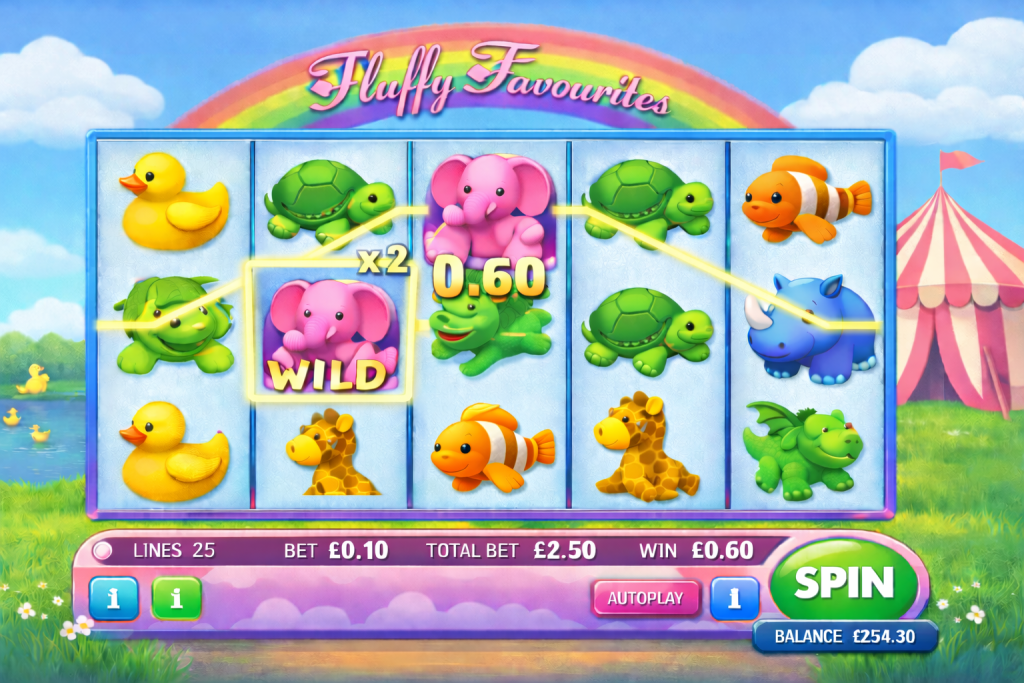
At the heart of the Fluffy Favourites series lies a concept that is often underestimated in gambling game design: comfort. Comfort here should not be confused with safety, nor should it be mistaken for low stakes or trivial outcomes. Instead, it refers to a design strategy that actively reduces cognitive strain while preserving uncertainty. In other words, the games are constructed to feel easy to inhabit, even when they are not necessarily easy to win.
The most immediately visible expression of this concept is the animal-centred aesthetic. Domestic pets, soft shapes, warm colour palettes, and familiar visual cues create an environment that feels emotionally non-threatening. From a psychological perspective, this matters because visual framing influences how risk is perceived before any spin is even made. Players are primed for a gentle experience, and that expectation shapes how subsequent outcomes are interpreted. Losses feel less punitive; wins feel reassuring rather than explosive.
However, the concept runs deeper than art direction. The mechanical language of the series is intentionally conservative. Core rules are easy to grasp, symbol hierarchies are intuitive, and feature triggers are clearly signposted. There is little need for instruction manuals or extended tutorials. This reduction in cognitive load allows players to focus on rhythm rather than calculation. The game does not ask to be solved; it asks to be inhabited.
This is where Fluffy Favourites diverges from many contemporary slot designs that rely on layered mechanics, persistent meters, or evolving feature trees. Those systems reward analytical engagement but also demand sustained attention. Fluffy Favourites takes the opposite approach. It limits the number of concurrent variables the player must track, thereby lowering mental fatigue across longer sessions. This makes the experience particularly well-suited to repeat play, even when outcomes are uneven.
Another defining aspect of the concept is temporal predictability. While individual results remain uncertain, the overall pacing of events tends to follow a recognisable pattern. Small wins appear frequently enough to maintain continuity, while larger features are spaced in a way that feels earned rather than abrupt. This creates a sense of flow that encourages players to remain engaged without escalating emotional intensity.
Importantly, this comfort-oriented strategy does not eliminate risk. Volatility still exists, and bankroll depletion remains a real possibility. What changes is how that risk is framed and experienced. By smoothing emotional peaks and troughs, the series reduces stress responses that might otherwise shorten sessions or provoke impulsive behaviour. In effect, the design shifts the player from a state of anticipation to one of sustained engagement.
From a behavioural standpoint, this positions Fluffy Favourites as a session-focused series rather than a chase-focused one. The games are not primarily built around the promise of a single transformative moment. Instead, they offer continuity, familiarity, and a sense of control, even when outcomes are ultimately governed by chance. This is a powerful combination, particularly for players seeking entertainment rather than high-arousal gambling experiences.
Understanding this conceptual foundation is essential before examining individual mechanics or variations within the series. Without it, the characteristics of Fluffy Favourites can appear shallow or repetitive. Viewed through the lens of comfort as a deliberate design strategy, however, those same characteristics reveal a coherent and carefully maintained system that prioritises how play feels over how it appears on paper.
Core Structural Characteristics: How the Fluffy Favourites System Behaves Over Time
What stays consistent across a session
This table captures the recurring behavioural pattern you feel while playing — the pacing, the feedback, and the “shape” of a session. It is a quick way to scan the series logic without reading it like a manual.
| Aspect | Series behaviour |
|---|---|
| Spin rhythm | Fast, consistent |
| Win frequency | Frequent low-impact |
| Base game role | Active, not passive |
| Emotional amplitude | Compressed |
| Session outcome | Gradual, not spiky |
When analysing the Fluffy Favourites series as a system rather than a collection of features, several structural characteristics emerge with striking consistency. These characteristics are not immediately visible during short playtests. They become apparent only when the game is observed across extended sessions, where repetition reveals design intent. This is where the series distinguishes itself most clearly from more volatile, spectacle-driven slot architectures.
The first defining characteristic is rhythm stability. Spins in Fluffy Favourites are designed to resolve quickly and predictably. Outcomes are rarely delayed by complex animations or layered sub-features. This rapid resolution creates a steady cadence that encourages continuation rather than interruption. From a behavioural perspective, this reduces the friction points at which players typically disengage, such as long non-winning streaks punctuated by emotionally jarring events.
A second characteristic is the deliberate distribution of low-impact wins. Small returns occur frequently enough to maintain balance visibility, even when the overall trajectory of a session is neutral or negative. These wins do not significantly alter bankroll direction, but they perform an important psychological function: they reaffirm participation. The player is reminded that interaction produces feedback, even if that feedback is modest. This reinforces engagement without inflating expectations.
Thirdly, the base game is structurally prioritised. In many slot systems, the base game functions merely as a waiting room for bonuses. In Fluffy Favourites, the base game carries enough activity to feel complete in its own right. This does not mean it is highly profitable, but it is active. Symbols align often enough to sustain interest, and the absence of excessive dead spins prevents emotional fatigue. As a result, players are less inclined to perceive non-bonus play as wasted time.
Another core characteristic lies in outcome compression. Extreme results, both positive and negative, are comparatively rare. Large swings do occur, but they are contextualised within a framework that dampens their emotional impact. Wins do not feel explosive; losses do not feel catastrophic. This compression contributes to the series’ reputation for being calm or forgiving, even when statistical volatility may suggest otherwise.
Finally, there is a consistent separation between clarity and uncertainty. Players are never confused about what has happened or why an event has triggered. At the same time, they cannot reliably predict when significant features will occur. This balance preserves trust in the system while maintaining the fundamental unpredictability required for sustained engagement.
Taken together, these structural characteristics explain why Fluffy Favourites often feels more stable than it is. The system does not eliminate risk; it manages how risk is experienced. This distinction is crucial for understanding player behaviour within the series and sets the foundation for examining how different structural branches modify this core design logic.
Two Structural Branches: Classic Lines and the Megaways Interpretation
Two formats, one comfort tone
The point is not which mechanic is “better”. The point is how the same series identity holds while the pacing model shifts from tick-based spins to flowing sequences.
While the Fluffy Favourites series maintains a coherent identity, it is not structurally monolithic. Over time, it has evolved into two distinct architectural branches that share visual language and thematic tone but differ meaningfully in how play unfolds. Understanding this split is essential for interpreting player experience across the series.
The first branch is the classic line-based structure, typically built around a five-reel, three-row configuration with a fixed number of paylines. This model embodies the original design philosophy of the series. Outcomes resolve in discrete spins, wins are calculated linearly, and each spin represents a complete event. The rhythm here is uniform. Players know precisely when a spin begins and ends, and the emotional arc of each action is short and contained.
In this classic structure, session flow is smooth and predictable. Because paylines are fixed, the visual field remains stable from spin to spin. This stability reinforces familiarity, which in turn supports longer sessions. The player’s attention is not fragmented by shifting reel layouts or cascading effects. Instead, engagement is maintained through repetition and subtle variation within a known framework.
The second branch introduces the Megaways interpretation, which reconfigures the series around variable reel heights, a six-reel grid, and cascading wins. On the surface, this appears to be a dramatic departure from the original model. In practice, however, the underlying comfort-oriented philosophy remains intact, albeit expressed differently.
Megaways introduces micro-variability. Each spin can unfold into a sequence of cascading events, extending the resolution of a single action. This creates the impression of increased activity without necessarily increasing emotional intensity. Wins chain together, but they are often incremental. The player experiences continuity rather than climax, which aligns with the series’ broader design ethos.
What changes most significantly in the Megaways branch is perception of momentum. Because outcomes can unfold over multiple cascades, players may feel that progress is being made even when net returns are modest. This can subtly alter risk perception, making sessions feel more productive than they are. Importantly, this does not transform Fluffy Favourites into a high-adrenaline product. The cascades are visually gentle and thematically consistent, preventing the escalation seen in more aggressive Megaways implementations.
Comparing the two branches reveals how structural choices shape behaviour. The classic model supports steady, almost meditative play, while the Megaways version introduces a sense of motion and continuity. Neither fundamentally disrupts the core characteristics of the series, but each attracts slightly different engagement patterns. Some players prefer the clarity and finality of fixed-line spins; others are drawn to the flowing sequences of cascades.
By accommodating both structures within a single series identity, Fluffy Favourites demonstrates a rare flexibility. It adapts to contemporary mechanical trends without abandoning its foundational principles. This ability to evolve while preserving behavioural consistency is one of the defining characteristics of the series and a key reason for its longevity.
Reel and Symbol Behaviour: Predictability Without Rigidity
One of the most understated characteristics of this series lies in how its reels and symbols behave over time. At first glance, nothing appears unusual. The symbols are familiar, the hierarchy is clear, and outcomes resolve without flourish. Yet it is precisely this restraint that reveals a deeper behavioural logic when play is observed across longer sessions.
The reels are designed to communicate consistency. Symbol distribution does not aim to surprise the player through sudden rarity or dramatic clustering. Instead, it establishes a visual rhythm in which mid-tier symbols appear regularly enough to create recognisable patterns. This repetition is not mechanical in the sense of being predictable on a spin-by-spin basis, but it is statistically legible. Over time, players begin to sense what a “normal” spin looks like, and deviations from that norm carry weight without feeling disruptive.
Wild symbols play a supporting rather than dominant role. They are present often enough to maintain hope but not so frequently that they distort expectations. Importantly, wilds tend to enhance existing alignments rather than create outcomes in isolation. This reinforces the perception that wins are earned through structural alignment rather than sudden intervention. Psychologically, this supports a feeling of coherence: the game behaves according to its own internal logic rather than arbitrary generosity.
Another notable aspect is the relative stability of reel behaviour across sessions. There are few moments where the reels feel as though they have shifted into a radically different mode. Some slot systems rely on invisible state changes that dramatically alter symbol frequency after certain events. Here, such transitions are subtle if they exist at all. The absence of sharp behavioural shifts contributes to the sense that the game is honest in its presentation, even when outcomes are unfavourable.
This stability also affects how losses are processed. Because symbol behaviour remains consistent, losing spins feel like part of an ongoing sequence rather than a punishment or correction. The player is less likely to attribute losses to external manipulation and more likely to accept them as inherent to the flow of play. This reduces frustration and lowers the emotional volatility of the session.
In practical terms, reel and symbol behaviour in this series is designed to fade into the background. It does not demand attention, analysis, or adaptation. Instead, it provides a reliable framework within which the player can remain engaged without feeling challenged or tested. This quiet competence is a defining characteristic: the game does not need to impress the player to retain them. It simply needs to behave consistently enough to be trusted.
Bonus Mechanics as a Pattern, Not a Peak
How bonus modes slot into the session
This flow shows the bonus as a pacing tool: a short change in conditions that returns you to the same core loop, rather than a dramatic “finale” that hijacks the game.
- Base gameStable pace, frequent small feedback
- Bonus triggerA visible event, not a hidden state
- Return to base gameNo “finale” — the loop resumes cleanly
Bonus features within this series are best understood not as climactic events, but as structural extensions of the base game. This is a critical distinction. In many slot architectures, bonuses function as emotional peaks designed to compensate for extended periods of inactivity. Here, bonuses are integrated into the overall rhythm rather than positioned as moments of rupture.
Free spins, when triggered, do not radically transform the experience. They preserve the core visual language and mechanical behaviour of the base game while introducing modest enhancements, most notably through multipliers and extended spin counts. The transition into the bonus mode is smooth, almost understated. There is no dramatic shift in tone, no escalation of visual intensity. This continuity reinforces the idea that the bonus is not a separate game, but a temporary change in conditions.
The structure of free spins encourages endurance rather than anticipation. Re-trigger potential extends the duration of the bonus rather than inflating its immediate value. As a result, the player’s focus shifts from waiting for a single decisive moment to managing a prolonged sequence of outcomes. This aligns closely with the session-oriented philosophy that underpins the series as a whole.
Pick-style bonuses, where present, introduce a different but complementary dynamic. These features provide instant resolution and a sense of agency through choice, yet they remain bounded in scope. Rewards are clearly framed, outcomes are quickly revealed, and the feature concludes without lingering effects. This brevity prevents the feature from overshadowing the rest of the session while still offering variation.
Crucially, neither type of bonus is positioned as the sole meaningful source of returns. While bonuses can improve session outcomes, they are not required for the game to feel active or engaging. This reduces the psychological pressure associated with chasing features and mitigates the frustration that often accompanies near-miss scenarios in bonus-heavy designs.
From a behavioural standpoint, bonuses in this series function as pacing tools. They break monotony without disrupting flow. They offer variation without demanding adaptation. Most importantly, they respect the player’s established expectations by behaving in ways that are consistent with the base experience.
By treating bonus mechanics as part of an ongoing pattern rather than as isolated spectacles, the series maintains emotional equilibrium across extended play. This design choice may appear conservative, but it is central to the series’ identity. The bonus is not where the game suddenly becomes exciting; it is where the game becomes slightly different, for a while, before returning to familiar ground.
Volatility, RTP and Risk Perception: Why the Series Feels Safer Than It Is
Risk that rises gently, without spikes
This is a conceptual curve: it shows how risk can feel in-session even when the underlying volatility exists. The shape is smooth on purpose — gradual tension rather than sudden jolts.
Discussions around volatility and RTP often dominate how slot games are categorised, yet in the case of the Fluffy Favourites series, these metrics alone fail to explain player experience. On paper, several entries in the series sit within ranges that would typically be described as medium to high risk. In practice, however, the games are widely perceived as calm, forgiving, and manageable. This disconnect between numerical classification and lived experience is not accidental; it is one of the most carefully engineered characteristics of the series.
The first factor shaping this perception is outcome distribution. Rather than concentrating returns into rare, extreme events, the series spreads value across frequent low- to mid-level wins. This does not increase expected return, but it alters how variance is encountered. Losses are interspersed with small recoveries, preventing long stretches of unbroken depletion that tend to amplify stress responses. The bankroll declines, but it does so gradually and with regular interruptions.
RTP, while stable across versions, plays a secondary role in shaping behaviour. Players rarely experience RTP as a percentage; they experience it as time. How long their balance lasts, how often it is replenished, and how sharply it fluctuates all matter more than the theoretical long-term return. Fluffy Favourites extends perceived playtime by smoothing volatility, even when the underlying mathematics remain unchanged.
Another important element is transparency. The game rarely gives the impression that something significant is being withheld or delayed indefinitely. Feature triggers are visible, bonus mechanics are clearly defined, and outcomes resolve cleanly. This reduces the sense of hidden risk that can arise in more opaque systems, where players feel that results are influenced by unseen states or thresholds. Trust in the system lowers anxiety, which in turn softens the emotional impact of losses.
Risk perception is also moderated by pacing. Because spins resolve quickly and consistently, negative outcomes do not linger. There is little time for anticipation to build into tension, and little spectacle to magnify disappointment. The emotional amplitude of each spin is intentionally limited. Over time, this creates a sense that the game is steady, even when variance accumulates beneath the surface.
Taken together, these elements explain why Fluffy Favourites often attracts players who describe themselves as risk-averse, despite engaging with a product that still involves meaningful uncertainty. The series does not remove risk; it reframes it. By managing how volatility is delivered rather than reducing it outright, the design allows players to coexist with risk without constantly reacting to it.
Player Experience and Session Psychology: Sustaining Engagement Without Escalation
Why the session keeps moving
A simple loop with gentle variation. The goal is continuity: the game stays in the same emotional register rather than escalating into a “must-chase” cycle.
The psychological profile of a typical Fluffy Favourites session differs markedly from that of many modern slot experiences. Rather than building towards intensity, the session tends to settle into a stable emotional range early on and remain there. This has significant implications for how players interact with the game over time.
One of the most influential factors is tempo. The combination of fast spin resolution and minimal visual interruption creates a continuous flow that discourages stop-start behaviour. Players are less likely to pause, reassess, or disengage because there are few natural breakpoints. This continuity supports longer sessions, not through excitement, but through ease.
Sound design and visual presentation reinforce this effect. Audio cues are soft, repetitive, and non-intrusive. Visual feedback is clear but restrained. Wins are acknowledged without being celebrated excessively, and losses pass without emphasis. This sensory moderation prevents overstimulation and reduces emotional fatigue, allowing attention to be sustained without effort.
Crucially, the game does not challenge the player’s competence. There are no strategic decisions to master, no evolving mechanics to track, and no sense that better play would meaningfully change outcomes. This removes performance pressure, which is a common source of stress in more complex systems. The player is free to participate without judgement, success metrics, or progression anxiety.
From a session psychology perspective, this creates a form of passive engagement. The player remains involved not because they are actively seeking resolution or mastery, but because there is little reason to leave. The experience is comfortable, familiar, and emotionally contained. This does not produce memorable highs, but it also avoids sharp lows.
This mode of engagement is particularly effective for players who view slots as background entertainment rather than as focal activities. Fluffy Favourites accommodates distraction. It allows for partial attention without penalty, making it compatible with extended, low-effort play. In doing so, it occupies a distinct psychological niche within the broader slot ecosystem.
Ultimately, the series demonstrates that sustained engagement does not require escalation. By prioritising emotional regulation over stimulation, Fluffy Favourites offers a model of play that is steady, predictable, and enduring. This approach may lack drama, but it succeeds in creating an experience that players can return to repeatedly without feeling drained or overwhelmed.
Who the Fluffy Favourites Series Is Really For
Where this series naturally settles
This is not a judgement of play styles. It is a balance view — showing which preferences the series quietly supports, and which ones it does not actively reinforce.
- Session-oriented players
- Casual, low-pressure play
- Low cognitive load preference
- High-risk chasers
- Intensity-driven play
- Strategy-heavy users
Every gambling product implicitly selects its audience through design, whether intentionally or not. In the case of Fluffy Favourites, that selection process is unusually precise. The series is often described as broadly appealing, but this generalisation obscures the fact that it serves certain player profiles far better than others. Understanding who the series is really for requires looking beyond demographics and focusing instead on behavioural preferences.
Fluffy Favourites is fundamentally suited to players who value continuity over climax. These are individuals who are less motivated by the pursuit of rare, life-changing wins and more interested in maintaining a steady, manageable session. They are comfortable with modest outcomes, provided those outcomes arrive regularly and predictably. For such players, the series offers reassurance rather than provocation.
It also appeals strongly to players who experience cognitive fatigue quickly when confronted with complex mechanics. The absence of layered systems, evolving states, or strategic decision-making reduces mental effort. This makes the series accessible not only to newcomers, but also to experienced players who occasionally prefer low-demand play. In this sense, Fluffy Favourites functions as a form of decompression within a wider gambling repertoire.
Another group well served by the series consists of session-oriented players with fixed budgets. Because bankroll erosion tends to be gradual rather than abrupt, players can better anticipate session length and expenditure. This predictability supports controlled play, even if outcomes remain uncertain. The game rarely surprises players with sudden, disproportionate losses, which can be particularly disruptive for those managing tight limits.
Conversely, the series is less suitable for players driven by intensity. Those who seek sharp emotional swings, aggressive volatility, or highly interactive features may find the experience underwhelming. Fluffy Favourites does not reward persistence with escalating excitement, nor does it provide the kind of dramatic narrative arcs that characterise more theatrical slot designs. For thrill-seekers, the series can feel flat rather than calming.
In short, Fluffy Favourites is designed for players who prioritise comfort, familiarity, and emotional regulation. It is not a universal solution, but it is a highly effective one within its intended behavioural niche. Recognising this alignment helps explain both the loyalty it inspires and the indifference it provokes among those seeking something fundamentally different.
FAQ: Fluffy Favourites Characteristics
Common questions, clear answers
These answers focus on how the series behaves in practice, not on promotional claims or isolated features.
What defines the Fluffy Favourites series?
Is Fluffy Favourites suitable for long sessions?
How risky are Fluffy Favourites slots?
What is the main difference between classic and Megaways versions?
Are bonus features essential to enjoying the game?
Why does the series feel low-stress compared to other slots?
Understanding Fluffy Favourites as a Behavioural Design System
When viewed in isolation, the individual elements of the Fluffy Favourites series can appear unremarkable. Familiar symbols, straightforward mechanics, restrained bonuses, and an absence of dramatic escalation do not, on their own, suggest a particularly distinctive product. Yet when these elements are examined collectively and over time, a far more coherent and intentional design system becomes visible. Fluffy Favourites is not defined by novelty or spectacle, but by behavioural consistency.
At its core, the series demonstrates how slot design can prioritise emotional regulation without sacrificing uncertainty. Rather than attempting to capture attention through intensity, it retains players by making participation feel manageable. This is achieved through a careful balancing of rhythm, feedback, and expectation. Spins resolve quickly, outcomes are communicated clearly, and variability is distributed in a way that minimises shock. The result is an experience that feels stable even when it is not statistically gentle.
One of the most significant achievements of the series is its ability to separate perceived risk from actual risk. Players are exposed to genuine variance, yet that variance is framed in a way that softens its emotional impact. Losses are rarely abrupt, wins are rarely overwhelming, and the space between the two is filled with regular, low-level reinforcement. This does not change the mathematics of the game, but it profoundly changes how those mathematics are lived. For many players, this distinction is what determines whether a session feels tolerable or stressful.
The structural discipline of the series is also evident in its evolution. By accommodating both classic line-based models and Megaways implementations without abandoning its core identity, Fluffy Favourites shows that mechanical adaptation does not require behavioural reinvention. New formats introduce variation in flow and presentation, but they do not disrupt the underlying promise of comfort and continuity. This restraint is rare in an industry often driven by the pressure to escalate.
Equally important is what the series chooses not to do. It does not demand strategic mastery. It does not reward analytical optimisation. It does not position the player as someone who can outplay the system through insight or persistence. Instead, it offers a form of engagement that is passive but not empty, predictable but not deterministic. This makes it particularly well suited to players who view slots as a background activity rather than a competitive challenge.
From a broader perspective, Fluffy Favourites illustrates how gambling products can be shaped around session psychology rather than momentary impact. The series is less concerned with creating memorable events than with creating an environment that players are willing to inhabit repeatedly. This approach may not generate stories of dramatic wins, but it fosters familiarity and trust, which are powerful drivers of long-term engagement.
In understanding Fluffy Favourites as a behavioural design system, it becomes clear that its success lies not in what it promises, but in what it reliably delivers. It delivers consistency, emotional containment, and a sense of control within an inherently uncertain activity. For players who value those qualities, the series offers exactly what it appears to be: not a spectacle, but a steady companion in the landscape of chance-based entertainment.