
Megaways Demo Fluffy Favourites – A Closer Look at Structure, Volatility and How the Game Really Plays
Looking Past the Soft Surface of a Megaways Favourite
I am Mark D. Griffiths, and I want to be clear from the outset about what this page is and what it is not. This is not a cheerful walkthrough of a cute-looking slot, nor is it an attempt to persuade you that Fluffy Favourites Megaways is something it is not. It is an analytical exploration of a game that often gets misunderstood because of its presentation and its branding. The demo version, in particular, deserves a more serious look than it usually receives.
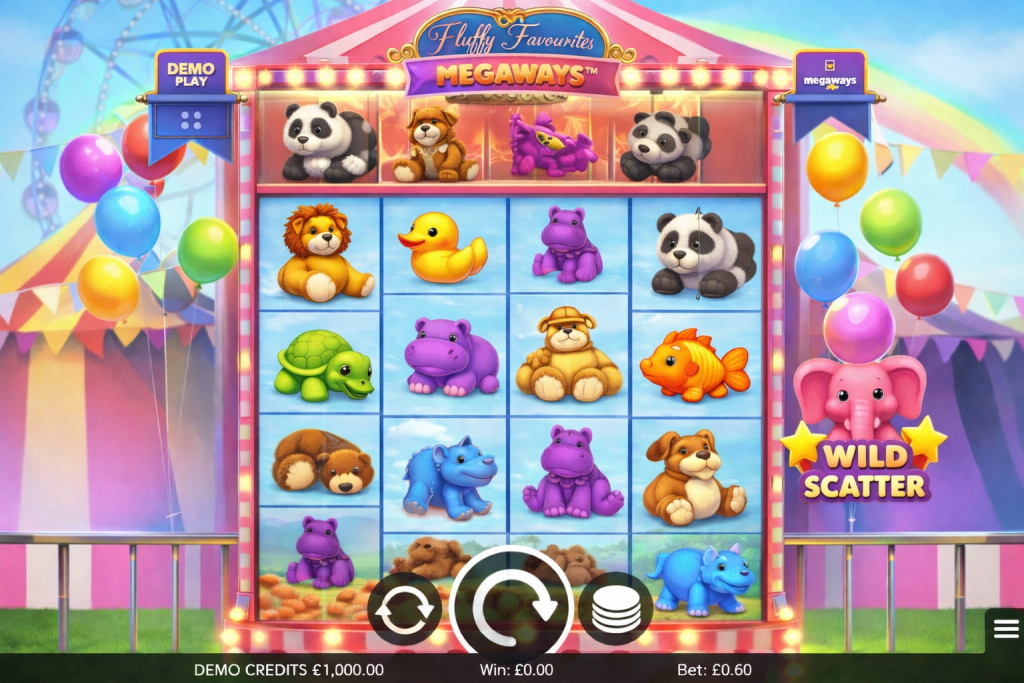
Fluffy Favourites Megaways presents itself with familiar imagery, friendly characters, and a colour palette that suggests something light and approachable. For many players, that visual language creates an assumption: that the game is casual, forgiving, and suited to quick sessions with low emotional or strategic investment. In practice, that assumption rarely survives extended play. This is a slot built on a structure that rewards patience, tolerance for dry stretches, and an understanding of how modern Megaways mechanics distribute outcomes over time.
The reason this page focuses so heavily on the demo is simple. The demo environment removes financial pressure and replaces it with observational clarity. When money is not at stake, it becomes much easier to notice rhythm, pacing, and behavioural patterns. You begin to see how often the base game resolves without consequence, how frequently the reels flirt with bonus conditions without committing to them, and how multipliers function more as long-term narrative devices than as instant rewards.
This is also why the demo version can feel uncomfortable for some players. Without the distraction of balance changes or emotional swings tied to real stakes, the underlying design becomes obvious. Fluffy Favourites Megaways is not engineered to entertain on every spin. It is engineered to build tension slowly, sometimes relentlessly, and to resolve that tension in short, concentrated moments. The demo exposes that philosophy very clearly.
Throughout this page, I will be speaking directly to the reader, not to search engines and not to marketing expectations. I will describe how the game behaves rather than how it is advertised. I will focus on structure, probability flow, and experiential rhythm. If you are looking for reassurance, shortcuts, or guarantees, you will not find them here. If, however, you want to understand why this slot feels the way it does, and whether that feeling aligns with your own preferences, then you are in the right place.
Before we move into the mechanics themselves, one final clarification is necessary. Analysing a slot does not mean attempting to control it. There is no strategy that overrides randomness, and nothing written here should be interpreted as a method for beating the game. The purpose is comprehension, not conquest. With that in mind, we can now look at how Fluffy Favourites Megaways is actually constructed.
Core Game Architecture: How Megaways Shapes Volatility and Expectation
At the heart of Fluffy Favourites Megaways lies a familiar Megaways framework, but familiarity should not be mistaken for simplicity. The game uses variable reel heights to generate thousands of possible symbol combinations on each spin. This design is often promoted as a way to increase excitement by multiplying potential outcomes, but in practical terms it serves a more subtle purpose: it smooths probability across time rather than across individual spins.
Each reel can display a different number of symbols, and the total number of ways adjusts dynamically. This variability creates frequent small connections and near-misses, giving the impression of constant activity. However, activity is not the same as value. Many of these connections resolve into negligible or zero-impact results once cascades are accounted for. Understanding this distinction is critical to understanding why the game feels busy yet often unrewarding in the base phase.
Cascading reels are the second structural pillar of the game. When a winning combination appears, the symbols involved are removed and replaced from above, potentially creating additional wins within the same spin. On the surface, this suggests momentum and continuity. In reality, cascades are the mechanism by which the game concentrates probability into fewer spins while leaving many others empty. A cascade chain either develops quickly or collapses almost immediately, and there is very little middle ground.
This architecture has direct implications for volatility. Rather than distributing wins evenly, the game clusters them. Long stretches of uneventful spins are not anomalies; they are part of the intended experience. The Megaways system ensures that when a meaningful event does occur, it has room to expand through multiple symbol drops, multiplier interactions, and bonus triggers. The cost of that potential is paid in advance through silence.
Another important aspect of the architecture is how expectations are managed. Variable reel heights constantly change the visual landscape, which can give the impression that conditions are improving or deteriorating from spin to spin. In truth, each spin is statistically independent. The shifting number of ways does not signal proximity to a bonus or an increased likelihood of success. It is a presentation layer, not a predictive one.
The demo version is particularly useful here because it strips away the temptation to read meaning into these visual fluctuations. Over extended sessions, patterns emerge that have nothing to do with short-term streaks. You begin to notice that high-way spins often resolve with minimal impact, while lower-way configurations occasionally deliver disproportionate results due to symbol alignment and cascade timing. This reinforces an important lesson: in Megaways slots, quantity of ways is less important than the context in which those ways occur.
Fluffy Favourites Megaways also relies heavily on what might be described as delayed significance. Many spins appear inconsequential in isolation but contribute indirectly by setting emotional expectations. Near-alignments of key symbols, partial cascade chains, and interrupted multiplier opportunities all serve to keep attention engaged without materially altering balance. This is not accidental. It is a carefully tuned pacing mechanism.
When viewed through this architectural lens, the game becomes easier to assess honestly. It is not chaotic, and it is not generous. It is methodical, patient, and unapologetically uneven. The Megaways framework is not there to provide constant stimulation, but to support occasional expansion when the internal conditions align. The demo allows you to witness this process without distortion.
Understanding the core structure is essential before moving on to symbols, multipliers, and bonuses. Without that foundation, it is too easy to misinterpret individual features as isolated advantages or disadvantages. In Fluffy Favourites Megaways, nothing operates in isolation. Every element is subordinate to the architecture, and the architecture is designed to make you wait.
Symbol Behaviour and Psychological Weight on the Reels
When players talk about symbols in Fluffy Favourites Megaways, they usually talk in terms of presence: which ones appear often, which ones feel rare, and which ones seem to “matter”. That way of thinking is understandable, but it misses the more important question, which is how symbols behave in relation to the game’s underlying structure. Symbols in this slot are not designed to be memorable on their own. They are designed to function as signals, interruptions, or catalysts within a much larger system.
Most of the standard symbols serve a deliberately modest role. They fill space, they create short-lived connections, and they maintain the illusion of constant motion. In the demo, this becomes especially apparent. You will see frequent small matches that trigger cascades but resolve without consequence. These outcomes are not there to reward you; they are there to keep the reels in motion and to reset attention. Over time, this creates a rhythm where inactivity feels active, even when the balance remains unchanged.
Wild symbols are often misunderstood in this context. In many slots, wilds act as a form of rescue, stepping in to complete otherwise broken combinations. Here, they are more conditional. A wild only has meaningful impact when it appears in alignment with an already favourable configuration of symbols and reel heights. Outside of that context, it functions as visual reinforcement rather than a genuine turning point. The demo makes this clear by repetition. You will encounter wilds that look promising but resolve into negligible outcomes, and you will encounter occasional wild placements that suddenly amplify a cascade chain. The difference is not frequency, but timing.
The elephant scatter symbols deserve special attention, not because they are particularly rare, but because of how they are counted. In this game, scatters are evaluated only after all cascades have fully resolved. This detail has a profound psychological effect. During a cascade sequence, scatters can appear, disappear, and reappear in different configurations, creating a sense of proximity to the bonus. However, unless they remain on the screen once the cascade sequence ends, they have no functional value.
This mechanic generates a high number of near-miss moments. From a design perspective, these moments are not accidents. They create emotional engagement without altering the mathematical balance. In the demo environment, where outcomes are not financially charged, these near-misses become easier to analyse. You begin to notice how often the game presents partial bonus conditions and how rarely those conditions stabilise into an actual trigger. This is not cruelty; it is calibration.
Symbol behaviour in Fluffy Favourites Megaways is therefore less about individual identity and more about interaction. Symbols exist to test patience, to create fleeting hope, and occasionally to align in a way that justifies the long periods of restraint that precede them. The demo allows you to observe this behaviour over time, without the pressure to interpret every appearance as meaningful.
Once this perspective is adopted, frustration often gives way to clarity. The slot is not teasing you personally, nor is it responding to your recent history. It is executing a predefined behavioural model in which symbols are tools, not promises. Understanding that model is essential before moving on to the feature that most strongly defines the game’s personality: its multipliers.
Two Multiplier Systems and the Illusion of Acceleration
One of the defining characteristics of Fluffy Favourites Megaways is the presence of two distinct multiplier systems operating simultaneously. On the surface, this can appear generous, even indulgent. In practice, these systems serve very different purposes and affect the player experience in very different ways. Understanding the contrast between them is central to understanding why the game feels the way it does.
The first system consists of what can be described as short-range or local multipliers. These are typically introduced through claw-related mechanics that attach a multiplier value to a specific wild or win event. Their impact is immediate and confined. When they activate, they can noticeably boost the value of a single cascade chain or winning configuration. This immediacy makes them highly visible and emotionally satisfying when they work.
However, their limitations become obvious in the demo. These multipliers do not persist beyond the moment in which they appear. They do not influence subsequent spins, nor do they alter the broader state of the game. As a result, their presence can create a false sense of acceleration. A boosted win feels like progress, but it does not bring the player any closer to a bonus or to sustained momentum. Once the spin resolves, the game resets entirely.
The second multiplier system operates on a very different timescale. Within the Free Games feature, the game introduces a cumulative multiplier that increases incrementally with each winning event and cascade. This multiplier does not reward immediacy; it rewards continuity. Its value lies not in a single hit, but in the ability to maintain winning momentum across multiple spins within the bonus.
This distinction has important consequences. Many bonus rounds will end before the cumulative multiplier reaches a meaningful level. Early wins may look underwhelming, and only those bonus sessions that manage to sustain cascades over time will unlock the full potential of the system. From a psychological standpoint, this creates tension. Each additional cascade feels valuable not only for its immediate payout, but for its contribution to future potential.
The demo is particularly effective at exposing this contrast. You will often see local multipliers deliver visually impressive but strategically insignificant results, while the cumulative multiplier quietly grows in the background, sometimes without ever being fully realised. This is where many players misjudge the game. They focus on the visible boosts and overlook the conditions required for the slower system to matter.
Crucially, these two multiplier systems do not compete with one another; they coexist. One provides momentary excitement, the other provides long-term structure. Together, they reinforce the game’s core philosophy: short-term stimulation paired with long-term restraint. The illusion of acceleration comes from the presence of multipliers at all, but the reality is that only sustained alignment allows that acceleration to translate into meaningful outcomes.
By observing both systems in the demo, without the pressure to capitalise on them, it becomes easier to see their true roles. They are not there to make every session exciting. They are there to ensure that when conditions align, the game has the capacity to expand rapidly. Whether that capacity is realised is a matter of probability, patience, and tolerance for imbalance.
With this understanding in place, the structure of the bonus feature itself becomes far easier to interpret, as does the emotional arc the game expects the player to follow.
Free Games Bonus Architecture: Where Outcomes Are Actually Decided
The Free Games feature in Fluffy Favourites Megaways is often described in simple terms: collect enough scatters, receive a set number of spins, watch the multipliers grow. That description is accurate, but it is not particularly useful. What matters is not what the bonus is, but how it behaves over time and where, within that behaviour, outcomes are truly shaped.
The trigger itself already sets the tone. Because scatter symbols are evaluated only once all cascades have completed, the bonus is not something that erupts suddenly. It arrives after a pause, after motion has ceased. That pause is significant. It reinforces the idea that the bonus is not an extension of base-game momentum, but a separate phase with its own internal logic. In the demo, this separation is especially clear, because the emotional shift is not masked by financial relief or excitement.
Once the Free Games begin, the early phase is typically restrained. The cumulative multiplier starts at its lowest point, and early wins, if they appear at all, tend to be modest. This is the stage where many players mentally disengage, assuming that the bonus has already failed to deliver. From a structural perspective, this phase serves a filtering function. It quickly eliminates bonus rounds that do not meet the internal conditions required for expansion.
The middle phase is where the design reveals its intent. If cascades begin to chain and the multiplier starts to climb, the bonus changes character. Each additional win now carries two forms of value: its immediate payout and its contribution to the multiplier state. This creates a layered form of tension. A win that would be unremarkable in the base game suddenly feels consequential because it preserves continuity. In the demo, this is often the point where players first recognise that the bonus is not about isolated hits, but about survival.
The final phase, when it occurs, is brief and decisive. High multipliers only matter if they coincide with favourable symbol alignment. When they do, results escalate quickly. When they do not, the bonus can end with a sense of unfulfilled potential. Importantly, this is not a flaw. It is the logical conclusion of a system that prioritises conditional amplification over guaranteed payoff.
What becomes clear through repeated observation is that the Free Games feature is not designed to entertain evenly. It is designed to reward a very specific sequence of events. Most bonuses will never reach that sequence. The demo makes this explicit by removing the emotional distortion that real stakes introduce. You are left with a clear view of how rarely all phases align and how sharply the outcome distribution is skewed.
Understanding this architecture reframes disappointment. A quiet bonus is not a failure; it is the default. A volatile bonus is not generosity; it is permission granted under strict conditions. The game does not promise balance. It promises capacity, and only when its internal thresholds are crossed.
Pacing and Rhythm: Why the Game Refuses to Hurry
Pacing is one of the least discussed aspects of slot design, yet in Fluffy Favourites Megaways it is arguably the most defining. This is a game that resists urgency. It does not reward impatience, and it does not adapt to short attention spans. Instead, it establishes a rhythm that unfolds slowly and, at times, uncomfortably.
In the base game, long stretches of inactivity are common. Spins resolve quickly, cascades fizzle out early, and visible progress is scarce. For players accustomed to constant reinforcement, this can feel hostile. In reality, it is deliberate. The game creates space between meaningful events so that those events retain impact when they finally occur. The demo is particularly effective at demonstrating this, because nothing interrupts the pattern. There are no withdrawals, no emotional justifications, only repetition.
Near-miss situations play a significant role in this rhythm. Partial scatter appearances, interrupted cascades, and isolated multiplier activations all contribute to a sense of anticipation without delivering resolution. Over time, this trains the player to recognise that anticipation itself is part of the experience. The game is not building towards something on every spin; it is maintaining tension across many spins.
The bonus feature does not abandon this philosophy. Even within Free Games, momentum is fragile. A single non-winning spin can halt multiplier growth and collapse potential. This keeps the rhythm uneven, even during the game’s most anticipated phase. There is no sustained acceleration, only brief windows where expansion becomes possible.
What makes this pacing distinctive is its consistency. The game does not oscillate between generosity and restraint. It remains restrained, with occasional exceptions. This predictability, paradoxically, makes it easier to assess. In the demo, after sufficient exposure, the rhythm becomes familiar. You begin to anticipate silence rather than noise, and that shift in expectation changes how the game is perceived.
For some players, this rhythm will feel oppressive. For others, it will feel honest. There is no attempt to disguise volatility behind constant micro-rewards. The game allows boredom to exist, trusting that tension will do its work. That is an unusual design choice in a market increasingly focused on stimulation.
By observing pacing without the emotional overlay of real money, the demo clarifies an essential truth. Fluffy Favourites Megaways is not slow because it lacks ideas. It is slow because speed would undermine its structure. It needs time to create contrast, and it is willing to lose players who are unwilling to give it that time.
With this understanding, the remaining sections fall into place. The demo is not simply a free version of the game; it is the clearest lens through which its intentions can be seen.
Demo Mode as a Testing Environment, Not a Teaser
The demo mode of Fluffy Favourites Megaways is often treated as a lightweight preview, a place to pass time before deciding whether to commit real money. That perspective underestimates its value. In this particular game, the demo functions far more effectively as a testing environment than as a promotional tool. It reveals the underlying logic with a clarity that real-money play frequently obscures.
Without financial consequence, patterns become easier to recognise. The base game’s restraint, which can feel frustrating when stakes are involved, becomes informative instead. You can observe how often spins resolve without effect, how rarely cascades develop into something meaningful, and how frequently the game presents partial conditions that never mature into features. These observations are difficult to make when attention is divided between outcomes and balance management.
One of the most useful aspects of the demo is its ability to expose frequency without distortion. Over the course of fifty, one hundred, or two hundred spins, you begin to form a realistic sense of how often Free Games appear, how many spins typically pass between notable events, and how rarely multipliers align with favourable symbol structures. This is not about predicting results, but about calibrating expectations.
The demo also allows for detached analysis of multiplier behaviour. Short-range boosts can be watched without emotional investment, making it easier to see how often they meaningfully alter outcomes. Likewise, the cumulative multiplier in Free Games can be observed across multiple bonus rounds, revealing how often it fails to reach impactful levels. These insights are far more valuable than any single impressive win.
Equally important is what the demo does not show. It does not convey emotional pressure, risk tolerance, or the psychological effect of sustained loss. It cannot replicate the tension that real stakes introduce, nor can it simulate decision-making under stress. Understanding these limitations is essential. The demo shows structure and rhythm, not personal experience.
Used correctly, the demo answers a simple but important question: does the game’s behaviour align with your tolerance for imbalance and delay? It does not promise entertainment. It offers information. For a slot as unapologetically uneven as this one, that information is worth far more than excitement.
Numbers Without Illusions: Interpreting RTP, Volatility, and Configuration
Numerical specifications often give the impression of certainty. RTP percentages, volatility labels, and maximum win figures are presented as if they offer definitive insight into how a game will perform. In Fluffy Favourites Megaways, these numbers are better understood as boundaries rather than guarantees.
Return to Player figures, for example, are frequently discussed as fixed attributes. In reality, they are configuration-dependent. Different operators may run slightly different versions of the game, and the demo may not always reflect the exact parameters of every live environment. This does not mean the numbers are misleading, but it does mean they should be interpreted cautiously. An RTP value describes long-term behaviour across enormous sample sizes, not short-term experience.
Volatility is similarly abstract. Describing the game as high volatility is accurate, but insufficient. The volatility here is not expressed through frequent swings between wins and losses, but through extended restraint punctuated by occasional expansion. This is a form of volatility that tests patience more than luck. It is felt through absence rather than excess.
Maximum win figures are perhaps the most misunderstood of all. They represent theoretical ceilings under optimal conditions, not realistic targets. In a game where multiple layers of alignment are required, these ceilings function more as proof of capacity than as indicators of likelihood. The demo makes this clear by showing how rarely the necessary conditions even begin to assemble.
What matters more than the numbers themselves is how they interact. A moderate RTP combined with high volatility and conditional multipliers creates a very specific experience. Returns are not smoothed out over time; they are concentrated. Losses feel flat, wins feel sharp, and neutrality is rare.
Approaching these figures without illusion allows for a more honest assessment. They do not tell you what will happen, only what is possible. The demo helps translate abstraction into observation. By watching how often high-potential situations fail to materialise, and how rarely low-probability alignments succeed, the numbers gain context.
In the end, statistics are descriptive, not predictive. They outline the shape of the game, not its moment-to-moment behaviour. In Fluffy Favourites Megaways, that shape is narrow, tall, and unforgiving. Understanding it is not about hope, but about acceptance.
Who This Demo Speaks To, and Who It Quietly Pushes Away
Every slot communicates preferences, even when it does not state them openly. Fluffy Favourites Megaways is no exception. Its demo version, in particular, acts almost like a filter. Some players will feel an immediate sense of friction, while others will recognise a familiar, if demanding, rhythm. Neither reaction is accidental.
This demo is most suitable for players who are comfortable with delayed gratification. If you are willing to observe long stretches of inactivity without interpreting them as failure, the game becomes readable. You begin to notice how restraint functions as part of the design rather than as a sign of poor balance. For analytical players, this restraint provides space to think. The absence of constant reward allows patterns to surface.
It also suits players who are curious about structure rather than spectacle. If your interest lies in how features interact, how volatility is expressed across time, and how bonus potential is protected rather than distributed, the demo offers clarity. You are not rushed. Nothing competes aggressively for your attention. The game assumes you are prepared to watch it operate.
Conversely, the demo is likely to frustrate players who value immediacy. If you expect frequent reinforcement, visible progress, or the sense that every spin advances you towards something tangible, this game will feel uncooperative. The demo does not soften that experience. In fact, it often intensifies it by removing the emotional justification that real-money play can provide.
It is also poorly suited to short sessions. Ten or twenty spins are rarely enough to reveal anything meaningful. Without sustained exposure, the game can appear empty or repetitive. This is not because nothing is happening, but because what is happening unfolds on a longer timeline than many players are accustomed to.
Recognising whether you belong to the first group or the second is one of the demo’s primary functions. It does not persuade; it reveals. In doing so, it saves time and manages expectation more effectively than any promotional description could.
Questions Players Ask Once the Pattern Becomes Clear
Is the demo version representative of the real game?
How often does the Free Games feature trigger?
Do multipliers behave the same way in demo mode?
Can large wins occur in the demo?
Is this demo suitable for short play sessions?
Final Reflections on a Slot That Demands Time, Not Attention
After extended exposure to the demo version of Fluffy Favourites Megaways, one conclusion becomes difficult to avoid: this is a game that does not compete for your attention, it waits for your patience. That distinction matters. In an environment where many slots rely on constant stimulation and rapid feedback, this one takes the opposite approach. It slows the tempo, stretches the distance between meaningful events, and places the burden of engagement on the player rather than on the interface.
The demo makes this design choice unmistakably clear. Without financial stakes to colour perception, the structure stands exposed. Long sequences of uneventful spins are not interruptions to the experience; they are the experience. They establish a baseline against which everything else is measured. When a feature does appear, or when a multiplier begins to grow in a meaningful way, the contrast is sharp precisely because silence preceded it.
What stands out most is how little the game attempts to reassure. There are no frequent consolation rewards, no steady drip of minor wins designed to maintain momentum. Instead, the game assumes that you are willing to tolerate uncertainty. It offers potential rather than consistency, and it does so without apology. For some players, this will feel uncompromising. For others, it will feel refreshingly honest.
The dual multiplier structure reinforces this philosophy. Short-term boosts create brief flashes of activity, but they rarely alter the overall trajectory. The cumulative multiplier within Free Games, by contrast, embodies the game’s deeper logic: progress is possible, but only if momentum is sustained. Most bonus rounds will not achieve that momentum, and the demo demonstrates this without embellishment. When a bonus does unfold successfully, it feels earned rather than granted.
There is also a quiet coherence to how the game’s elements interact. Symbol behaviour, cascade logic, and pacing are not independent features layered on top of one another. They are interdependent components of a single system designed to concentrate outcomes. The demo allows you to see this system in motion, free from the emotional noise that often accompanies real-money play. In doing so, it provides a clearer basis for judgement than any promotional description could.
Perhaps the most valuable insight the demo offers is self-knowledge. It reveals not only how the game behaves, but how you respond to that behaviour. If extended inactivity feels intolerable, or if near-miss situations generate frustration rather than curiosity, this game is unlikely to suit you. If, however, you find value in observing structure, understanding rhythm, and accepting imbalance as part of the design, the demo serves as an effective introduction.
Fluffy Favourites Megaways does not promise comfort. It promises capacity. The demo shows you the shape of that promise and leaves the decision to you. There is no urgency to proceed, no pressure to commit. In that sense, the demo does exactly what a good analytical tool should do: it informs without persuading.