
Megaways Fluffy Favourites: Understanding a Bonus-Driven Megaways System
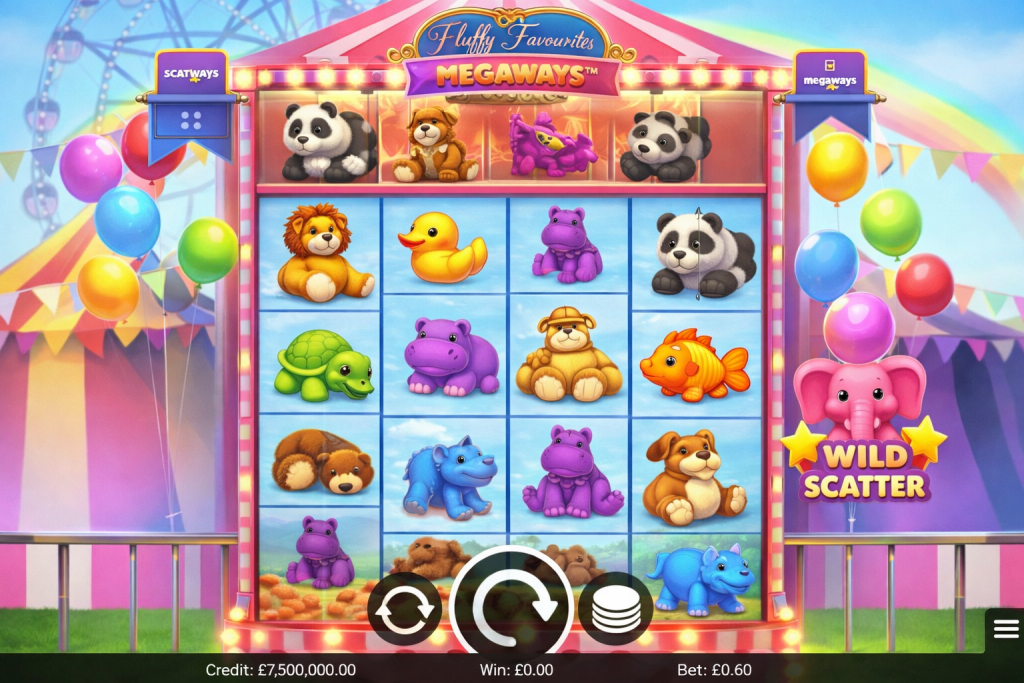
When a Familiar Series Enters an Unfamiliar Engine
I have always been cautious with games that attempt to modernise a recognisable identity by simply attaching a popular engine to it. Too often, this process strips a series of its internal rhythm and replaces it with mechanical noise. That is precisely why Fluffy Favourites Megaways deserves closer attention, not as a spectacle, but as a structural experiment.
At first glance, the premise seems straightforward. A long-running, approachable slot series is paired with a variable reel system that has come to symbolise volatility, instability, and session unpredictability. For many players, this combination is either immediately attractive or instantly suspicious. Both reactions miss the more interesting question: what actually happens to a bonus-driven, comfort-oriented design when it is placed inside a constantly shifting reel framework?
This page is not written to persuade, promote, or exaggerate. It exists to examine behaviour. Fluffy Favourites Megaways is not a game that announces its intentions loudly. It does not rely on explosive animations, aggressive sound design, or constant escalation. Instead, it operates through contrast. Familiar symbols move through unfamiliar spaces. Established expectations are preserved in some areas and quietly dismantled in others.
What makes this slot worth extended analysis is not the presence of Megaways itself, but the restraint with which it is applied. Many Megaways titles force players into heightened attention states almost immediately. This one does not. It allows its base game to breathe, sometimes to the point where players question whether anything meaningful is happening at all. That hesitation is intentional. It reflects a design philosophy inherited from the broader Fluffy Favourites lineage rather than from the Megaways engine.
There is also a broader misconception worth addressing early. Megaways is often treated as a genre rather than a tool. In reality, it is simply a structural modifier. Its impact depends entirely on what it is modifying. When applied to high-volatility, peak-driven games, it amplifies extremes. When applied to a series like Fluffy Favourites, it performs a different function altogether. It introduces movement without demanding aggression.
Throughout this analysis, I will focus on how this game behaves over time, how its phases relate to one another, and why many short-form impressions fail to capture its actual design intent. This is not a slot that reveals itself quickly, and it is certainly not one that benefits from being judged by a handful of spins. Its logic becomes visible only when one steps back and observes how its systems interact across longer sessions.
Understanding Fluffy Favourites Megaways requires abandoning the idea that all Megaways games are designed to feel the same. It also requires recognising that familiarity, when handled carefully, can coexist with mechanical variation without collapsing into contradiction. That balance is rare, and it is the reason this title warrants a deeper, more patient reading.
The Fluffy Favourites Series as a Design System
The behavioural cues that stay consistent across the series
This is a compact reference for reading the series as a system. It avoids numbers on purpose and focuses on how pace, expectation, and tone are shaped in practice.
To understand what Fluffy Favourites Megaways is doing, one must first understand what the Fluffy Favourites series has always been. It is tempting to describe these games in purely aesthetic terms, but doing so overlooks their more important contribution: consistency of behavioural design.
From its earliest entries, the Fluffy Favourites series has prioritised predictability of experience over intensity of outcome. These games are not designed to overwhelm. They are designed to reassure. Their base games typically serve as low-pressure environments where anticipation is allowed to build slowly, without constant interruption or forced excitement. This is not accidental. It is a deliberate response to player fatigue in a market saturated with high-impact mechanics.
The defining feature of the series is its relationship with bonuses. In Fluffy Favourites titles, the base game exists primarily as a transitional phase. Wins occur, but they are rarely the point. The player’s attention is guided, subtly but persistently, toward free spins. This does not mean bonuses are rare. Rather, they are positioned as the natural resolution of a session rather than a sudden reward. Over time, players come to understand this rhythm intuitively.
Another important aspect of the series is its emotional neutrality. While the visuals are friendly and accessible, they are not manipulative. There is little in the way of artificial urgency. Sound design tends to be soft, animations are restrained, and visual feedback is clear without being excessive. This creates a space in which players are encouraged to remain, rather than react.
What the Fluffy Favourites series generally avoids is just as telling as what it embraces. It avoids aggressive volatility curves. It avoids sharp, destabilising swings. It avoids the sense that every spin could or should radically alter the session. Instead, it builds trust through repetition. Players know what kind of experience they are entering, even if they cannot predict individual outcomes.
This predictability has consequences. It shapes expectations. Regular players of the series develop an understanding of how long it may take for meaningful engagement to occur and where that engagement is most likely to be found. They do not approach these games seeking immediate peaks. They approach them seeking flow.
Seen in this light, the introduction of Megaways is not a cosmetic upgrade but a philosophical challenge. Megaways systems thrive on variability. They are defined by constant change in reel height and win potential from one spin to the next. For many series, this variability becomes the central experience. For Fluffy Favourites, however, it cannot be allowed to dominate without undermining the very qualities that made the series enduring.
The solution adopted here is subtle. Rather than using Megaways to intensify outcomes, the design uses it to animate space. The reels move more, but the emotional register does not escalate in parallel. The player is given more visual and structural variation, but not more pressure. This preserves the series’ identity while allowing it to evolve.
Understanding Fluffy Favourites as a design system rather than a collection of themed slots makes it easier to see why this Megaways adaptation behaves the way it does. It is not trying to compete with louder, more aggressive titles. It is extending an existing philosophy into a new mechanical context. The result is a game that feels familiar without being static, and dynamic without becoming destabilising.
This balance is not obvious during short play sessions. It reveals itself gradually, through repeated exposure and observation. That is precisely why Fluffy Favourites Megaways is often misunderstood. It looks like a Megaways slot, but it behaves like a Fluffy game. Recognising that distinction is the first step toward reading it correctly.
What Megaways Usually Does to a Slot
The usual Megaways pathway, before any series identity is applied
This diagram shows a typical cause-and-effect line: a mechanical change creates a visual state, which reshapes player attention and, eventually, how volatility is perceived.
Megaways has acquired a reputation that often precedes it. Long before a player presses spin, expectations are already set: instability, rapid fluctuation, and the constant sense that any given outcome might be radically different from the last. This reputation did not emerge by accident. In most implementations, the Megaways engine is used as an amplifier. It stretches volatility, compresses patience, and encourages a mode of play defined by anticipation rather than continuity.
At its core, Megaways is a variable reel structure. Reel heights change from spin to spin, altering the number of symbol positions and, by extension, the number of possible winning combinations. This constant reshaping of the playfield introduces movement even when nothing else is happening. The grid never truly settles. For many players, this alone creates engagement, because visual instability is easily mistaken for momentum.
In the majority of Megaways titles, this structural variability is paired with design choices that push intensity. Base games are often busy, filled with frequent small wins, cascades, modifiers, or visual triggers that suggest proximity to something larger. Bonuses, when they arrive, tend to be short, sharp, and decisive. They are designed to resolve tension quickly, either through a spike or a collapse. The session rarely lingers in ambiguity.
This has a predictable effect on player behaviour. Megaways games encourage active monitoring. Players watch reel heights, scan for expanding symbols, and track multipliers with heightened attention. The experience becomes reactive. Each spin demands interpretation, and the absence of a notable event can feel like a missed opportunity rather than a neutral outcome.
There is also an important psychological shift associated with Megaways. Because the system constantly advertises its own variability, players are nudged toward the belief that the next spin might be fundamentally different. This sustains engagement, but it also accelerates fatigue. When every spin signals potential, the absence of fulfilment becomes more noticeable.
Crucially, none of these traits are inherent requirements of the Megaways engine itself. They are design decisions layered on top of it. Megaways can just as easily be used to introduce motion without escalation, variation without pressure. The reason this is rarely done is simple: restraint is harder to market than intensity.
This context matters because it frames how unusual Fluffy Favourites Megaways actually is. To appreciate what it does differently, one must first recognise what Megaways typically does when left unchecked. Only then does the deviation become visible.
The Collision Point: Fluffy Design Meets Megaways Logic
Where a familiar series meets a variable engine
This comparison highlights the exact point of divergence: the same Megaways framework produces very different behaviour once it is filtered through the Fluffy design philosophy.
When the Fluffy Favourites design philosophy encounters the Megaways engine, something unexpectedly quiet happens. There is no attempt to dominate one system with the other. Instead, the game allows both to coexist, even when their priorities appear to conflict.
The most immediate change introduced by Megaways is spatial rather than emotional. The reels expand and contract, symbols appear in unfamiliar configurations, and the grid feels more fluid than in classic Fluffy titles. However, this movement is not accompanied by an increase in urgency. The soundscape remains composed. Animations resolve calmly. Wins do not demand attention beyond their numerical outcome.
What Megaways changes, structurally, is the texture of the base game. Instead of static repetition, there is constant micro-variation. Patterns do not repeat as visibly. This reduces monotony without introducing stress. The player is given something to look at, not something to chase. In this sense, Megaways functions as a background process rather than a foreground event.
Just as important is what does not change. The hierarchy of the game remains intact. Free spins are still the primary destination. The base game does not suddenly become the main source of value. Multipliers, while present, do not redefine the session on their own. They remain contextual, meaningful only within the correct phase of play.
This selective application of Megaways logic creates a hybrid rhythm. The game feels more alive than traditional Fluffy titles, but it does not abandon their patience. There is movement without acceleration, variation without volatility spikes. For players familiar with Megaways, this can initially feel underwhelming. For players familiar with Fluffy Favourites, it can feel subtly refreshing.
The true significance of this collision lies in expectation management. Players entering with a Megaways mindset may misread the early stages of play, interpreting restraint as emptiness. Players entering with a Fluffy mindset may initially overestimate how much has changed. Both interpretations correct themselves over time.
What emerges is a game that resists immediate classification. It is not a softened Megaways slot, nor is it a reskinned Fluffy title. It is an experiment in coexistence, testing whether a system built on variability can support a design philosophy built on continuity.
This tension is not resolved instantly, and it is not meant to be. It unfolds across sessions, revealing its logic gradually. The player is not asked to adapt quickly. Instead, they are invited to observe. In a landscape where most games compete for attention through escalation, this restraint is not only unusual, it is intentional.
The Base Game as a Transitional Environment, Not a Destination
In Fluffy Favourites Megaways, the base game is best understood as a space of preparation rather than performance. This is a subtle but important distinction. Many players approach Megaways titles expecting the base game to act as a constant source of stimulation, with frequent cascades, visual intensity, and the suggestion that something decisive is always about to occur. Here, that expectation is deliberately moderated.
The Megaways engine introduces constant structural movement. Reel heights fluctuate, symbol distributions shift, and no two spins present the same spatial configuration. Yet this movement is not used to manufacture urgency. Instead, it provides a sense of liveliness without escalation. The grid feels active, but the session remains calm. This is not accidental restraint; it is a continuation of the Fluffy design language expressed through a different mechanical lens.
Cascades do occur, and multipliers do appear, but they behave like brief signals rather than promises. A multiplier in the base game is transient. It rises within a spin, contributes to a short sequence of outcomes, and then disappears. There is no sense of accumulation. Nothing is carried forward. Each spin resets the emotional state of the game. This design choice prevents the base game from developing its own narrative arc, which in turn preserves the primacy of the bonus phase.
What the Megaways structure adds here is variation without obligation. The player sees more combinations, more shapes, more fleeting patterns, but is never encouraged to treat these moments as meaningful milestones. Wins arrive and resolve cleanly. Losses pass without commentary. The game does not attempt to convince the player that persistence in the base game will be rewarded through gradual build-up. Instead, it positions the base game as a neutral passage.
For some players, this can initially feel sparse. There is little to analyse spin by spin, little to track, and few cues that suggest momentum. That absence is intentional. By resisting the temptation to turn the base game into a secondary attraction, the design avoids diluting the impact of what follows. The base game does not compete with the bonus; it clears the ground for it.
This approach also reshapes player behaviour. Those accustomed to scanning Megaways grids for signs of imminent change may find that habit unrewarded here. The game does not provide reliable tells. It does not hint. It does not foreshadow. Instead, it encourages a more passive form of engagement, where attention softens rather than sharpens. Over time, this produces a calmer session profile, one that aligns closely with the broader Fluffy ethos.
Seen in this light, the base game of Fluffy Favourites Megaways is not underdeveloped. It is intentionally incomplete. It exists to contrast with the bonus phase, not to rival it. Its function is transitional, guiding the player from one state of play to another without exhausting their focus along the way.
Free Spins as a System With Memory and Direction
What changes after a win in free spins
The bonus is simple to read: a win does not end the moment — it upgrades what comes next.
The free spins phase is where Fluffy Favourites Megaways reveals its true complexity, not through spectacle, but through persistence. Unlike the base game, the bonus remembers. Actions taken early in the sequence influence what follows. This single distinction reshapes the entire experience.
Entry into the bonus is measured rather than celebratory. The initial allocation of free spins is modest, setting expectations low and preventing immediate overinvestment. This is a deliberate pacing decision. Rather than presenting the bonus as a finite event with a defined beginning and end, the game treats it as a framework that can expand from within.
The multiplier is the central organising force of the free spins system. Unlike its fleeting base game counterpart, this multiplier grows cumulatively. Each successful cascade contributes to a rising value that carries forward. The effect is not explosive but directional. The bonus develops a sense of trajectory. Early spins feel exploratory. Later spins feel consequential.
This gradual accumulation changes how players perceive time within the bonus. Because progress is visible and persistent, each spin contributes to a broader arc. Even modest wins take on significance, not because of their immediate value, but because of their contribution to the multiplier’s growth. The player is no longer reacting to isolated outcomes; they are observing a system unfold.
Importantly, the design resists sudden resolution. There is no predetermined peak. The bonus does not build toward a guaranteed climax. Instead, it allows for multiple internal crescendos, each shaped by retriggers and multiplier growth. This creates a layered experience where satisfaction comes from continuity rather than culmination.
Retriggers, when they occur, do not reset the bonus state. They extend it. This reinforces the sense that the free spins phase is elastic rather than segmented. The bonus breathes. It stretches in response to successful play, maintaining its internal logic without restarting its emotional clock. This continuity is rare in modern slot design, where bonuses are often treated as discrete episodes.
The result is a bonus phase that feels longer than it often is, not because it contains more spins by default, but because it sustains attention through development. The player is not waiting for a moment. They are watching a process. This distinction is crucial. It transforms free spins from a payoff into an experience.
In Fluffy Favourites Megaways, the bonus is not designed to shock. It is designed to settle in. Its memory gives it weight. Its direction gives it purpose. Together, these qualities create a phase of play that stands in deliberate contrast to the neutrality of the base game, completing the structural dialogue that defines the slot as a whole.
Retriggers as Elasticity, Not Reward
Retrigger extends the same bonus run
The key idea: the line keeps going. A retrigger adds length and preserves progress instead of starting a new session.
Retriggers in Fluffy Favourites Megaways are frequently misunderstood because they do not behave like rewards in the traditional sense. In many slots, additional free spins are framed as a correction or a gift, a sudden extension granted after an already completed outcome. Here, retriggers function differently. They are structural, not compensatory.
The bonus is designed with the assumption that it may need to expand in order to express its logic fully. The initial number of free spins is deliberately conservative, not because the game intends to limit potential, but because it expects development to occur internally. Retriggers are the mechanism through which that development is allowed to continue.
What matters is that retriggers do not reset the state of the bonus. The multiplier does not collapse. The rhythm does not restart. Instead, the existing trajectory is extended. This preserves continuity. The bonus remains a single, evolving event rather than a sequence of disconnected segments stitched together by chance.
This design choice has a subtle psychological effect. Players do not experience retriggers as sudden highs. There is no sharp emotional spike. Instead, there is a sense of permission, as if the system has decided that it is not finished speaking yet. The bonus does not end and then resume. It simply carries on.
By treating retriggers as elasticity rather than reward, the game avoids one of the most common pitfalls in modern slot design: emotional inflation. When every extension is framed as a triumph, satisfaction diminishes quickly. Here, extension is normalised. It becomes part of the expected behaviour of the system, not an exception.
This normalisation also stabilises pacing. Retriggers arrive without breaking immersion. They do not hijack attention. They quietly reinforce the idea that the bonus phase is fluid, capable of adapting to its own internal momentum. As a result, players remain oriented within the bonus rather than being jolted out of it.
The cumulative effect is a bonus structure that feels cohesive rather than fragmented. Retriggers serve the system, not the other way around. They allow the bonus to reach a natural resolution point instead of forcing it to conclude prematurely. In doing so, they support the broader design philosophy of continuity over spectacle.
Two Speeds, One Game: Why Base and Bonus Should Never Be Judged Together
Two speeds, one game
The slot operates in two clearly separated tempos. Understanding the difference explains why the experience feels uneven by design.
One of the most common analytical errors made when evaluating Fluffy Favourites Megaways is treating the base game and the bonus as if they operate under the same rules. They do not. They are built to function at different speeds, with different priorities, and for different psychological states.
The base game operates at a neutral pace. Its purpose is not to escalate or accumulate, but to maintain stability. Each spin stands alone. Outcomes resolve fully and leave no residue. The player is not asked to remember, track, or anticipate. Attention can drift without penalty. This is not a flaw. It is a design choice that reduces cognitive load.
The bonus game, by contrast, demands continuity. It introduces memory through the multiplier, direction through accumulation, and elasticity through retriggers. Actions have consequences beyond the current spin. The player’s attention naturally sharpens, not because the game demands urgency, but because it offers coherence. The system begins to tell a story through progression rather than surprise.
Judging the slot based solely on the base game often leads to disappointment. It can appear uneventful, even empty, especially to players conditioned by high-pressure Megaways titles. Conversely, judging it solely on the bonus can lead to unrealistic expectations about frequency or immediacy. Neither phase is designed to represent the whole experience on its own.
The key is understanding how these two speeds interact. The calm of the base game preserves energy. It prevents emotional exhaustion. When the bonus arrives, the player is receptive rather than fatigued. The contrast enhances engagement without requiring intensity at every stage.
This separation of speeds also clarifies intent. The game does not attempt to be everything at once. It does not blur phases in pursuit of constant stimulation. Instead, it assigns each phase a specific role within the session. The base game sustains. The bonus develops. Together, they form a complete loop.
Recognising this division changes how the slot is read. It shifts evaluation away from isolated moments and toward overall structure. Fluffy Favourites Megaways is not designed to impress instantly. It is designed to remain legible over time. Understanding its two-speed architecture is essential to appreciating what it is actually trying to achieve.
Playing in Demo Mode: What This Game Actually Reveals
Demo mode is a viewfinder, not a verdict
Use it to read pacing and structure. Treat outcome expectations as locked until real sessions supply enough context.
Fluffy Favourites Megaways is not a game that explains itself quickly, and demo mode is often the first place where this becomes apparent. Many players approach demo play as a way to sample outcomes or test volatility. In this case, demo mode serves a different function. It reveals structure rather than results.
Short demo sessions tend to be misleading. A brief run through the base game may feel uneventful, even static, especially for players accustomed to Megaways titles that front-load stimulation. This reaction says less about the game and more about the expectations brought into it. The design does not reward impatience. It withholds clarity until patterns have time to form.
What becomes visible over longer demo sessions is rhythm. The player begins to recognise how often the base game resolves without ceremony, how frequently minor cascades appear and disappear without consequence, and how rarely the game attempts to suggest imminent transformation. This neutrality is instructive. It teaches the player not to overinterpret individual spins.
Demo mode also allows the bonus structure to be observed without emotional distortion. Because there is no financial pressure, the gradual development of the free spins phase can be followed more clearly. The multiplier’s behaviour becomes legible. Retriggers can be understood as extensions rather than surprises. The bonus reveals itself as a process, not a moment.
Importantly, demo play exposes compatibility. This slot is not universally appealing, and it does not attempt to be. Over time, players will sense whether the measured pace, delayed engagement, and emphasis on continuity align with their preferred style of play. Demo mode answers that question more honestly than any numerical specification ever could.
In this context, demo mode is not about practice. It is about observation. It allows the game to be read on its own terms, without the noise of expectation or outcome-focused thinking. For Fluffy Favourites Megaways, that distinction matters.
Who This Slot Is Designed For — and Who It Is Not
Who this slot is designed for
Compatibility, not promises: this is about pacing preference and how you like a session to behave.
Fits
- Calm base game pacing without constant pressure.
- Bonuses that develop through accumulation rather than a single spike.
- Reading behaviour across time, not judging by a handful of spins.
- Visual movement that stays controlled and non-intrusive.
Does not fit
- Immediate escalation and constant “something is coming” tension.
- Short, explosive bonuses that resolve everything instantly.
- A base game that regularly produces decisive peak moments.
- High sensory intensity on every spin.
Every well-defined game excludes as much as it includes. Fluffy Favourites Megaways is no exception. Its design choices make it particularly well suited to certain player profiles, while leaving others disengaged.
This slot is designed for players who value coherence over immediacy. Those who are comfortable with calm base games, who do not require constant reinforcement, and who appreciate bonuses that develop rather than detonate will find alignment here. It suits players who enjoy observing systems unfold, rather than chasing isolated moments of intensity.
It is also well suited to those familiar with the Fluffy Favourites lineage. Players who already understand the series’ patience and bonus-focused logic will recognise the underlying rhythm, even as the Megaways engine introduces surface-level variation. For them, the game feels like an evolution rather than a departure.
Conversely, players seeking rapid escalation are unlikely to connect with this design. Those who expect Megaways to deliver constant pressure, frequent high-impact sequences, or immediate justification for continued play may find the experience unrewarding. The game does not meet those expectations because it was never designed to.
This mismatch should not be read as a failure. Disengagement, in this case, signals clarity of intent. The slot knows what it is trying to be and does not attempt to compromise that identity to appeal to every audience. In a crowded landscape, this restraint is a strength.
Understanding who the game is for, and who it is not, completes the analytical picture. Fluffy Favourites Megaways does not ask to be liked universally. It asks to be understood.
Frequently Asked Questions About Fluffy Favourites Megaways
Reading Fluffy Favourites Megaways for What It Is
Fluffy Favourites Megaways is best understood not as a hybrid chasing novelty, but as a controlled exercise in limitation. It adopts a powerful and often overwhelming engine, then deliberately restricts what that engine is allowed to express. In doing so, it exposes a side of Megaways design that is rarely explored: one where movement does not automatically imply intensity.
The game’s defining characteristic is discipline. Every major system operates within clearly drawn boundaries. The base game does not attempt to entertain on its own. It does not inflate minor outcomes into false signals, nor does it invite players to read patterns that are not meant to exist. Its calm is structural, not accidental. By remaining emotionally neutral, it preserves the player’s capacity to engage meaningfully when engagement is actually required.
The bonus phase, in contrast, is allowed to develop identity. Here, continuity matters. The multiplier accumulates, retriggers extend rather than restart, and the session acquires direction. Importantly, this direction is not guaranteed to end in a dramatic peak. The bonus is not engineered to climax on demand. Instead, it unfolds according to internal logic, which may resolve quietly or assert itself gradually. That uncertainty is part of its design integrity.
What makes this approach unusual is its refusal to collapse these phases into one another. Many modern slots blur the line between base and bonus in pursuit of constant stimulation. Fluffy Favourites Megaways resists that trend. It separates states of play clearly, assigning each a role and allowing contrast to do the work that spectacle often attempts to replace.
This separation also clarifies player responsibility. The game does not promise excitement at every moment, nor does it disguise its intentions. Players who approach it with patience and a willingness to observe are rewarded with coherence. Those who demand immediate justification may disengage early. Both outcomes are consistent with the design.
Ultimately, Fluffy Favourites Megaways is a game about trust. It trusts its own pacing. It trusts its audience to recognise structure over noise. It trusts that familiarity, when handled with care, can coexist with mechanical variation without losing purpose.
Reading it correctly means setting aside assumptions attached to the Megaways label and engaging with the slot as a system rather than a spectacle. When approached in this way, it reveals a quiet confidence that is increasingly rare. It does not attempt to outshout its peers. It simply does what it was designed to do, at the speed it was designed to do it.
That restraint is not a limitation. It is the point.