
Mechanics Fluffy Favourites : How Simplicity Masks Structural Sharpness
Why Fluffy Favourites Deserves a Mechanics Dissection
I have spent much of my academic and professional life examining how games shape behaviour, perception, and decision-making. Most of that work has focused on structural characteristics rather than surface appeal. Fluffy Favourites is an interesting case precisely because it is so often dismissed on aesthetic grounds. Its presentation suggests simplicity, safety, even harmlessness. Yet beneath that exterior sits a carefully constructed system that rewards close mechanical scrutiny.
The majority of writing about Fluffy Favourites treats it as a light, casual slot designed for short sessions and low cognitive effort. That description is not entirely inaccurate, but it is incomplete. What tends to be overlooked is how deliberately the game’s mechanics are insulated, segmented, and masked. This slot does not rely on complexity to generate engagement. Instead, it relies on behavioural comfort, predictable rhythm, and controlled bursts of volatility that remain largely invisible to the untrained eye.
This is precisely why a mechanics-focused page is warranted. Fluffy Favourites is not interesting because it is innovative. It is interesting because it is restrained. Every system in the game is isolated, every feature is compartmentalised, and every visual cue is designed to reduce perceived risk. The result is a slot that feels emotionally flat while remaining mathematically sharp. That tension between perception and structure is what makes the game worthy of deeper analysis.
When players report that Fluffy Favourites feels “easy” or “safe”, they are responding to its user experience rather than its underlying logic. Mechanics analysis allows us to separate those layers. By examining how the base game operates, how features are triggered, and how volatility is distributed across sessions, we can understand why this slot behaves the way it does, and why it often surprises players who underestimate it.
Throughout this page, I approach Fluffy Favourites not as entertainment, but as a behavioural system. The aim is not to tell you how to play, but to explain how the game plays you. In doing so, we uncover a design philosophy that prioritises familiarity over innovation and consistency over spectacle. That philosophy is not accidental, and it has very specific implications for player experience.
For clarity, this analysis focuses on the original Fluffy Favourites rather than its later variations. While the broader series shares certain thematic elements, the mechanical identity of the original release provides the cleanest example of the design principles under discussion.
The Architecture Beneath the Surface: Core Mechanical Foundations
Static Structure, Independent Spins
The reel layout stays fixed, and each result resolves fully before the next spin begins. The game does not carry progress, momentum, or “building” states between spins — it simply cycles through the same decision loop.
A single input triggers a fresh, self-contained outcome check.
Wins (or losses) resolve on the fixed paylines with no hidden carryover.
The system returns to the same baseline: no memory, no progression, no “warm-up”.
What matters here is the loop itself: every spin is a complete cycle. Nothing “builds” in the background, and there is no mechanical advantage to waiting for a particular moment.
At the heart of Fluffy Favourites lies a design choice that is increasingly rare in modern slot development: mechanical restraint. The game is built on a static grid with fixed paylines, and that decision alone determines much of its behavioural profile. There are no expanding reels, no cascading symbols, no shifting formats that suggest evolution or progression. What the player sees in the first spin is structurally identical to what they will see in the hundredth.
This static foundation creates an environment of predictability, but not in the sense of outcomes. Rather, it stabilises expectations. The grid does not surprise the player, and that absence of surprise is itself a psychological tool. When nothing appears to change structurally, attention shifts away from the system and towards individual events. Wins and losses are experienced in isolation rather than as part of a perceived trajectory.
From a mechanical perspective, fixed paylines serve another purpose. They remove ambiguity. In variable-ways systems, players often misinterpret near-misses or partial alignments as meaningful signals. In Fluffy Favourites, paylines are explicit and outcomes are visually resolved without interpretive effort. This reduces cognitive load and reinforces the impression that the game is straightforward, even when the underlying volatility suggests otherwise.
Equally important is the absence of progression mechanics. There are no meters to fill, no symbols to collect, and no persistent states that carry meaning across spins. Each spin is mathematically independent and experientially framed as such. The game does not encourage the player to believe that patience will be rewarded or that loss brings them closer to success. Any such belief arises externally, not from the system itself.
This spin independence model is central to understanding Fluffy Favourites. Many slots rely on implied momentum, using visual devices to suggest that a feature is approaching. Fluffy Favourites avoids this entirely. Feature triggers occur without warning, and their appearance does not alter the behaviour of the base game before or after activation. This design choice removes anticipation as a sustained emotional driver and replaces it with momentary spikes of attention.
The result is a slot that feels emotionally flat during extended play. That flatness is often interpreted as safety or fairness, but it is more accurately described as emotional neutrality. The game does not escalate, threaten, or reassure. It simply persists. From a behavioural standpoint, this persistence encourages longer sessions by reducing emotional fatigue. There is little frustration and little excitement, only occasional interruption.
In this sense, the core mechanical foundation of Fluffy Favourites is not passive. It actively manages player expectations by refusing to engage in narrative or progression. The system does not promise anything, and because it promises nothing, it rarely disappoints in obvious ways. That is not simplicity by accident, but by design.
Symbols Without Signals: Neutrality as a Design Strategy
Symbols as Behaviour, Not Signals
This layout reads symbols as behavioural roles rather than as visual icons. Colour is used only to separate function, not to imply hierarchy or timing.
Mechanical role
Populate paylines and resolve standard wins without altering rules or triggering secondary effects.
Behaviour over time
Entirely static. Frequency and function remain unchanged across spins and sessions.
Mechanical role
Combines wild substitution and scatter access, concentrating multiple mechanics into a single symbol.
Behaviour over time
Constant multi-role behaviour with no scaling, stacking, or adaptive weighting.
Mechanical role
Act solely as gateways into discrete features, switching the game into a temporary rule set.
Behaviour over time
Event-based only. Once resolved, no state or momentum carries forward.
One of the most revealing aspects of Fluffy Favourites is its symbol system. On the surface, the reels are populated with a cast of animals that appear expressive and characterful. Behaviourally, however, these symbols are almost entirely neutral. They do not evolve, they do not interact, and they do not convey information about future states. Their role is decorative rather than strategic.
This distinction matters. In many slots, certain symbols act as signals. They appear more frequently before features, stack in recognisable patterns, or trigger small changes that players learn to interpret as meaningful. Fluffy Favourites deliberately avoids this. With the exception of explicitly functional icons, the symbols do nothing beyond fulfilling payline requirements. They are interchangeable in psychological terms, even if their payouts differ.
The most significant exception is the pink elephant, which occupies a unique position within the game’s mechanical language. It functions simultaneously as a wild and a scatter, and in doing so, it collapses multiple roles into a single visual element. This consolidation reduces visual complexity while increasing functional density. Players see one symbol doing many jobs, rather than many symbols doing one job each.
From a behavioural standpoint, this has an interesting effect. The pink elephant appears to be active even when it does not produce a feature. As a wild, it contributes to base game wins. As a scatter, it hints at the possibility of free spins. Its mere presence suggests opportunity, regardless of outcome. This creates a sense of engagement without requiring the system to increase payout frequency.
Crucially, the symbol does not change its behaviour over time. It does not become more likely to appear, nor does it alter its function in response to previous results. Any impression of increased activity is perceptual rather than mechanical. The game leverages familiarity and repetition to produce comfort, not progression.
The remaining symbols reinforce this neutrality. They do not cluster, stack, or trigger secondary effects. Their distribution feels even, and their behaviour remains constant across sessions. For the player, this consistency translates into trust. There is no need to learn the symbol set, because there is nothing to learn. The system does not reward pattern recognition, and therefore does not punish its absence.
This design choice has a subtle but important implication. By removing symbolic signals, Fluffy Favourites discourages the player from forming theories about timing or readiness. There is nothing to watch for, nothing to wait on. Engagement is maintained not through anticipation, but through continuity. The reels keep spinning, and the symbols keep resolving, without suggesting that anything is building beneath the surface.
In behavioural terms, this is a form of visual noise management. The game presents enough variation to avoid monotony, but not enough meaning to invite interpretation. Symbols become part of the background rhythm rather than focal points of analysis. For a slot that is often described as casual, this neutrality is its most defining mechanical feature.
The Quiet Engine: Understanding Base Game Behaviour
A Simple Upward Rhythm Line
A conceptual timeline that shows how the base game often feels: long low-activity stretches, occasional small peaks, and no sense of forced escalation. This is a UX illustration, not a payout chart.
The base game of Fluffy Favourites is where its mechanical personality becomes most apparent. Unlike slots that rely on escalating tension or frequent visual disruptions, this game operates in what can best be described as a controlled, low-intensity state. Spins resolve quickly, outcomes are clear, and nothing in the interface demands heightened attention. This is not accidental pacing; it is a deliberate attempt to normalise inactivity.
Extended flat phases are a defining characteristic of the base game. Long sequences without notable wins are not anomalies but expected behaviour. Importantly, these stretches are not framed as failures. There are no warning signs, no dramatic near-misses, and no audiovisual cues that imply missed opportunity. Losses arrive quietly and leave just as quietly. As a result, players often tolerate these phases far longer than they would in a more emotionally charged environment.
Micro-wins play a key role in sustaining this tolerance. Small payouts appear with enough regularity to punctuate the silence without meaningfully altering bankroll trajectory. These outcomes do not suggest success, nor do they reset expectation. Instead, they act as rhythmic markers, confirming that the system is still active. Behaviourally, this reinforces continuation rather than excitement.
What is particularly notable is how the base game avoids any sense of preparation. Many slots use visual clustering or repeated symbol appearances to imply that a feature is approaching. Fluffy Favourites does not. The base game does not change its behaviour before a bonus trigger, nor does it respond differently after one has occurred. This lack of narrative continuity removes anticipation as a long-term motivator.
The emotional result is a feeling often described as safety. Players report that the game feels forgiving or relaxed, even during extended losing periods. Mechanically, however, nothing about the system reduces risk. Volatility remains embedded in the distribution of outcomes, not in their presentation. The base game simply declines to dramatise that risk.
This design choice has consequences for session length. Because the base game does not exhaust the player emotionally, it encourages persistence. There is little reason to stop and little reason to escalate. The game becomes a background activity, maintaining engagement through familiarity rather than stimulation. In behavioural terms, this is one of the most effective ways to sustain play without overt reinforcement.
Ultimately, the base game of Fluffy Favourites functions as a neutral carrier for volatility. It does not generate excitement, but it does not provoke discomfort either. By keeping emotional intensity low, it creates space for sharp contrasts when features eventually appear. The quiet engine makes the spikes feel sharper, precisely because it refuses to announce them.
Compartmentalised Excitement: The Feature Isolation Model
Each feature runs in its own sealed space. Duration and pacing differ, but neither prepares or influences the other.
Free Spins
Mode-
Long duration: sustained attention across multiple spins.
-
Separate rule set: altered payout conditions apply only here.
-
Time corridor: retriggers extend duration, not complexity.
Toybox Pick
Event-
Instant resolution: outcome appears and closes immediately.
-
One-time event: no duration, no continuation.
-
No carryover: the system resets instantly.
One of the most structurally significant aspects of Fluffy Favourites is the way its features are isolated from one another. The game contains multiple bonus mechanisms, yet they operate as entirely separate systems. There is no shared logic, no cumulative effect, and no mechanical conversation between them. Each feature exists as a self-contained event.
This isolation begins with triggering conditions. The free spins feature and the Toybox pick feature are activated independently, using different symbols and thresholds. Progress towards one does not influence the likelihood of the other. From a mechanical standpoint, this prevents compounding volatility. Each feature injects risk and reward into the session without amplifying the effects of the other.
The Toybox pick feature exemplifies this design philosophy. It appears abruptly, resolves quickly, and leaves no trace behind. There is no anticipation phase beyond the triggering moment, and no after-effect once the picks are completed. The feature delivers a short burst of uncertainty followed by immediate resolution. It is volatility in compressed form.
In contrast, the free spins feature introduces duration rather than immediacy. Once triggered, it shifts the player into a separate mode of play with altered payout conditions. However, even here, isolation remains intact. The base game does not change before free spins, and it resumes unchanged afterward. The feature does not bleed into the surrounding gameplay.
What is absent is as important as what is present. There are no meta-features, no chains of bonuses, and no layered rewards. Fluffy Favourites refuses to build momentum across features. Each bonus is a closed system with a clear beginning and end. This prevents the accumulation of emotional investment that often leads players to chase outcomes.
From a behavioural perspective, feature isolation serves to regulate excitement. By preventing features from interacting, the game limits the intensity of any single moment. Even high-paying outcomes feel contained. They do not suggest that something larger is imminent, nor do they redefine the session’s trajectory.
This design choice also reinforces the illusion of fairness. Because features are independent, players are less likely to attribute meaning to their order or frequency. A Toybox feature following a dry spell does not feel compensatory, and a free spins trigger does not feel earned through endurance. Each event appears random, because mechanically, it is.
In this way, Fluffy Favourites maintains control over its emotional economy. Excitement is permitted, but only in bounded doses. The player is allowed moments of intensity, but never a sustained climb. Feature isolation ensures that the game remains balanced in tone, even when outcomes vary dramatically. It is a system designed not to overwhelm, but to persist.
A Different Set of Rules: Free Spins as a Separate Economy
Free Spins are not a “bonus moment” but a temporary corridor with its own internal economy. Retriggers extend the corridor instead of creating a new state.
Normal rules, neutral pacing, no progression carried forward.
Corridor collapses. No residue, no carryover.
When free spins activate in Fluffy Favourites, the game does not merely add a bonus layer to the existing structure. It replaces the underlying economy. This distinction is crucial. Free spins are not an extension of the base game, nor are they a reward that builds naturally from it. They represent a temporary suspension of normal conditions and the introduction of an alternative rule set.
The most visible change is the multiplier applied to wins during the feature. All payouts are increased, creating the impression that probability itself has shifted. In reality, what changes is scale, not frequency. Wins are not more likely to occur, but when they do, their impact is magnified. This creates a powerful perceptual effect. Players often report that free spins feel more active or generous, even when outcome distribution remains uneven.
What differentiates this feature mechanically is its duration. Unlike the Toybox pick, which resolves almost immediately, free spins occupy time. They invite the player into a contained sequence of events where attention becomes focused and temporal awareness diminishes. Each spin carries the same uncertainty as the base game, but the promise of continuation sustains engagement beyond individual outcomes.
Retrigger potential is central to this experience. The possibility of extending the feature creates a corridor-like structure, where the end always feels deferred. Importantly, retriggers do not require cumulative progress. They occur under the same conditions as the initial trigger, preserving the independence of each event. The system does not reward proximity; it rewards coincidence.
From a behavioural standpoint, this design encourages overestimation of control. Players may feel that maintaining focus or adjusting expectations influences outcomes, when in fact the system remains indifferent. The free spins economy amplifies this illusion by elongating exposure. The longer the feature lasts, the more meaning players are inclined to assign to its internal patterns.
Despite this, the feature remains isolated. When free spins conclude, the game returns immediately to its baseline state. There is no cooldown, no residual multiplier, and no altered symbol behaviour. The transition is abrupt and final. The separate economy collapses, and the base game resumes as if nothing occurred.
This clean separation prevents emotional carryover. Wins achieved during free spins do not recalibrate the base game’s tone, nor do losses within the feature generate compensation afterward. The player experiences two distinct systems within a single session, each governed by its own logic. Understanding this separation is essential to understanding why free spins in Fluffy Favourites feel significant without fundamentally altering the game’s long-term behaviour.
Soft Surfaces, Hard Edges: Volatility Masking in Practice
The slot’s surface signals comfort, while the underlying outcome distribution behaves far less gently. This contrast is easiest to grasp when placed side by side.
How the game feels in moment-to-moment play.
Soft, friendly presentation that discourages risk awareness.
High variance sits underneath the calm surface.
The rhythm of outcomes across a session.
Calm flow with little signalling or escalation.
Clustered payouts punctuate long low-activity stretches.
What the player assumes versus what variance delivers.
Feels low because losses are not dramatized.
Mathematically high: outcomes vary sharply over time.
Volatility in Fluffy Favourites is often misunderstood because it is carefully disguised. The game presents itself through soft colours, friendly characters, and an absence of aggressive audiovisual cues. Nothing about the interface suggests risk. Yet from a structural perspective, volatility is not reduced; it is redistributed.
The key to this redistribution lies in clustering. Significant payouts tend to arrive in concentrated bursts rather than being spread evenly across play. Long periods of low activity are punctuated by short intervals of heightened reward. This pattern is characteristic of higher-volatility systems, but in Fluffy Favourites, it is rendered less visible through presentation.
Because the base game is emotionally neutral, these clusters do not feel as dramatic as they might elsewhere. There is no escalation leading into them and no aftermath that frames them as pivotal moments. Wins appear, resolve, and disappear without ceremony. This minimisation of spectacle reduces the psychological weight of both success and failure.
Risk in this system is therefore quiet. Players are exposed to variance without being constantly reminded of it. The absence of warning signs means that losses do not feel like setbacks, and wins do not feel like turning points. Behaviourally, this encourages continuation, as there is little emotional feedback to suggest stopping.
Another important aspect of volatility masking is the distribution of risk between the base game and features. While features offer the potential for larger outcomes, they do not absorb all volatility. The base game remains capable of producing extended dry spells, and features do not guarantee relief. This balanced exposure prevents the formation of clear expectations.
Over long sessions, this design produces a distinctive experience. The game neither rewards short bursts of play nor punishes extended ones overtly. Instead, it maintains a steady rhythm punctuated by occasional deviation. Players who expect frequent stimulation may find the experience dull, while those seeking emotional stability may find it deceptively comfortable.
Volatility masking does not make the game safer. It makes it quieter. By reducing emotional cues associated with risk, Fluffy Favourites allows variance to operate without resistance. The player is less likely to react strongly to outcomes and more likely to remain engaged despite them.
In this sense, the game exemplifies a mature approach to slot design. It does not rely on spectacle to manage behaviour. Instead, it uses restraint, neutrality, and isolation to control how volatility is perceived. The result is a system that feels gentle while remaining mathematically uncompromising, a combination that defines the mechanical identity of Fluffy Favourites.
Control Without Influence: Player Interaction and the Illusion of Agency
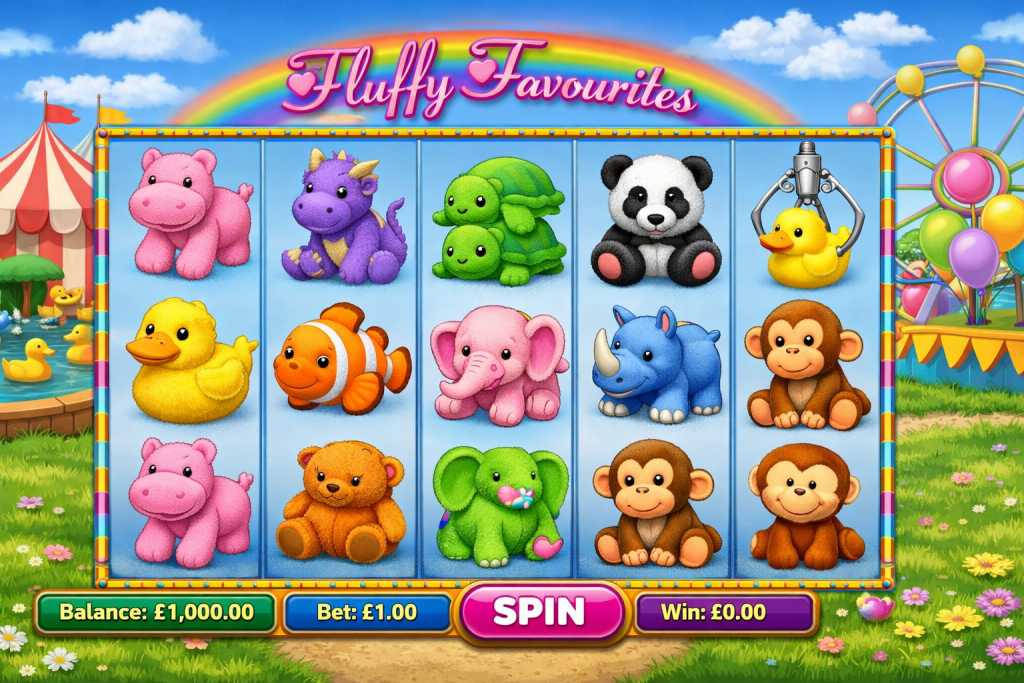
From the player’s perspective, Fluffy Favourites appears to offer a clean and uncomplicated interaction model. There are no side decisions to make, no bonus paths to choose between, and no moments where timing or reaction seem relevant. On the surface, this can feel liberating. In reality, it creates a very specific form of perceived agency that deserves closer examination.
The only meaningful variable the player can adjust is stake size. This choice affects scale, not structure. Higher bets increase the absolute size of wins and losses, but they do not alter the internal behaviour of the game. Feature frequency, symbol distribution, and outcome variance remain unchanged. The system does not respond to confidence, patience, or aggression. It simply applies the same logic at a different numerical level.
Despite this, many players report a strong sense of personal influence. This is not because the game encourages strategy, but because it removes obvious points of failure. There are no wrong decisions to make, and therefore no immediate feedback that challenges the illusion of control. When outcomes feel neutral rather than punitive, players are more likely to attribute continuation to choice rather than compulsion.
Another contributing factor is the absence of signalling. Because the game provides no indicators of imminent features or changing states, players are free to project meaning onto randomness. A cluster of pink elephants may feel suggestive, even though it carries no predictive value. The system neither confirms nor denies these interpretations, allowing them to persist unchallenged.
Bet sensitivity reinforces this illusion in subtle ways. Larger stakes produce more noticeable micro-wins and more emotionally salient losses. This heightened feedback can feel like increased engagement, even though the underlying probabilities are identical. The player experiences a stronger emotional response and may interpret that intensity as influence.
What Fluffy Favourites does particularly well is avoid exposing the limits of agency. There are no mechanics that explicitly demonstrate independence between spins, such as visible counters or progress resets. The system remains opaque, not through complexity, but through simplicity. It offers nothing to analyse, and therefore nothing to disprove.
From a behavioural standpoint, this is a powerful design choice. By giving the player control over presentation rather than outcome, the game satisfies the desire for participation without surrendering any structural authority. The interaction feels fair, personal, and calm, even though it is mechanically indifferent. Control exists, but only at the surface.
Part of a Pattern: Mechanical Identity Within the Fluffy Favourites Series
This is a compact “mechanics switchboard”: it shows what stays the same across releases and what flips hard enough to change session rhythm.
Whether the reel format is static or dynamically changing.
How layered the feature set is relative to the baseline release.
How the session rhythm reads in practice (calm vs dynamic).
To understand Fluffy Favourites fully, it must be viewed not only as an individual game but as part of a broader design lineage. Across the series, certain mechanical principles repeat with remarkable consistency. These are not thematic coincidences, but structural decisions that define the brand’s identity.
At the core of this identity is comfort. The games are designed to feel familiar within moments of play. Static grids, clear paylines, and restrained feature sets appear repeatedly. Complexity is avoided, not because it is undesirable, but because it interferes with predictability. The series prioritises recognisable behaviour over novelty.
Variants within the series introduce surface-level changes, but rarely disrupt the underlying logic. Remastered editions refine audiovisual elements without altering structural foundations. Thematic offshoots add new symbols or bonus presentations, yet preserve isolation between features and independence between spins. Even when mechanics are expanded, they are compartmentalised rather than integrated.
More radical adaptations, such as Megaways-style versions, do modify core systems. Variable reel heights and cascading wins introduce a different rhythm and a different volatility profile. However, even here, traces of the original philosophy remain. Features are still separated, progression remains minimal, and the emphasis on comfort persists despite increased complexity.
What distinguishes the original Fluffy Favourites is its purity. Without additional layers or experimental mechanics, it presents the series’ philosophy in its clearest form. There is no attempt to disguise structure through spectacle. The game does exactly what it appears to do, and nothing more.
This consistency is why the original remains relevant. While newer versions may attract attention through variation, the foundational release offers the most transparent example of the design principles at work. It demonstrates how engagement can be sustained through neutrality, how volatility can be masked without being reduced, and how player trust can be cultivated through restraint.
Seen in this context, Fluffy Favourites is not a novelty slot or a lightweight diversion. It is a template. Its mechanical identity lies in its refusal to escalate, to persuade, or to perform. Instead, it maintains equilibrium. For players seeking stimulation, this may feel uneventful. For designers and analysts, it reveals a disciplined approach to behavioural control that is both deliberate and effective.
What This Page Is, and What It Is Not
Before proceeding, it is important to establish the boundaries of this analysis. This page is not a review in the traditional sense. It does not assess graphics, sound design, or entertainment value. Nor does it function as a guide or strategy manual. There will be no advice on staking patterns, no speculation about timing, and no claims regarding optimal play. Those approaches misunderstand the nature of slot mechanics and overstate the player’s influence within a fixed probabilistic system.
Instead, this page is concerned with structure. Specifically, it examines how Fluffy Favourites is assembled as a system of rules, constraints, and behavioural cues. Mechanics, in this context, refers to the interaction between mathematical design and player perception. It is about how often events occur, how they are framed visually, and how their outcomes are distributed across time.
Equally important is what this page does not attempt to do. It does not anthropomorphise the game, assign intention to randomness, or suggest hidden states where none exist. Fluffy Favourites does not remember past spins, reward persistence, or punish impatience. Each spin is independent, and any impression of momentum is a product of presentation rather than probability. Recognising this distinction is essential to understanding the slot’s appeal.
This analysis also avoids promotional language. Terms such as “big wins”, “massive potential”, or “must-play” obscure more than they reveal. From a mechanical perspective, what matters is not the size of possible outcomes, but the conditions under which they occur and the frequency with which they are realistically encountered. Fluffy Favourites is designed to make those conditions feel distant without feeling inaccessible, a subtle but significant distinction.
Finally, this page assumes an attentive reader. The explanations that follow are not simplified to the point of distortion. Concepts such as volatility, feature isolation, and perception management are discussed directly, without metaphor or embellishment. The intention is to respect the reader’s intelligence and to provide a framework that can be applied beyond this single game.
By defining these limits at the outset, we can engage with Fluffy Favourites on its own terms. What emerges is not a story about cute animals or whimsical bonuses, but a study in controlled design. It is a reminder that even the most unassuming slots can reveal complex behavioural engineering when examined with sufficient care.
Clearing the Mechanical Fog: Frequently Asked Questions
Tap a question to reveal the full explanation.
Does Fluffy Favourites have low or high volatility?
Do free spins change the odds of winning?
Are the Toybox pick feature and free spins connected?
Does increasing the bet make features appear more often?
Is there any skill involved in playing Fluffy Favourites?
A Slot Built to Endure, Not to Impress
When viewed in isolation, Fluffy Favourites can appear almost unremarkable. There are no dramatic innovations, no layered bonus systems, and no mechanics that invite mastery or experimentation. Yet this apparent modesty is precisely what gives the game its distinctive mechanical strength. Fluffy Favourites is not designed to compete for attention in the short term. It is designed to survive prolonged exposure.
At every level of its construction, the game avoids escalation. It does not build tension through progression, nor does it attempt to manufacture excitement through artificial signals. Instead, it relies on consistency. Spins behave the same way today as they will tomorrow. Features arrive without ceremony and depart without consequence. Nothing accumulates, nothing carries forward, and nothing suggests that persistence will be rewarded with inevitability. This refusal to promise is central to the slot’s behavioural stability.
From a psychological perspective, this is a notable departure from more performative designs. Many modern slots rely on anticipation, near-misses, and visible meters to keep players emotionally invested. Fluffy Favourites removes these hooks almost entirely. What remains is a steady rhythm that neither flatters nor challenges the player. Engagement arises not from hope or frustration, but from familiarity.
This familiarity is often mistaken for fairness or safety. In reality, the game’s volatility remains intact. Risk has not been removed; it has been concealed. By presenting outcomes without dramatic framing, the slot reduces emotional response to variance. Losses feel less punitive, and wins feel less transformative. Over time, this emotional levelling encourages continuation, not because the player expects a breakthrough, but because nothing compels them to stop.
The separation of systems reinforces this effect. Base game, free spins, and pick features coexist without influencing one another. There is no sense of momentum, no feeling that one event sets the stage for the next. Each feature is a closed episode, and once it ends, it leaves no mechanical trace. This isolation prevents emotional carryover and limits the formation of narratives that might otherwise dominate player perception.
Crucially, Fluffy Favourites also avoids exposing the player to the limits of their agency. With no strategic decisions to make and no signals to interpret, there is little opportunity to feel mistaken or misled. The player participates without being tested. Control exists only at the level of stake and duration, and even that control does not alter the game’s internal logic. This creates a calm, almost neutral relationship between player and system.
In this sense, the slot represents a mature design philosophy. It does not seek to entertain through spectacle, nor does it attempt to disguise its randomness behind complexity. Instead, it embraces restraint as a means of behavioural regulation. The game persists by staying out of the way, allowing time to pass without friction.
For players who seek intensity, this approach may feel uneventful. For those who value predictability and emotional stability, it can be quietly absorbing. For analysts, it offers a clear example of how mechanical simplicity can coexist with psychological sophistication.
Fluffy Favourites ultimately demonstrates that a slot does not need to shout to be effective. By minimising drama, isolating systems, and masking volatility through presentation rather than mathematics, it achieves a form of endurance that more elaborate designs often lack. Its mechanics are not built to dazzle, but to remain. That, more than any individual feature, is its defining achievement.