
Fairground Fluffy Favourites: In-Depth Analysis of Base Play, Bonuses, and Session Dynamics
Slot Identity & Positioning
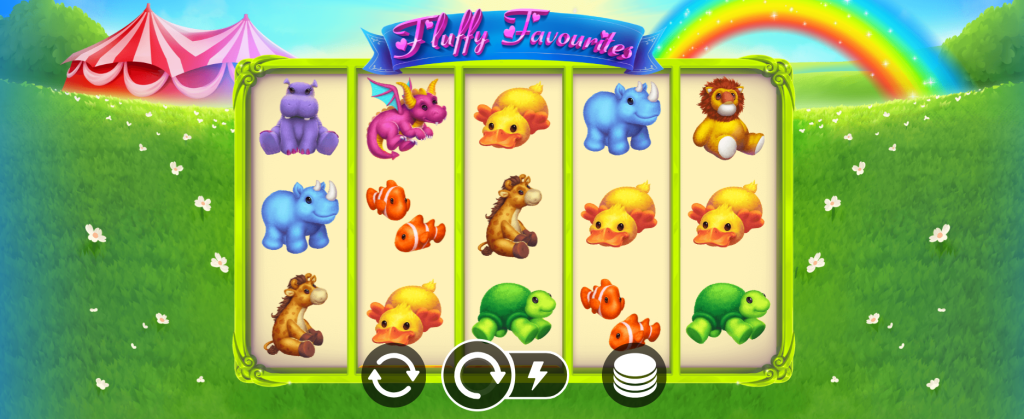
Fluffy Favourites: Fairground is a slot designed with a clear understanding of what many players are actually looking for: not novelty, not spectacle, but coherence. From the very first interaction, the game positions itself as something that does not require explanation. Its structure, pacing, and visual language immediately communicate a sense of order, suggesting that the experience will unfold within clearly defined boundaries.
This slot does not attempt to stand out by being different. Instead, it stands out by being recognisable. Its identity is anchored in familiarity, but not in a lazy or derivative sense. Rather, it reflects a deliberate design choice to prioritise stability over experimentation. The game signals that it will behave consistently, that its internal logic will not shift unexpectedly, and that players will not be required to renegotiate their understanding of the rules as the session progresses.
Within the broader landscape of modern slot games, Fluffy Favourites: Fairground occupies a space that is often underestimated: the space of psychological comfort. It is a game that reduces friction at entry. Players are not challenged to decode complex mechanics or adapt to multi-layered features. Instead, they are invited into a system that feels immediately manageable, even before the outcomes themselves are evaluated.
This positioning is especially relevant in the context of repeated play. Games built around novelty often exhaust their appeal quickly once the initial surprise fades. By contrast, Fluffy Favourites is structured to remain intelligible and dependable across multiple sessions. Its identity is not tied to discovery, but to return. The slot does not ask the player to remember what they learned last time; it assumes that understanding will persist naturally because the structure itself does not change.
Crucially, this does not mean the game lacks tension or engagement. Rather, it frames engagement differently. The appeal lies in anticipation within a known system, not in uncertainty about the system itself. This distinction is central to the game’s identity. Fluffy Favourites: Fairground presents itself as a slot where the player’s attention can remain focused on outcomes and timing, rather than on interpretation and adaptation.
Fairground Series Logic
Fairground Series Logic
The Fluffy Favourites series follows a consistent internal logic. These traits do not advertise features — they quietly shape how quickly a player understands, settles, and stays oriented during play.
Fixed structure
Clear bonus separation
Repeated mechanics
The Fairground series is built on a principle that is both simple and powerful: players feel more at ease when the structure of a game is predictable, even if its results are not. Across the series, this principle manifests as a consistent design language, a recurring mechanical framework, and a shared rhythm of play that remains stable from one title to the next.
Rather than treating each game as a standalone experiment, the Fairground series functions as a cohesive system. Each new entry reinforces the same underlying behavioural model. Players are encouraged to transfer expectations from previous experiences, confident that the fundamental logic will remain intact. This continuity significantly lowers the cognitive cost of engagement, allowing players to focus on timing and decision-making rather than comprehension.
At the heart of the Fairground logic is the separation between base play and heightened reward states. The series typically concentrates value into a clearly identifiable bonus mode, creating a straightforward narrative arc within each session. Base play establishes tempo and familiarity, while the bonus state introduces a temporary shift in intensity. Importantly, the transition between these states is always explicit. There is no ambiguity about when the game has entered a different mode of behaviour.
This clarity is not accidental. It reflects a broader commitment to transparency in design. The Fairground series avoids hidden mechanics and ambiguous triggers, favouring systems that can be understood through observation alone. Over time, players develop an intuitive sense of how the game behaves, when escalation is likely, and when a session has returned to its baseline state.
Fluffy Favourites: Fairground adheres closely to this series logic. It does not reinterpret the Fairground framework, nor does it attempt to stretch it in new directions. Instead, it refines the formula, presenting a disciplined execution of the same principles that define the series as a whole. The result is a game that feels immediately at home within the Fairground catalogue, reinforcing the sense that it belongs to a larger, coherent design philosophy.
From a behavioural perspective, this approach supports sustained engagement without demanding sustained attention. The player is not required to remain alert for unexpected changes in rules or mechanics. Instead, engagement is driven by rhythm, repetition, and anticipation within a stable system. Fluffy Favourites exemplifies this philosophy by offering a controlled, comprehensible experience that rewards familiarity rather than experimentation.
In this context, the game should not be viewed as an isolated product, but as a functional component within an established behavioural architecture. Its value lies not in how far it departs from the Fairground model, but in how confidently it inhabits it.
Core Game Structure
5×3 Slot Layout — how the eye reads it
The Fluffy Favourites grid never shifts. Reels stay left to right, rows stay top to bottom — once learned, the player follows motion, not structure.
The structural foundation of Fluffy Favourites: Fairground is intentionally orthodox. Its layout follows a configuration that has become a behavioural standard within the Fairground series, not because it is mathematically exceptional, but because it is cognitively efficient. The player is presented with a framework that requires no interpretation. From the first spin, it is immediately apparent how symbols interact, how wins are formed, and where the boundaries of the system lie.
This form of structural conservatism serves a specific psychological purpose. By eliminating ambiguity at the mechanical level, the game reduces the need for active problem-solving. Players are not encouraged to analyse or optimise the structure itself; instead, they are guided towards a passive but attentive mode of engagement. The game runs, resolves, and resets with a rhythm that is easy to internalise and difficult to misread.
Such clarity also shapes expectations around progression. Because the structure remains fixed, any sense of advancement must come from temporal factors rather than mechanical discovery. The player’s attention shifts from “how does this work?” to “when will something change?”. This is a subtle but important transition. It places emphasis on timing, anticipation, and session flow, rather than on mastery of complex systems.
The stability of the core structure also enables more accurate self-regulation. Players can quickly assess whether the game aligns with their preferences because there are no hidden layers that might emerge later. What is experienced in the opening minutes is broadly representative of the entire session. This transparency reduces frustration and supports informed continuation or disengagement, depending on the player’s goals.
Finally, the core structure acts as a neutral baseline against which all variations are measured. Because the underlying system is so consistent, even minor deviations — such as shifts in symbol behaviour or the activation of features — become perceptually salient. The structure itself does not compete for attention; it recedes into the background, allowing changes in state to carry greater psychological weight.
Visual & UX Design
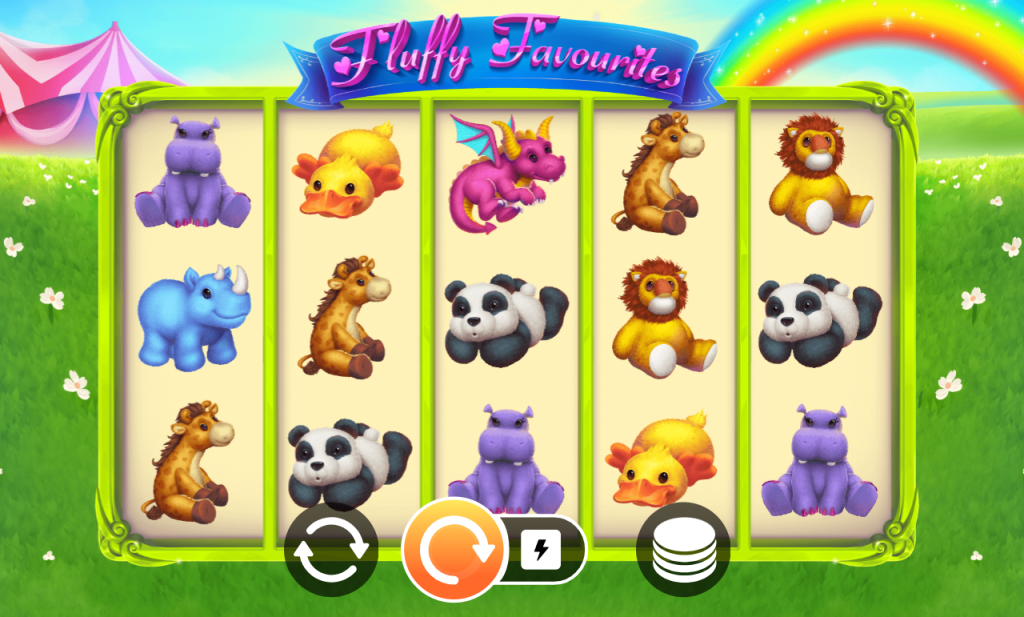
The visual and UX design of Fluffy Favourites: Fairground is best understood as a form of behavioural moderation. Every element on the screen appears calibrated to support calm interpretation rather than heightened emotional response. Colours are soft, contrasts are controlled, and animations are restrained. The result is a visual field that remains stable regardless of outcome frequency or session duration.
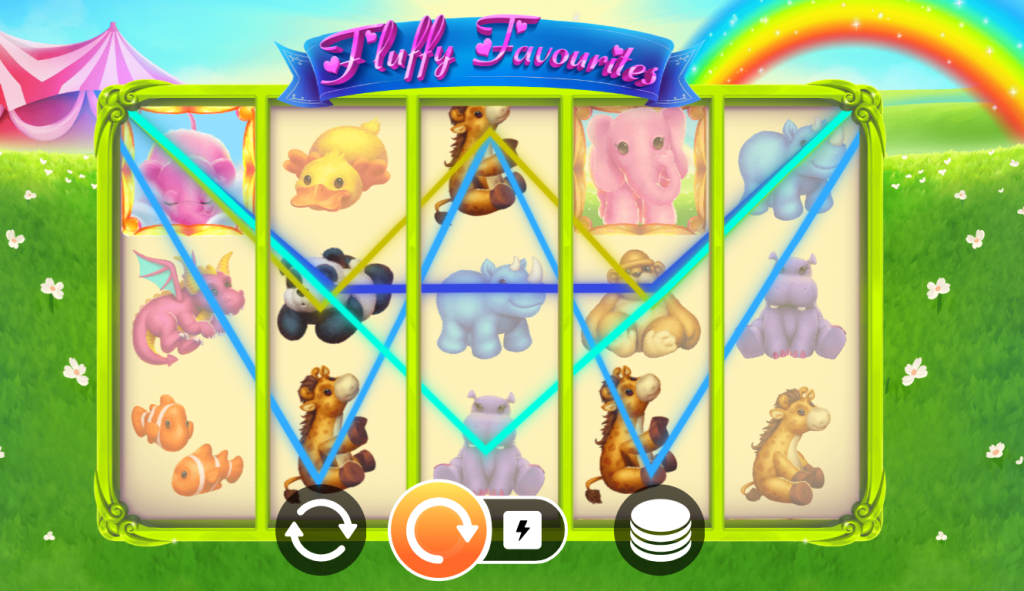
This design approach significantly influences how players process information. Visual simplicity reduces the time required to recognise patterns and outcomes, which in turn lowers cognitive fatigue. Wins and losses are registered quickly, without exaggerated emphasis. Over extended play, this contributes to a sense of continuity rather than escalation, making the experience feel measured rather than volatile.
Importantly, the UX design avoids artificial signals of urgency. There are no aggressive animations suggesting imminent success, no exaggerated visual cues that inflate the perceived significance of near-misses, and no disruptive transitions that break the flow of play. Instead, the interface maintains a consistent visual grammar, ensuring that the player’s emotional state is not pushed abruptly from one extreme to another.
This restraint also enhances trust. When visual feedback accurately reflects mechanical reality, players are less likely to misinterpret outcomes or overestimate significance. The game communicates what has happened without embellishment. In doing so, it reinforces the impression that the system is fair, legible, and internally coherent.
Taken together, the visual and UX design reinforce the same principle that underpins the core structure: reduction of friction. The player is not required to filter noise, decode symbolism, or manage competing stimuli. Attention can remain lightly focused, allowing engagement to persist without strain. In a landscape where many slots rely on sensory overload to sustain interest, Fluffy Favourites adopts a quieter, more disciplined approach — one that prioritises usability, stability, and sustained comfort over spectacle.
Base Game Behaviour
Session rhythm in the base game
The base game is built around a calm, repeatable loop. Instead of escalating every moment, it sustains motion and reserves intensity for clearly defined events.
Spin
Player action initiates the cycle without visual or cognitive friction.
Resolution
Small wins or neutral outcomes are acknowledged briefly, without breaking flow.
Reset
The visual state settles naturally back to baseline.
Continuity
No interruption — rhythm remains intact across spins.
Anticipation
The next spin feels expected, not forced or overstimulated.
The base game in Fluffy Favourites: Fairground is not designed to dominate the experience; it is designed to sustain it. Its primary function is to establish rhythm and maintain continuity, rather than to deliver peak moments. This distinction is central to understanding how the slot behaves over time. The base game operates as a controlled environment in which outcomes are frequent enough to keep attention engaged, yet modest enough to preserve the significance of larger events.
Rather than relying on prolonged periods of inactivity punctuated by sudden spikes, the game adopts a steadier cadence. Small wins, partial line hits, and regular visual confirmations of resolution create a sense of ongoing movement. Even when outcomes are unfavourable, the player is rarely left with the impression that nothing is happening. This is not accidental; it reflects a design choice aimed at maintaining perceptual activity without inflating reward magnitude.
From a behavioural standpoint, this approach supports shorter decision cycles. Players are less likely to disengage abruptly because each spin resolves quickly and clearly. There is little time for uncertainty or doubt to accumulate between outcomes. The game does not invite reflection after every loss; it simply moves forward, encouraging continuation through rhythm rather than promise.
The base game also functions as a preparatory phase. Its consistency allows anticipation to build gradually, not through overt signals, but through repetition. Over time, players become attuned to the pacing of the game, developing an intuitive sense of when a deviation from baseline might occur. This anticipation is not tied to specific triggers, but to the broader flow of play, making the eventual transition into a bonus state feel earned rather than arbitrary.
Crucially, the base game does not attempt to compete with the bonus mode for attention. It remains intentionally restrained, ensuring that its role as a stabilising force is preserved. In doing so, it supports a clear hierarchy of engagement: the base game sustains, while the bonus state defines. This separation allows the overall session to retain structure and coherence, even as outcomes fluctuate.
Payline Logic & Game Tempo
Payline density and perceived tempo
Paylines do more than calculate wins. They shape how often the game confirms that a spin is “resolved”, directly influencing rhythm, attention, and perceived speed.
Fewer active lines
Outcomes resolve less frequently, stretching attention over time. The space between noticeable events grows, making variance feel heavier and sessions quieter between moments of feedback.
25 paylines
Frequent resolution feedback keeps motion continuous. Even small wins confirm system activity, reinforcing flow and reducing the feeling of waiting between spins.
The use of a fixed set of paylines in Fluffy Favourites: Fairground is not merely a technical specification; it is a tempo-setting mechanism. Paylines determine not only how wins are calculated, but how frequently the game communicates feedback to the player. In this slot, the payline configuration is calibrated to maintain a steady stream of resolution without overwhelming the player with complexity.
A higher number of paylines increases the likelihood of partial or low-value outcomes, which in turn reinforces the perception of activity. In behavioural terms, this supports sustained engagement by reducing the length of inactive sequences. Players receive frequent confirmation that the system is responsive, even when returns are modest. This is particularly effective in maintaining attention during shorter sessions, where prolonged inactivity might otherwise prompt disengagement.
However, the design avoids tipping into excess. While outcomes are frequent, they are not exaggerated. The game does not rely on constant visual celebration to create the illusion of success. Instead, it allows the payline structure to quietly support momentum. Wins resolve, are acknowledged, and the game returns to its baseline state without unnecessary emphasis.
This balance between frequency and restraint is key to the slot’s tempo. The game progresses at a pace that feels deliberate rather than rushed. Spins follow one another smoothly, without extended pauses or disruptive transitions. The player is carried forward by continuity, not by urgency. This encourages a form of engagement that is measured and self-paced.
Over longer sessions, the payline logic contributes to a sense of stability. Because outcomes are distributed evenly across the structure, the player’s experience remains relatively consistent from one segment of play to the next. There are no sudden shifts in feedback density that might distort perception or inflate expectations. The tempo remains even, reinforcing the impression that the game operates within well-defined parameters.
Taken together, the base game behaviour and payline logic form the backbone of the Fluffy Favourites experience. They establish a rhythm that is both predictable and sustainable, ensuring that engagement is maintained through structure rather than spectacle. This measured tempo is a defining characteristic of the slot, shaping how it feels to play not just in moments of excitement, but across the entire session.
Substitute Feature (Fluffy Mechanic)
Symbol substitution — where it helps, and where it stops
Substitution in Fluffy Favourites is assistive, not dominant. The symbol supports completion, then steps back — preserving hierarchy rather than replacing it.
Original line
A standard line resolves on its own terms. No assistance is applied unless a clear opportunity exists.
Fluffy assists
The substitute appears only where it meaningfully completes the line. Certain symbols and states remain excluded.
Resolution
The line resolves, the help ends. The symbol does not persist beyond its function.
The substitute feature in Fluffy Favourites: Fairground is not designed as a spectacle, but as a regulatory mechanism. Its purpose is not to dominate the experience, but to subtly influence how outcomes are distributed across the base game and bonus phases. Unlike features that radically alter reel behaviour or introduce cascading complexity, this mechanic operates within clearly defined limits.
At its core, the substitute function increases symbolic flexibility. By allowing certain symbols to stand in for others, the game reduces the number of dead outcomes without collapsing the distinction between ordinary and valuable results. This is a critical balance. The mechanic smooths the experience, but it does not dissolve structure. There remain boundaries that the substitute feature does not cross, and those boundaries are essential to preserving the hierarchy of symbols and rewards.
From a behavioural perspective, this feature plays a quiet but important role in perception. It increases the frequency of resolved events without dramatically increasing their magnitude. Players encounter more moments of completion, more visual confirmations that the system is active and responsive. However, these moments rarely feel decisive on their own. Instead, they reinforce continuity, keeping the base game from feeling sparse or inert.
The substitute feature also contributes to emotional regulation. By preventing long sequences of unproductive spins, it reduces frustration without creating a false sense of momentum. The player remains aware that meaningful change is still contingent on entering a different game state. In this way, the feature supports engagement without undermining anticipation. It fills space without filling it too completely.
Importantly, the substitute mechanic does not obscure the underlying logic of the game. Its operation is visible and comprehensible. Players can observe when it contributes to an outcome and when it does not. This transparency reinforces trust in the system, ensuring that the feature is perceived as part of the game’s structure rather than as an unpredictable intervention.
In practical terms, the substitute feature acts as a form of pacing control. It maintains activity during base play while preserving the distinctiveness of the bonus phase. The game remains active, but not resolved. Progress is suggested, but not delivered. This tension between assistance and limitation is what allows the feature to support long-term engagement without diminishing the impact of escalation.
Bonus Trigger Behaviour
The trigger changes interpretation, not the interface
The same symbols remain on screen. What changes is the reading frame: baseline becomes tension, then a marked shift into a distinct bonus state.
Same symbol set
unchangedWhat the player reads
incrementalDistributed. The session feels steady; the interface does not demand monitoring.
Background expectation builds quietly through repetition, not through loud cues.
Results are read as incremental confirmation rather than a decisive turning point.
The manner in which Fluffy Favourites: Fairground approaches bonus triggering reflects its broader commitment to structural clarity. The transition from base play into a bonus state is neither abrupt nor ambiguous. Instead, it is framed as a clear behavioural shift, one that the player can recognise immediately as a change in rules rather than a continuation of the same pattern.
Bonus triggering is treated as an event, not a background occurrence. Visual cues, pacing changes, and momentary pauses in flow all signal that the game has entered a different mode of operation. This separation is essential. It ensures that the bonus does not blur into the base game, preserving its psychological weight and narrative significance within the session.
Equally important is the role of anticipation. The game allows tension to accumulate gradually through repetition rather than overt signalling. Near-misses and partial alignments do not overwhelm the player with exaggerated cues; they simply exist as part of the natural rhythm. Over time, this creates a background expectation that something may change, without forcing that expectation into constant awareness.
When the bonus is finally triggered, it feels earned rather than arbitrary. This perception is not tied to probability, but to structure. Because the base game has remained stable and restrained, the shift into a bonus state is experienced as a genuine departure from the norm. The player recognises that the rules have changed, and that outcomes will now be evaluated differently.
This clarity also protects against desensitisation. In games where bonuses occur too frequently or without sufficient contrast, their impact diminishes. In Fluffy Favourites, the bonus trigger retains its significance because it interrupts a well-established baseline. The game does not attempt to disguise this interruption; it highlights it.
From a session-level perspective, the bonus trigger functions as a pivot point. It marks a transition from maintenance to escalation, from rhythm to variation. Whether the bonus ultimately delivers substantial returns or not, its activation reshapes the emotional contour of the session. This is the point at which the game temporarily departs from its stabilising role and allows intensity to surface.
Together, the substitute feature and the bonus trigger behaviour illustrate how Fluffy Favourites manages change. One smooths the base experience, the other punctuates it. Neither operates in isolation. Instead, they form a coordinated system in which stability and escalation are carefully separated, ensuring that each retains its intended psychological effect.
Free Games Mode
The Free Games mode in Fluffy Favourites: Fairground represents a deliberate departure from the behavioural equilibrium established during base play. It is not merely an extension of the existing system, but a temporary reconfiguration of how outcomes are valued and experienced. The shift into this mode is defined less by visual spectacle and more by a change in underlying expectations.
Once activated, the Free Games mode alters the economic meaning of each spin. Outcomes that would feel modest during base play acquire greater weight, not because the structure becomes more complex, but because the rules governing value have shifted. This recalibration is central to the mode’s impact. The player does not need to learn new mechanics; they simply experience familiar interactions under heightened conditions.
Importantly, the Free Games mode maintains structural continuity. Reels, symbols, and paylines behave in recognisable ways, ensuring that the player’s existing understanding remains valid. This continuity prevents cognitive overload at the very moment when emotional arousal is likely to increase. The bonus state feels intense, but not chaotic. It amplifies what already exists rather than replacing it.
The mode also redefines the tempo of play. Spins acquire a greater sense of consequence, encouraging closer attention without demanding strategic input. Each outcome feels more meaningful, even when results are incremental. This heightened salience sustains engagement throughout the bonus sequence, ensuring that attention does not dissipate after the initial trigger.
Crucially, the Free Games mode is framed as a bounded experience. The player is aware that this heightened state is temporary. This awareness shapes behaviour, concentrating attention and reinforcing the sense that the current phase of play is distinct from the baseline. The bonus does not blur into the rest of the session; it stands apart as a clearly demarcated interval of intensified evaluation.
Retrigger System & Bonus Limits
Retrigger System & Bonus Limits
Retriggers add a second layer of anticipation inside Free Games: each spin can resolve value and also extend the state. The ceiling matters because it turns extension into controlled tension rather than an open-ended loop.
What the system adds
Retriggers create dual attention inside Free Games: each spin matters now, and also carries the possibility of continuation. That second layer sustains engagement without changing the symbol language.
Why the ceiling matters
The cap preserves definition. Extension can escalate, but it cannot become indefinite — preventing fatigue and protecting closure.
The retrigger system in Fluffy Favourites: Fairground introduces a secondary layer of anticipation within the Free Games mode. Rather than treating the bonus as a fixed-length event, the game allows for controlled extension, creating the possibility of prolonged engagement without surrendering structural discipline.
Retriggers operate as conditional reinforcements. Their potential presence encourages sustained attention throughout the bonus sequence, as each spin carries not only immediate value but also the possibility of continuation. This dual function enhances immersion, keeping the player oriented towards both present outcomes and future extension.
However, this system is not open-ended. The presence of a defined upper limit on retriggers is a critical design choice. By imposing a ceiling, the game preserves the integrity of the bonus as a temporary state. The player may experience a sense of escalation, but that escalation remains contained within known boundaries. This containment prevents the bonus from losing definition through excessive duration.
From a behavioural perspective, the retrigger limit serves an important regulatory function. It balances excitement with closure. Players are allowed to hope for extension, but not to assume it indefinitely. The bonus retains a sense of momentum without drifting into repetition or fatigue. When the limit is reached, the return to base play feels natural rather than abrupt.
The interaction between retriggers and limits also shapes the emotional contour of the bonus. Each extension reinforces the perception of progress, while the knowledge of a ceiling maintains tension. The player remains engaged precisely because the outcome is uncertain but not unbounded. This is a controlled form of variability, designed to sustain interest without overwhelming the session.
Taken together, the Free Games mode and its retrigger system define the peak state of Fluffy Favourites: Fairground. They introduce intensity without disorder, extension without excess, and anticipation without confusion. The bonus phase does not seek to eclipse the rest of the game; it punctuates it. In doing so, it preserves the overall coherence of the experience, ensuring that heightened moments remain meaningful precisely because they are limited.
Volatility & Session Flow
Volatility in Fluffy Favourites: Fairground is best understood not as a static label, but as a dynamic experience unfolding over time. The game does not present itself as immediately aggressive, nor does it attempt to disguise periods of lower return. Instead, it constructs volatility through contrast: long stretches of regulated stability interrupted by clearly marked phases of heightened potential.
Across a typical session, the flow follows a recognisable pattern. Base play establishes a steady rhythm, supported by frequent but modest resolutions. This creates a sense of continuity that encourages persistence without creating false urgency. The player is carried forward by repetition rather than escalation, allowing engagement to build gradually rather than spike prematurely.
What defines the game’s volatility is not how often outcomes occur, but where value is concentrated. Meaningful shifts in return are largely confined to the bonus state. As a result, the base game feels comparatively controlled, even when extended sequences produce limited returns. This separation ensures that volatility is experienced as episodic rather than constant, preserving emotional balance across the session.
From a behavioural standpoint, this structure supports a particular type of engagement. Players are less likely to experience abrupt emotional swings because the game avoids rapid alternation between extremes. Instead, tension accumulates slowly, released in discrete moments of escalation. The session feels segmented into phases, each with its own emotional texture, rather than as a continuous oscillation between gain and loss.
This phased flow also encourages temporal awareness. Players can sense when a session is in a maintenance phase versus a peak phase. Such awareness supports more deliberate interaction, as players are not continuously reacting to sudden changes in intensity. The game feels navigable rather than overwhelming, even when outcomes are unfavourable.
Ultimately, the volatility of Fluffy Favourites: Fairground is not designed to dominate attention. It is designed to structure it. By concentrating intensity into recognisable moments and maintaining stability elsewhere, the game creates a session flow that feels measured, comprehensible, and internally consistent. Volatility exists, but it is framed, contained, and predictable in its expression.
RTP Variants & Player Transparency
Session intensity
Volatility is felt as a contour, not a statistic. Base play stays steady, Free Games create a peak, and the return to baseline is part of the design.
One of the more understated aspects of Fluffy Favourites: Fairground is the presence of multiple RTP configurations. Rather than presenting a single, immutable return profile, the game exists in more than one mathematical form. This variability is not immediately visible during play, yet it has meaningful implications for player understanding and transparency.
The existence of RTP variants reflects the realities of modern slot distribution, where different operators may deploy different configurations of the same game. From a design perspective, this does not alter the structure, pacing, or behaviour of the slot. The experience feels the same at the surface level. However, the long-term statistical expectations differ, shaping outcomes across extended play.
What is significant here is not the numerical difference itself, but how it is communicated. Fluffy Favourites does not embed misleading cues or inflated claims within its presentation. The game’s interface remains neutral, placing responsibility on the player to consult available information rather than attempting to frame expectation through design.
This approach aligns with the broader Fairground philosophy of legibility. Just as mechanics and bonus behaviour are clearly delineated, so too is the existence of configurable parameters. Players who seek transparency are able to find it, while those who prefer not to engage with such details are not confronted with them during play.
From a behavioural perspective, this separation is important. It prevents mathematical expectation from intruding on moment-to-moment experience. The player interacts with the game as a system of outcomes and timing, not as a set of probabilities to be optimised. Transparency exists without becoming a source of cognitive burden.
In practical terms, RTP variation reinforces the idea that Fluffy Favourites: Fairground is a product designed to behave consistently within defined boundaries, even when underlying parameters differ. The structure remains stable, the flow remains familiar, and the experience remains legible. What changes is not how the game plays, but how it resolves over time.
By maintaining this distinction, the game supports informed engagement without demanding analytical involvement. Transparency is offered as an option, not imposed as a condition. This balance reflects a mature design approach, one that recognises the diversity of player preferences and allows understanding to coexist with simplicity.
FAQ — Common Questions About Fluffy Favourites: Fairground
Frequently asked questions
Short, behaviour-focused answers to common questions about Fluffy Favourites. These explain how the game behaves and feels in real sessions.
Who This Slot Is Really For
Fluffy Favourites: Fairground is best understood as a study in restraint. It is a slot that deliberately avoids excess — of mechanics, of visual stimulation, and of behavioural volatility. Instead, it offers a composed and internally consistent experience, one that places comprehension and continuity above spectacle. This is not an oversight or a limitation; it is the defining principle of the game.
The slot is designed for players who value clarity. Those who prefer to understand the structure of a game quickly, and to remain within that structure for the duration of a session, will find Fluffy Favourites particularly accommodating. Its rules do not evolve, its mechanics do not multiply, and its rhythm does not shift unpredictably. What the player encounters in the opening phase is representative of the experience as a whole.
At the same time, the game is not devoid of tension. Its intensity is carefully localised within the bonus phase, allowing periods of stability to coexist with moments of escalation. This separation gives the session a recognisable shape: preparation, anticipation, and release. For players who appreciate this form of pacing — where heightened moments are clearly defined rather than continuously present — the game provides a balanced and navigable experience.
Fluffy Favourites is also well suited to players seeking measured engagement. It accommodates both short, low-commitment sessions and longer periods of play without demanding sustained concentration or rapid decision-making. The slot does not pressure the player through constant stimulation; instead, it supports a steady interaction that can be entered and exited without disruption.
Conversely, players drawn to complexity, rapid variation, or highly erratic patterns may find the experience too contained. This is not a game that rewards exploration or adaptation. It rewards familiarity and recognition. Its appeal lies in returning to a system that behaves as expected, rather than uncovering new layers with each session.
In the context of the Fairground series, Fluffy Favourites: Fairground stands as a refined and disciplined entry. It demonstrates how a slot can remain engaging without expanding its scope, and how consistency itself can be a source of appeal. For players who value structure, legibility, and controlled pacing, it offers an experience that is quietly confident, deliberately measured, and designed to endure rather than impress.