
Too Fluffy Favourites: Playing Without Pressure in Modern Slots
A Familiar Face with a Clear Purpose: Why Fluffy Favourites Too Exists
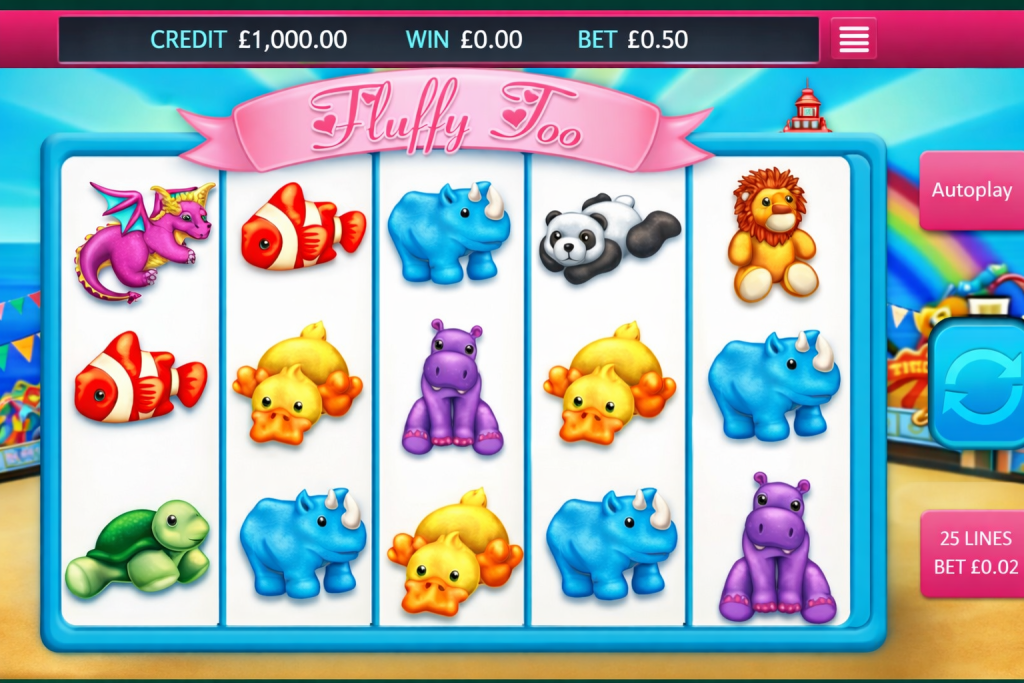
As someone who has spent decades examining how people interact with games, I tend to approach slot design less as entertainment spectacle and more as behavioural architecture. Fluffy Favourites Too is a good example of why that distinction matters. This game was not created to surprise the market or redefine the genre. It exists because a very specific type of slot player exists, and because that player consistently responds to predictability, comfort, and controlled pacing.
Fluffy Favourites Too continues a lineage that is intentionally conservative. From the first spin, it communicates safety rather than excitement. The visual language is friendly, the sound design avoids sharp peaks, and the underlying structure signals stability. Nothing here asks the player to learn, adapt, or re-evaluate. That is not a limitation; it is the core design decision.
This slot serves players who value rhythm over risk. Its purpose is not to generate memorable single moments, but to support long, uninterrupted sessions where nothing feels abrupt or punitive. Wins arrive often enough to maintain engagement, losses arrive quietly enough to avoid emotional spikes, and bonuses appear with sufficient regularity to break monotony without redefining the session.
What makes this interesting from an analytical perspective is that the game does not attempt to hide its intentions. Fluffy Favourites Too does not simulate tension, nor does it create artificial escalation. Instead, it offers a consistent experience where expectations are rarely violated. For a subset of players, particularly those engaging in mobile or background play, this consistency is not merely attractive; it is essential.
In that sense, the game functions less like a challenge and more like a service. It fills a space in the slot ecosystem that many modern releases have abandoned in favour of volatility and spectacle. Fluffy Favourites Too exists because there remains a large audience that prefers familiarity over intensity, and reliability over surprise.
Part of a Deliberate Lineage: Understanding Its Place in the Fluffy Series
How the experience stays familiar while the emphasis shifts
This comparison keeps the focus on design intent rather than judgement. It highlights what the earlier Fluffy titles typically emphasised, and what feels more characteristic in Fluffy Favourites Too during normal play.
| Feature focus | Earlier Fluffy titles | Fluffy Favourites Too |
|---|---|---|
| Session rhythm How the pace feels over time | Generally steady, with small bursts of activity used mainly to keep attention refreshed rather than to build tension. | Even more “flat” and reliable across long sessions, with fewer moments that noticeably change the emotional temperature. |
| Bonus role Interruption vs transformation | Bonuses act as light variety. They break repetition but rarely redefine the overall feel of play. | Bonuses read as an interruption that preserves continuity. The shift is subtle, and the return to base play feels smooth. |
| Perceived risk What “risk” feels like | Low-pressure play, with outcomes that tend to avoid sharp swings and keep frustration contained. | Risk feels even more domesticated: fewer stark contrasts, more frequent small reinforcement, less incentive to chase. |
| Cognitive load How much attention it asks for | Minimal learning curve. The interface and symbols are legible quickly, supporting casual and background play. | Still minimal, with an especially clean “read” on mobile. The game remains easy to follow even when played passively. |
| Reward texture Small returns vs standout moments | Frequent modest outcomes dominate, creating a sense of continuity rather than rare dramatic peaks. | Reinforces the same texture, leaning further into regular small returns and fewer session-defining highlights. |
| Theme function Mood shaping, not storytelling | Cute visuals reduce tension and soften loss perception, supporting longer sessions without fatigue. | The “comfort” layer feels more deliberate: softer mood, lower urgency, and a calmer overall sensory profile. |
To understand Fluffy Favourites Too properly, it must be viewed as part of a broader design ecosystem rather than as a standalone product. The Fluffy series has always been defined by restraint. Across its iterations, the core philosophy has remained remarkably stable: approachable themes, uncomplicated mechanics, and an emphasis on emotional comfort rather than competitive thrill.
Within that context, Fluffy Favourites Too does not introduce a new direction. Instead, it refines an existing one. Compared to earlier entries, the game slightly smooths pacing, subtly adjusts reward distribution, and modernises presentation without altering behaviour. This is not evolution in the dramatic sense, but in the maintenance sense. The series is being kept aligned with its audience rather than pushed toward a new one.
What the series consistently avoids is just as telling as what it includes. There are no layered bonus systems, no escalating modifiers, and no mechanics that demand attention or strategy. By resisting these trends, the Fluffy line maintains a clear identity. Players returning to the series are not looking for novelty; they are looking for reassurance that the experience they enjoyed previously still exists.
Fluffy Favourites Too reinforces this identity by positioning itself as a dependable continuation rather than an upgrade. It signals to returning players that their preferences are understood and respected. For new players, it acts as an accessible entry point into a style of slot play that prioritises ease and predictability.
From a behavioural standpoint, this consistency builds trust. When a player knows what to expect, cognitive load decreases, emotional regulation improves, and session length often increases. The Fluffy series capitalises on this by offering a recognisable structure across titles, allowing players to transfer expectations seamlessly from one game to the next.
In practical terms, Fluffy Favourites Too occupies the role of stabiliser within the wider slot landscape. It is not designed to compete with high-volatility titles for attention, but to coexist alongside them as a counterbalance. Its place in the series is not defined by innovation, but by continuity, and for its intended audience, that continuity is precisely the point.
The Quiet Engine Beneath the Surface: How the Base Game Really Works
Tap a step to see what the game is doing in that moment
The loop stays stable: the game does not accumulate progress or demand that you track a meter. Each step resolves cleanly and returns to the same baseline.
Spin
Step 1 · Input
The reels move and the result is presented quickly. The point is continuity: the game stays readable and does not create unnecessary drama.
Why it matters: This step sets the rhythm. A steady pace supports long sessions, particularly on mobile and autoplay.
When analysing Fluffy Favourites Too outside the marketing frame, the base game deserves far more attention than it usually receives. In many slots, the base game is merely a waiting room for bonus features. Here, it is the primary environment in which most player behaviour occurs. Understanding this layer is essential, because it defines the rhythm, emotional tone, and expectations long before any bonus sequence appears.
The structural simplicity is intentional. A familiar reel layout, clearly differentiated symbols, and an absence of visual noise create an environment where outcomes are immediately legible. Nothing competes for attention. This clarity reduces decision fatigue and allows the player to remain engaged without feeling mentally taxed. From a psychological perspective, this is one of the strongest predictors of extended session play.
Symbol distribution plays a subtle but important role. Lower-value symbols appear frequently enough to generate a steady stream of minor returns, while higher-value symbols are visually distinct but not framed as rare or aspirational. This balance avoids frustration without creating anticipation spikes. The result is a base game that feels active even when outcomes are modest.
Spin pacing is another key element. The game neither rushes nor lingers. Animations resolve quickly, but not abruptly. Wins are acknowledged without ceremony, losses pass quietly. Over time, this produces a smoothing effect on emotional response. Players are less likely to experience sharp emotional highs or lows, which in turn supports longer, more controlled engagement.
What is particularly notable is how the base game communicates fairness. There is no suggestion that something is being withheld, no prolonged dry spells designed to heighten anticipation. Instead, the game presents itself as transparent and consistent. Whether or not this reflects the underlying mathematics precisely is less important than the perception it creates. Players feel that what they see is what they get.
This design choice has consequences. Players who thrive on tension, escalation, or dramatic swings may find the experience flat. However, for the intended audience, the base game provides exactly what is sought: a stable, low-friction environment where play can continue without constant emotional recalibration.
Over extended sessions, this structure reveals its true function. The base game is not a prelude; it is the core experience. Bonus features, when they appear, act as interruptions rather than destinations. This inversion of the typical slot hierarchy is central to understanding why Fluffy Favourites Too behaves the way it does and why its audience responds so consistently to it.
Mathematical Mood and Perceived Generosity: Reading the Game’s Emotional Numbers
A steady climb built from small outcomes
This is a visual shorthand for how the slot can feel “generous” without dramatic spikes: frequent modest results create a smooth, upward rhythm rather than rare, extreme peaks.
Reading this chart: the slope rises smoothly because the “wins” are frequent and modest. The absence of sharp peaks is the point: the game can feel generous through rhythm rather than through rare, dramatic events.
Players rarely experience mathematics directly. What they experience instead is mood. In Fluffy Favourites Too, the mathematical design is engineered to produce a specific emotional atmosphere rather than a specific pattern of outcomes. This atmosphere can be described as calm, forgiving, and predictable, even when the underlying numbers do not necessarily support that interpretation.
Hit frequency is a critical factor here. Wins occur often enough to break sequences of losses before they become emotionally salient. These wins are usually small, sometimes barely exceeding the stake, but their regularity creates a sense of continuity. From a behavioural standpoint, frequent low-level reinforcement is one of the most effective ways to sustain engagement without triggering over-arousal.
Equally important is the distribution of non-winning spins. Losing outcomes are not clustered in a way that draws attention to absence. They are interspersed with near-neutral results, such as partial line hits or visually engaging but low-paying combinations. This reduces the perception of risk even when the balance is slowly declining.
The payout profile reinforces this impression. There are few dramatic jumps. Instead, returns accumulate gradually, often offsetting losses rather than surpassing them. This creates what many players interpret as generosity, even though the net result may be modest. The key is that the game rarely feels punitive.
From an analytical perspective, this is where perception diverges from reality. A mathematically average session may feel subjectively positive because the emotional markers of loss are softened. Players are less likely to recall individual negative outcomes and more likely to remember the overall smoothness of the experience.
This effect is amplified by the absence of strong contrast. In slots where rare large wins exist, every non-winning spin is implicitly compared against that possibility. In Fluffy Favourites Too, such comparisons are muted. There is little sense of missing out on something larger, which reduces frustration and impatience.
Over time, this mathematical mood shapes player behaviour. Session length tends to increase, stakes remain stable, and decision-making becomes more automatic. The game encourages continuity rather than escalation. For many players, this aligns with their goals: background play, relaxation, and avoidance of emotional volatility.
It is important to note that this design does not aim to deceive. Rather, it aligns mathematical structure with emotional outcome. The numbers are arranged to support a particular style of play, and the game communicates that style clearly. Players who enter expecting excitement may be disappointed, but players seeking steadiness will find their expectations met with remarkable consistency.
In this sense, the mathematics of Fluffy Favourites Too function less as a challenge and more as a regulator. They guide emotional response, shape perception, and maintain equilibrium. For a slot built on comfort and familiarity, this alignment between numbers and mood is not accidental. It is the foundation on which the entire experience rests.
Patterns Over Moments: How Behaviour Emerges Across a Full Session
A timeline you can tap: calm phases, not dramatic swings
Tap any segment to see what that phase typically feels like. The pattern is the point: activity stays controlled, “quiet” runs are short and unremarkable, and variation is mild rather than explosive.
Active spins
active spinsFrequent small reinforcement keeps attention engaged. The pace stays steady rather than urgent.
When viewed spin by spin, Fluffy Favourites Too can appear uneventful. Its behavioural character only becomes visible when examined across time. This is a game that reveals itself through repetition rather than through isolated events, and its true structure emerges only once a player settles into a sustained session.
One of the most distinctive features of the game’s behaviour is the absence of escalation. Many modern slots are built around rising intensity: longer losing runs, sharper contrasts, and sudden reward spikes. Here, the experience remains comparatively flat. Activity is distributed evenly, with no prolonged droughts and no sudden bursts designed to reset emotional attention. This creates a behavioural pattern that is cyclical rather than progressive.
The session tends to move through gentle phases rather than defined stages. There are periods where small wins cluster, followed by quieter stretches where outcomes resolve quickly and without visual emphasis. Importantly, these quieter stretches are rarely long enough to be interpreted as punishment. They feel transitional rather than corrective, allowing the player to remain emotionally neutral.
What this produces is a form of passive engagement. The player does not wait for something specific to happen. Instead, they remain present because nothing actively pushes them away. In behavioural terms, this is a powerful retention mechanism. Discomfort is one of the strongest triggers for session termination, and Fluffy Favourites Too minimises discomfort almost entirely.
Another notable aspect is how the game handles anticipation. There are no mechanics that suggest imminent change. Scatter symbols appear without ceremony, near-misses are visually understated, and bonus triggers do not follow observable build-up patterns. This removes the sense that a reward is being delayed or earned. Instead, rewards simply occur when they occur.
Over time, this shapes expectation. Players stop tracking outcomes closely and begin to operate on feel rather than calculation. Decisions such as whether to continue, adjust stake, or end a session are made less consciously. The game becomes background rather than focal, which is precisely where its behavioural strength lies.
This pattern also explains why the game divides opinion. Players seeking stimulation, progression, or narrative will find little to hold onto. However, players who value stability will experience the game as unusually calm and reliable. Behaviourally, it functions as a low-noise environment, and in a market increasingly defined by intensity, that restraint becomes its defining feature.
Bonus Features in Context: Interruption, Not Transformation
The feature is a variation, not a climax
Use the panels to compare what stays consistent and what shifts slightly when the bonus arrives. The differences are real, but they are designed to feel controlled rather than dramatic.
Base game
baselinePace
Steady, readable, and designed for repetition without urgency.
Outcomes resolve quickly and predictably. The point is flow: the game is comfortable to keep running without demanding attention.
Emotional impact
Low-pressure reinforcement with minimal spikes.
Small outcomes arrive often enough to keep the session feeling “alive”, while losses pass without exaggerated negative framing.
Payout behaviour
Frequent modest returns that support continuity over contrast.
The base game rarely produces session-defining moments. Its role is to maintain rhythm, not to create a single peak that reframes the session.
Bonus feature
variationPace
Slightly more eventful, but still controlled and consistent.
The feature adds movement and texture, yet avoids a dramatic tempo change. The session does not feel “reset” by the bonus.
Emotional impact
A mild lift rather than a high-tension moment.
The bonus is framed as a gentle deviation. It refreshes attention without creating expectations that the base game cannot sustain afterwards.
Payout behaviour
More opportunity for improvement, but the texture stays “small-to-mid”.
The feature can increase returns, yet it is not designed to create a single dramatic peak. It behaves like an extension of the same ecosystem.
In Fluffy Favourites Too, bonus features exist, but they do not redefine the experience. This is a critical distinction. Rather than acting as climactic moments, bonuses function as temporary deviations from the established rhythm. They are interruptions, not transformations, and understanding this framing is essential to interpreting their real value.
Free spins are triggered without fanfare. There is no prolonged build-up, no dramatic audiovisual shift, and no sense that the game has entered a fundamentally different mode. The reels continue to behave in largely familiar ways, and while returns may increase marginally, the underlying pacing remains intact.
This continuity is deliberate. By keeping the bonus environment closely aligned with the base game, the designers avoid creating sharp contrasts that might disrupt emotional regulation. The player is not pulled into a heightened state only to be dropped back into calm. Instead, the transition is smooth, almost understated.
Wild symbols play a supportive role rather than a dominant one. They enhance outcomes when they appear, but they do not drive the bonus experience. There is no accumulation mechanic, no expanding behaviour, and no sense of compounding advantage. Each spin remains largely independent, reinforcing the idea that bonuses are moments of variation rather than opportunities for leverage.
Retriggers, when they occur, extend time rather than value. They lengthen the interruption without significantly increasing its intensity. This further supports the game’s overarching behavioural goal: maintaining equilibrium. Even within the bonus feature, volatility is restrained.
From a psychological perspective, this approach reduces disappointment. In games where bonuses promise transformation, players often experience frustration when outcomes fail to meet inflated expectations. Here, expectations remain modest. The bonus delivers exactly what the rest of the game has trained the player to expect: continuity with slight variation.
This also affects memory. Players are less likely to recall specific bonus events because they do not stand out sharply from the surrounding play. Instead, the bonus blends into the session as one of many minor fluctuations. The experience is remembered as smooth rather than segmented.
Ultimately, the bonus features reinforce rather than disrupt the game’s identity. They provide relief from repetition without challenging the established rhythm. For players aligned with the game’s philosophy, this consistency is reassuring. For others, it may feel anticlimactic. But viewed within the broader behavioural architecture of Fluffy Favourites Too, the bonuses do exactly what they are meant to do: maintain balance, avoid excess, and keep the session moving forward without emotional shock.
The Bonus Cycle as a System: Before, During, and After the Feature
A closed loop: the bonus arrives, then the system resumes
Tap a segment of the ring to see how each stage behaves. The diagram reinforces a simple point: the game does not create a dramatic “before and after” split. The bonus is an interruption that returns you to the same baseline.
Pre-bonus neutrality
pre-bonus neutralityThe game does not push a “you are close” narrative. Outcomes resolve cleanly, and the session stays emotionally even. The absence of build-up reduces chasing behaviour and keeps expectation modest.
When bonus features are analysed in isolation, much of their behavioural impact is missed. In Fluffy Favourites Too, the more revealing question is not what happens during a bonus, but how the game behaves around it. The bonus cycle here is not a peak; it is a modulation within a broader system, and its influence extends both backwards and forwards in time.
Before a bonus triggers, the game does very little to signal anticipation. Scatter symbols appear without dramatic emphasis, and there is no visible narrative that suggests a feature is approaching. This absence of forewarning is significant. It prevents the formation of expectation and, by extension, the frustration that often follows unmet anticipation. Players are not encouraged to believe they are “close” to anything.
This design choice shapes behaviour subtly. Without a sense of progress toward a bonus, players are less likely to chase outcomes or reinterpret losses as necessary steps. Each spin remains self-contained. The bonus arrives as an event, not a culmination. From a psychological standpoint, this reduces both cognitive distortion and emotional investment in future outcomes.
During the bonus, continuity is preserved. The reels behave familiarly, the visual environment remains consistent, and the pacing does not accelerate. Even when returns improve, the improvement feels incremental rather than transformative. The bonus does not redefine the session; it momentarily reshapes it.
What is perhaps most revealing is what happens immediately after the bonus concludes. In many slots, post-bonus play is characterised by a noticeable downturn, often experienced by players as a corrective phase. Here, the transition back to the base game is deliberately understated. There is no abrupt shift in tone or behaviour, and outcomes continue to resolve with the same calm regularity as before.
This lack of contrast serves an important function. It prevents the bonus from becoming a reference point against which all subsequent play is judged. The session does not fracture into “before” and “after” states. Instead, the bonus is absorbed into the overall experience, leaving no strong emotional residue.
Viewed as a system, the bonus cycle in Fluffy Favourites Too acts as a soft interruption that refreshes attention without destabilising behaviour. It neither promises nor delivers transformation. Its value lies in variation, not escalation. For players attuned to the game’s rhythm, this restraint supports continuity and reduces the likelihood of emotionally driven decisions following feature play.
Volatility, RTP, and the Lived Experience of Risk
Translate volatility into how the session feels
This scale avoids technical jargon. Tap a point to see what each risk level usually means in practice, in terms of tension, pacing, and how sharply outcomes swing.
Low tension
low tensionOutcomes feel calm and readable. Small wins appear often enough to keep the session moving, and losing sequences rarely feel sharp or punishing.
Technical measures such as volatility and return-to-player percentages are often discussed as abstract properties. In practice, players encounter them as sensations: tension, comfort, uncertainty, or control. In Fluffy Favourites Too, these parameters are configured to produce a specific lived experience of risk, one that is muted, predictable, and carefully bounded.
Volatility here operates at a low to moderate level, but more importantly, it is distributed evenly. There are no prolonged losing sequences designed to heighten contrast, nor are there rare, extreme outcomes that redefine a session. Risk is present, but it is rarely foregrounded. Losses occur gradually, and gains arrive in modest increments.
This creates an experience where bankroll decline is often perceived rather than observed. Players may continue playing for extended periods without a strong sense of depletion, even as their balance slowly decreases. From a behavioural perspective, this perception matters more than the numerical reality. It reduces urgency and discourages impulsive stake adjustments.
RTP functions in a similar way. While the percentage itself remains a long-term average, the way it manifests during play is what shapes behaviour. In this game, RTP expresses itself through frequent partial returns rather than through occasional significant recoveries. The player feels engaged in a constant exchange rather than a sequence of bets.
This structure also affects emotional resilience. Because outcomes rarely swing dramatically, players are less likely to experience regret or frustration linked to specific moments. There is little sense of having missed an opportunity or made a costly mistake. Each decision feels relatively inconsequential, which encourages persistence.
It is worth noting that this configuration does not suit all players. Those who seek sharp contrast, high tension, or the possibility of dramatic reversals may interpret the experience as flat or unrewarding. However, for players who value stability, the restrained expression of volatility and RTP creates a sense of safety.
In effect, risk is present but domesticated. It exists as a background condition rather than a focal challenge. The game does not ask the player to manage risk actively; it manages it on the player’s behalf. This delegation is central to the game’s appeal and explains why it supports long, steady sessions without provoking emotional fatigue.
Taken together, the volatility profile and the way RTP is expressed reinforce the broader identity of Fluffy Favourites Too. They align mathematical structure with emotional outcome, ensuring that the experience of risk remains consistent with the game’s overarching promise of comfort, continuity, and control.
Designed for Staying Power: UX Decisions and Mobile Behaviour
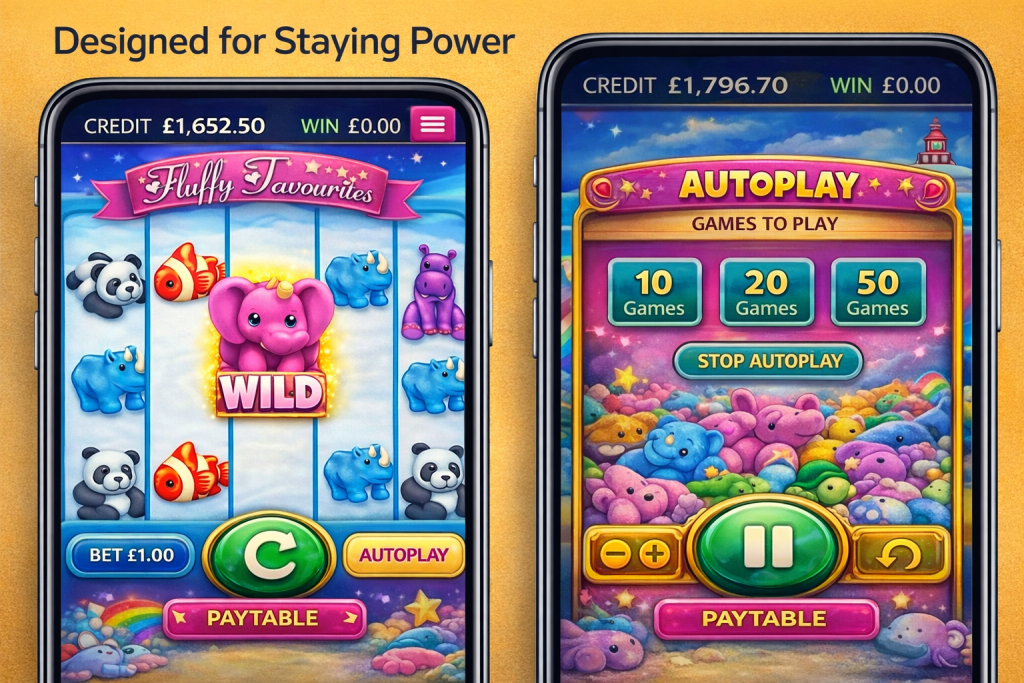
User experience in Fluffy Favourites Too is not decorative; it is functional. Every interface decision appears to have been made with session longevity in mind rather than visual impact. This becomes especially apparent when the game is played on mobile devices, where attention is fragmented and tolerance for friction is low.
The interface is immediately readable. Buttons are large, clearly separated, and placed where habitual mobile users expect them to be. There is no need for adjustment or exploration. This reduces the initial cognitive cost of engagement, which is often a decisive factor in whether a player settles into a session or abandons it early. In this game, entry is frictionless.
Spin resolution is another crucial element. Animations are short and consistent, with no unnecessary flourishes. The game avoids prolonged celebrations, even on winning outcomes. This keeps the pace steady and prevents interruptions to flow. On mobile, where players may be multitasking or playing in short bursts, this restraint is particularly effective.
Autoplay functionality reinforces this design philosophy. It is stable, predictable, and unobtrusive. Once activated, the game effectively runs itself, allowing the player to remain present without active input. This is not an accident. Autoplay in Fluffy Favourites Too is not a convenience feature; it is a core engagement mode. The game is designed to be watched as much as it is played.
Visual contrast is carefully controlled. Colours are soft, transitions are smooth, and nothing flashes aggressively or demands immediate attention. This reduces sensory fatigue, which is one of the most common reasons players disengage during longer sessions. The game does not compete with the player’s environment; it coexists with it.
Importantly, the UX avoids signalling urgency. There are no timers, no escalating prompts, and no visual cues suggesting that action is required. The player is never rushed. This absence of pressure supports a relaxed interaction style, particularly well suited to casual mobile play.
Taken together, these UX decisions transform the game into a low-demand digital space. It is easy to enter, easy to remain within, and easy to exit without emotional residue. For a slot built around comfort and continuity, this design coherence is not merely competent; it is essential.
Comfort as Strategy: The Psychology Behind Cute-Themed Slots
Why “cute” changes behaviour, not just aesthetics
Cute themes are often treated as decoration. In practice, they can lower perceived risk, soften frustration, and make long sessions feel easier to sustain. Tap a mode below to see the contrast.
High-stimulus slots
higher arousalComfort-driven slots
lower strainHigh-stimulus slots
higher arousalHigh-stimulus design increases arousal and makes outcomes feel more consequential. That can be engaging, but it also raises fatigue and makes frustration arrive sooner during long sessions.
The visual softness of Fluffy Favourites Too is often dismissed as superficial. In reality, it plays a central role in shaping player behaviour. Cute-themed slots operate on a different psychological register from darker, more aggressive designs, and their effects are both measurable and predictable.
Soft imagery lowers perceived risk. Friendly characters, rounded shapes, and warm colours create an environment that feels non-threatening. This does not change the underlying probabilities, but it changes how those probabilities are felt. Losses seem less severe, outcomes feel less consequential, and the overall experience is interpreted as safer than it actually is.
This has a direct impact on emotional regulation. Players are less likely to experience frustration or anger in response to negative outcomes. Instead, disappointment is muted, often reframed as neutral continuation rather than failure. Over time, this reduces emotional fatigue and supports extended play.
Cute themes also disrupt traditional gambling narratives. There is no hero’s journey, no conquest, and no implied mastery. The game does not suggest that skill, insight, or perseverance will be rewarded with transformation. Instead, it presents play as a gentle, repetitive activity without a narrative arc. This removes pressure and lowers expectations.
From a behavioural perspective, this environment encourages passive persistence. Players remain engaged not because they are chasing a goal, but because nothing actively discourages them. The game becomes a companion rather than a challenge. This is particularly appealing to players who use slots as a form of relaxation or background activity.
There is also an important memory effect. Sessions played in low-arousal environments are often recalled as shorter and less intense than they actually were. Time feels compressed. This can make the experience subjectively efficient and pleasant, even when objective measures such as duration or spend suggest otherwise.
It is important to stress that this design is not accidental or naive. Cute-themed slots like Fluffy Favourites Too are carefully calibrated to produce specific emotional outcomes. They reduce anxiety, soften disappointment, and normalise continuity. For their intended audience, this alignment between theme and behaviour creates a sense of trust.
In the broader context of slot design, such games fulfil a stabilising role. They offer an alternative to intensity, providing a space where play is gentle, predictable, and emotionally contained. For players who value calm over excitement, this psychological comfort is not a side effect. It is the primary appeal.
Who This Game Serves Well, and Who It Quietly Pushes Away
A quick fit check before you commit to a session
This matrix is deliberately plain-spoken: it helps you decide whether the slot’s calm rhythm and restrained volatility match what you want today. Tap a card to see the reasoning, or filter the view by fit level.
Ideal fit: long, calm sessions
ideal fitYou want steady play that stays readable and emotionally quiet. The slot’s rhythm supports extended sessions without demanding attention or creating high-tension swings.
Every slot, whether intentionally or not, makes a statement about the kind of player it is designed for. Fluffy Favourites Too is unusually clear in this regard. Its strengths become apparent only when the expectations of the player align with the assumptions built into the game’s structure. When they do not, the experience can feel oddly hollow.
This game is well suited to players who value continuity over excitement. Those who approach slots as a form of low-effort engagement, something to accompany another activity or to fill time without demanding focus, are likely to feel comfortable here. The game does not require vigilance. It does not punish inattention. A player can step away mentally and return without feeling lost or disadvantaged.
It also suits players who prefer emotional stability. Individuals who are sensitive to sharp losses, dramatic swings, or intense audiovisual stimulation often find high-volatility slots exhausting. Fluffy Favourites Too avoids these stressors. Its emotional range is narrow by design, and for many players, that narrowness is calming rather than restrictive.
The game also aligns well with fixed-stake players. Because it does not encourage escalation or suggest that higher stakes unlock qualitatively different experiences, it supports consistency. Players who prefer to choose a stake and remain with it throughout a session are unlikely to feel pressured to adjust.
By contrast, the game quietly discourages players who seek narrative progression or mechanical depth. There is no sense of advancement, no mastery curve, and no reward for sustained engagement beyond continuity itself. Players who enjoy analysing mechanics, anticipating patterns, or optimising decisions will find little to work with.
Similarly, those drawn to high-impact moments may struggle to connect with the experience. The absence of dramatic wins or transformative bonuses means there are few standout events to anchor memory or justify extended play in retrospect. For some, this will feel honest. For others, it will feel unrewarding.
In effect, Fluffy Favourites Too does not attempt to broaden its appeal. It narrows it deliberately. It offers a stable, low-pressure environment and trusts that the right players will recognise its value. Those who do not are not actively excluded, but they are given little reason to stay. This quiet selectivity is one of the game’s defining characteristics.
Fluffy Favourites Too: Clear Answers, No Distractions
Tap a question to reveal the answer
Short, practical answers to the most common questions about how Fluffy Favourites Too behaves during normal play.
| Question |
|---|
|
Yes. The game is built around steady pacing, restrained volatility, and low emotional intensity, which makes it comfortable for extended sessions without fatigue. |
|
No. Bonuses add variation rather than transformation. They momentarily interrupt the base rhythm but do not alter the overall behaviour of the slot. |
|
No. The design prioritises frequent, modest returns over rare, dramatic outcomes, reinforcing a sense of continuity rather than escalation. |
|
Yes. The interface, animation speed, and autoplay behaviour are clearly optimised for mobile play and background sessions. |
|
Generally not. Fluffy Favourites Too is designed for calm, low-pressure play rather than high-stimulation experiences. |
Fluffy Favourites Too and the Value of Playing Without Pressure
After examining Fluffy Favourites Too in detail, what stands out most is not any single mechanic, feature, or statistical parameter, but the coherence of its intent. This is a game that knows exactly what it is trying to be, and more importantly, what it is not trying to be. In an industry increasingly driven by escalation, spectacle, and intensity, that clarity is unusually refreshing.
Fluffy Favourites Too does not attempt to capture attention through drama. It does not promise transformation, mastery, or moments of triumph that redefine a session. Instead, it offers something far less glamorous and far more deliberate: stability. Every design decision, from pacing and volatility to visual tone and bonus structure, reinforces a single idea that runs quietly through the entire experience. Play should feel manageable, predictable, and emotionally contained.
From a behavioural perspective, this makes the game highly consistent. It does not invite chasing behaviour, nor does it provoke frustration through prolonged deprivation or exaggerated contrast. Losses occur gently, wins arrive frequently enough to sustain engagement, and bonuses act as mild variations rather than emotional turning points. The result is a slot that rarely surprises, but also rarely disappoints its intended audience.
This consistency comes at a cost. Players seeking stimulation, narrative progression, or moments of intensity will likely find the experience underwhelming. There is little here to analyse, optimise, or overcome. The game does not reward vigilance or insight, and it offers no illusion of control beyond the most basic parameters. For some players, that absence will feel empty.
However, for others, it is precisely the appeal. Fluffy Favourites Too respects the desire to play without being challenged, to remain engaged without being provoked, and to occupy time without emotional strain. It functions almost as a background system, one that can run alongside other activities without demanding focus or generating stress.
In this sense, the game serves a role that is often undervalued in discussions of slot design. Not every product needs to be exciting. Some are designed to be reliable. Some are designed to feel safe. Fluffy Favourites Too belongs firmly in that category. It does not compete for attention with high-volatility titles; it complements them by offering an alternative mode of play.
Ultimately, the success of this slot depends entirely on alignment. When player expectations match the game’s restrained philosophy, the experience feels smooth, honest, and coherent. When they do not, the game feels flat. There is little ambiguity here, and that transparency is perhaps its most commendable quality.
Fluffy Favourites Too does not ask the player to invest emotionally or cognitively. It asks only for time, and in return, it offers predictability, comfort, and continuity. In a market where intensity is often mistaken for value, that quiet proposition remains surprisingly durable.