
Remastered Fluffy Favourites: How RTP, Rhythm and Design Shape Slot Behaviour
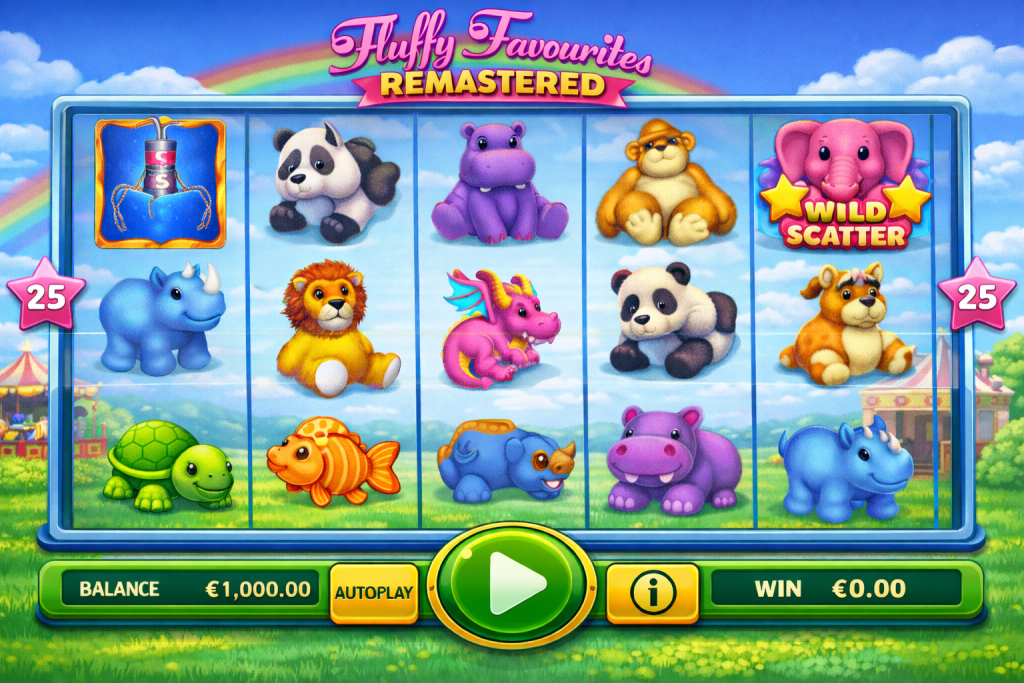
A Familiar Face, Rebuilt for a Different Era
I have spent much of my academic life examining how games structure attention, expectation, and reward. When I look at Fluffy Favourites Remastered, I am not interested in whether it is “cute”, popular, or nostalgic. What interests me is why a game that appears so visually benign can generate such prolonged engagement, and why its remastered form behaves differently from the version many players think they already know.
The Fluffy Favourites series occupies a curious place in modern slot design. On the surface, it presents a soft, almost disarming aesthetic: domestic animals, pastel colours, and an interface that feels closer to a casual mobile game than a high-risk gambling product. That surface, however, is precisely what makes the remastered edition worthy of closer scrutiny. This is not a cosmetic update designed merely to modernise graphics. It is a recalibration of pacing, volatility, and reward delivery that subtly alters how players experience time, loss, and anticipation.
Remastered versions of legacy slots often exist to solve a practical problem. Player expectations change, devices change, and attention spans shift. What worked ten years ago can feel sluggish or opaque today. In this case, the remaster does not attempt to reinvent the underlying identity of Fluffy Favourites. Instead, it refines it. The result is a game that feels more deliberate in how it withholds and releases value, and more consistent in how it trains players to tolerate extended sequences of low stimulation in exchange for occasional, emotionally salient events.
It is important to be clear about what this page is, and what it is not. This is not an encouragement to play, nor a promise of outcomes. It is an examination of structure. The question is not “can you win?”, but “how does this game organise your experience while you play?”. For readers who enjoy understanding systems rather than chasing anecdotes, Fluffy Favourites Remastered is an unusually transparent example of contemporary slot design philosophy.
What makes this version particularly interesting is that many players approach it with pre-existing assumptions. They believe they know how Fluffy Favourites behaves. The remastered edition quietly challenges that belief. Small changes in rhythm and balance can significantly alter how long sessions last, how losses are perceived, and how hope is maintained. Those changes are easy to miss if one looks only at features. They become obvious when one looks at behaviour.
The sections that follow are written with that perspective in mind. They are intended for readers who want to understand why this game feels the way it does, and why its simplicity is far more engineered than it appears.
Inside the Machine: How the Core Structure Shapes Experience
The base loop resets every time
Quick resolution, minimal feedback, and no carry-over between spins. The “quiet” feeling is engineered.
Spin
One action starts the cycle.
Immediate resolution
The outcome is decided and shown quickly.
Reset
No persistent state: nothing “builds” between spins.
Next spin
The loop restarts, unchanged.
At its mechanical core, Fluffy Favourites Remastered is conservative. A fixed grid, a traditional line-based payout structure, and a limited number of special symbols all signal familiarity. This is not an experimental or feature-heavy slot. That restraint is intentional. By limiting complexity at the surface level, the game allows its deeper behavioural patterns to operate without distraction.
The grid and paylines define a play environment in which most spins resolve quickly and quietly. There are few interruptions, few animations that demand attention, and very little feedback when nothing of consequence occurs. From a design perspective, this creates a low-noise baseline. Losses are not dramatised, and small wins are rarely framed as significant achievements. Over time, this conditions the player to accept long stretches of minimal outcome as normal rather than frustrating.
Volatility is often described as a headline statistic, but in practice it is experienced as rhythm. In this game, volatility expresses itself through scarcity rather than shock. High-value outcomes exist, but they are deliberately distanced from one another. The base game is structured to deliver frequent confirmation that something might happen soon, without actually allowing it to happen often. This is achieved through symbol distribution and through the careful placement of partial patterns that suggest progress without completion.
One of the most striking aspects of the remastered architecture is how it handles expectation management. Near-complete combinations appear often enough to keep attention engaged, but rarely enough to prevent habituation. The player is neither overwhelmed nor fully satisfied. This balance is central to the game’s ability to sustain long sessions, particularly among players who value endurance over intensity.
Another structural choice worth noting is the absence of escalating mechanics in the base game. There are no meters that fill, no visible progress bars, and no persistent state that carries over from spin to spin. Everything resets immediately. Paradoxically, this lack of visible accumulation increases reliance on internal, psychological accumulation. Players track patterns in their own minds, forming narratives about what is “due” or “building”, even though the system itself makes no such promises.
From a behavioural standpoint, this is a powerful design decision. When a game does not explicitly tell the player what to expect, the player supplies their own expectations. Those expectations are shaped by previous experiences, personal beliefs about randomness, and emotional memory rather than by clear rules. Fluffy Favourites Remastered benefits from this ambiguity. It feels predictable enough to trust, but opaque enough to remain intriguing.
The remastered edition refines these effects by smoothing transitions and tightening feedback loops. Spins resolve slightly faster, animations are cleaner, and outcomes are communicated with less visual clutter. None of these changes alter the mathematics in an obvious way, but together they reduce friction. Reduced friction means longer sessions, and longer sessions amplify the impact of the underlying volatility model.
It is also worth noting what the architecture does not do. It does not attempt to simulate progress or mastery. There is no sense that the player is becoming better at the game. Each spin is isolated, self-contained, and final. This design aligns with a passive consumption model rather than an active skill-based one. For some players, that is precisely the appeal. The game does not demand improvement, only patience.
In combination, these architectural choices produce a machine that feels calm, steady, and deceptively gentle. That calmness is not accidental. It is the foundation upon which all subsequent features operate. Without it, the bonus systems and multipliers would feel abrupt or incoherent. With it, they feel like natural extensions of an already established rhythm.
Understanding this structure is essential before examining symbols, bonuses, or comparisons with other versions. Without that foundation, it is easy to misinterpret what the game is doing, and why it does it so effectively.
When Numbers Change Behaviour: RTP as a Design Variable
RTP Configuration Comparison
| Aspect | RTP 95% | RTP 93% |
|---|---|---|
| Session length | Longer, smoother | Shorter, harsher |
| Bonus spacing | Slightly closer | More widely spaced |
| Recovery feeling | More forgiving | More resistant |
| Emotional rhythm | Flow-oriented | Endurance-oriented |
One of the most misunderstood aspects of slot design is the assumption that a single title represents a single experience. In reality, the same game can exist in multiple mathematical configurations, each subtly reshaping player behaviour. Fluffy Favourites Remastered is a clear example of this phenomenon through its alternative RTP settings.
Return to Player is often treated as an abstract percentage, something to be acknowledged and then forgotten. From a behavioural perspective, that view misses the point. RTP does not describe what happens in a single session. It describes how a game distributes value over time. When two versions of the same game differ by several percentage points, the distribution of outcomes across sessions changes in ways that players feel long before they consciously understand them.
In practical terms, a lower RTP configuration tends to compress rewards. Wins are less frequent, and recovery after losses takes longer. This does not necessarily make the game feel harsher in the short term, but it does increase the likelihood of extended neutral or losing sequences. For players, this often translates into sessions characterised by endurance rather than excitement. The game becomes something to sit with, rather than something that reacts quickly to engagement.
A higher RTP version of the same structure behaves differently, even though the features remain identical. Small wins occur slightly more often, and bonus-triggering events feel marginally closer together. Importantly, these changes do not usually register as generosity. Instead, they register as flow. The session feels smoother, less resistant, and more forgiving of extended play.
What is particularly interesting about Fluffy Favourites Remastered is how well its design absorbs these differences. Because the base game is already sparse and restrained, changes in RTP do not dramatically alter its personality. They alter its patience threshold. One configuration rewards persistence more readily than the other, but both encourage it. This consistency helps explain why many players struggle to articulate why the game feels different across platforms, even when their outcomes diverge.
From a psychological standpoint, RTP functions as a silent tutor. It teaches players how long they can expect to wait, how often disappointment is normal, and how much emotional energy to invest in anticipation. Over repeated sessions, players calibrate their expectations to match what the game delivers. When that calibration is slightly off, frustration or overconfidence can emerge. When it aligns, the experience feels natural, even when outcomes are unfavourable.
The remastered edition benefits from this flexibility because its design does not rely on sudden, dramatic payoffs to justify engagement. It relies on continuity. Whether the RTP is set higher or lower, the game trains players to accept gradual progression and delayed resolution. That training is not neutral. It shapes how players interpret randomness, fairness, and personal luck.
Understanding this aspect of the game is crucial for any meaningful analysis. RTP is not merely a statistic at the bottom of a page. It is an active component of how the game behaves, how long sessions last, and how players emotionally frame their experience. In Fluffy Favourites Remastered, it operates quietly but decisively.
Symbols, Signals, and the Management of Expectation
Symbols are often discussed in terms of aesthetics or payout value. In behavioural terms, their more important function is signalling. Symbols tell players when to pay attention, when to hope, and when to remain passive. The symbol system in Fluffy Favourites Remastered is deceptively simple, yet highly effective in shaping these responses.
The most significant symbol in the game performs more than one role. Acting both as a wild and as a trigger for bonus features, it collapses multiple forms of anticipation into a single visual cue. Every appearance carries layered meaning. It can improve a line, suggest proximity to a bonus, or do nothing at all. That ambiguity is not a flaw. It is a design strength.
When a single symbol is responsible for multiple outcomes, players begin to assign it disproportionate importance. Attention narrows. Emotional reactions intensify. Near-miss experiences become more salient because the same symbol that could have completed a win also could have triggered a feature. This duality increases the emotional weight of partial outcomes without increasing actual rewards.
The remaining animal symbols serve a different purpose. They provide stability. Their payouts are predictable, their behaviour consistent. Over time, players learn what these symbols mean and, just as importantly, what they do not mean. They are not associated with escalation or surprise. They fill space, resolve spins, and reinforce the baseline rhythm of the game.
This contrast between the central symbol and the supporting cast creates a hierarchy of attention. Most spins are cognitively cheap. They require little interpretation and produce little emotional response. Occasional spins, however, demand focus. When the key symbol appears, even without producing a meaningful outcome, it interrupts the routine. That interruption is enough to sustain engagement across long stretches of uneventful play.
From a psychological perspective, this system exploits a well-documented tendency to overvalue signals of potential change. Humans are more responsive to cues that suggest something might happen than to outcomes themselves. By repeatedly presenting symbols that hint at transformation without delivering it, the game maintains a state of low-level anticipation. Players remain engaged not because they are winning, but because they believe they are close.
The remastered version refines this effect through presentation. Animations are cleaner, symbol visibility clearer, and transitions smoother. These refinements reduce cognitive noise, allowing players to notice and respond to signals more readily. When signals are easier to perceive, their emotional impact increases, even if their objective significance remains unchanged.
It is also worth noting how restraint plays a role here. There are no excessive symbol modifiers, no complex interactions, and no sudden rule changes. This stability allows players to form strong associations. Once learned, the meaning of each symbol remains fixed. That consistency supports long-term engagement because it reduces uncertainty about the system while preserving uncertainty about outcomes.
In combination, the symbol system does not overwhelm or distract. It guides attention selectively, amplifying moments of potential significance and minimising the emotional cost of everything else. This balance is central to the game’s identity. It ensures that anticipation is sustained without requiring constant stimulation, a hallmark of mature, confidence-driven design rather than novelty-driven excess.
Together, the RTP configuration and the symbol system illustrate a broader point. Fluffy Favourites Remastered is not designed to impress through complexity. It is designed to endure. Its effectiveness lies in how quietly it teaches players to wait, to hope, and to continue.
Short Interventions, Long Effects: Understanding the Toybox Bonus
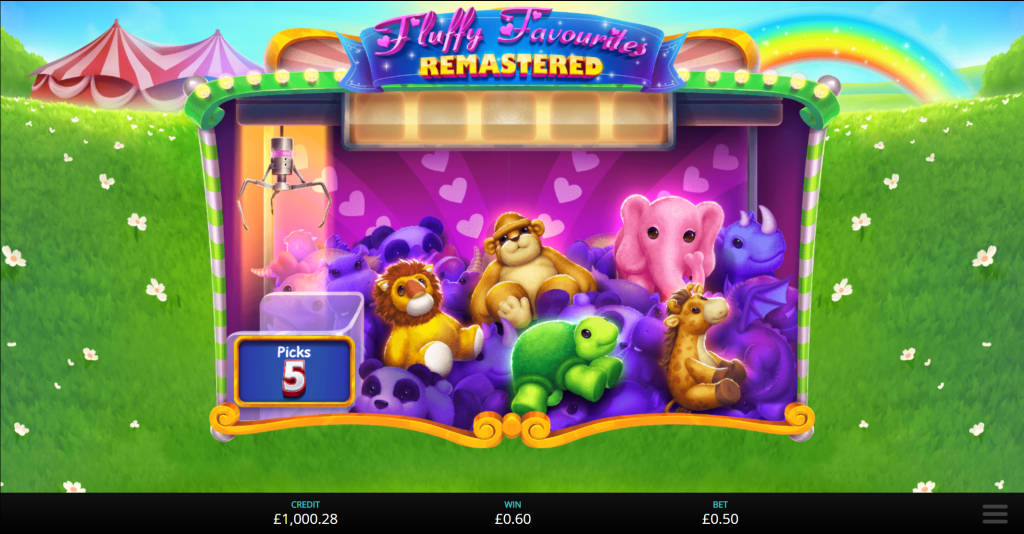
Bonus features are often treated as the emotional centrepiece of slot games, moments where the rules loosen and rewards finally accelerate. In Fluffy Favourites Remastered, the Toybox pick bonus plays a very different role. It is not designed to dominate the experience. It is designed to interrupt it.
The structure of the Toybox bonus is deliberately compact. Entry conditions are clear, resolution is immediate, and outcomes are final. There is no prolonged animation sequence, no sense of escalation, and no illusion of control beyond the initial selection. From a design perspective, this brevity is essential. The bonus exists not to redefine the session, but to recalibrate it.
Behaviourally, short bonuses serve a specific function. They provide relief without release. A player who has endured an extended sequence of neutral spins experiences the bonus as a confirmation that engagement is recognised, even if the numerical outcome is modest. This confirmation is often more important than the payout itself. It restores a sense of responsiveness to the system.
The pick-based structure reinforces this effect. Each choice feels discrete and personal, yet the range of possible outcomes is tightly controlled. This creates an illusion of agency without introducing genuine variability. Players feel involved, but the game remains firmly in control of value distribution. The result is a feature that feels interactive without becoming disruptive.
Crucially, the Toybox bonus does not attempt to compete with free spins or other high-impact features. Its rewards are capped, its duration limited, and its emotional footprint intentionally small. This prevents it from overshadowing the core rhythm of the game. Instead, it functions as a pressure valve, releasing tension just enough to make continued play feel justified.
In the context of the remastered design, this role becomes even clearer. Faster base gameplay and cleaner presentation mean that interruptions carry more weight. A short bonus stands out precisely because it is rare and contained. It marks a moment without redefining the session narrative.
From a psychological standpoint, this type of feature supports persistence. It reduces frustration without encouraging overconfidence. Players are reminded that positive outcomes exist, but they are not invited to expect transformation. This balance helps maintain realistic expectations, which in turn stabilises emotional engagement over time.
The Toybox bonus is therefore best understood not as a reward mechanism, but as a regulatory one. It smooths the experience, reinforces patience, and preserves the integrity of the broader system. In doing so, it exemplifies the understated confidence that characterises the remastered design as a whole.
Resolution Without Reinvention: The Role of Free Spins
Base Game
Creation phase built on scarcity. Outcomes are restrained, signals are subtle, and value is deliberately delayed.
Free Spins
Resolution phase where accumulated tension is released. Existing mechanics are amplified rather than replaced.
Free spins are often where slot games attempt to reinvent themselves. New mechanics appear, symbols mutate, and volatility spikes. Fluffy Favourites Remastered takes a more restrained approach. Its free spins do not introduce novelty. They introduce closure.
The defining feature of the free spins mode is a fixed multiplier applied consistently throughout the sequence. This choice signals intent. Rather than surprising the player, the game clarifies its purpose. Everything that has been withheld, delayed, or fragmented during the base game is given an opportunity to resolve under amplified conditions.
This design frames free spins as a resolution phase rather than a spectacle. There is no learning curve, no adjustment period, and no sudden increase in cognitive demand. Players enter the mode already understanding how outcomes are generated. The only difference is that outcomes now carry more weight.
From a behavioural perspective, this consistency is significant. It reduces uncertainty at the very moment when emotional intensity is highest. Players are not distracted by new rules or mechanics. Their attention remains focused on results. This focus heightens the perceived importance of each spin without requiring additional stimulation.
The automatic nature of the multiplier further reinforces this effect. There is no decision-making, no progression, and no opportunity to influence the outcome. The game signals that this phase is not about strategy or control. It is about allowing the accumulated logic of the session to play out.
Importantly, free spins in this game do not guarantee satisfaction. They offer potential, not redemption. Some sessions will resolve quietly, others more dramatically. What matters is that the mode feels earned rather than arbitrary. It arrives after sustained engagement and functions as a coherent extension of what came before.
In the remastered context, this approach aligns with the overall emphasis on rhythm and patience. Faster transitions and cleaner visuals ensure that the free spins mode feels integrated rather than separate. It does not interrupt the experience; it completes it.
Psychologically, this creates a clear narrative arc. The base game establishes scarcity and anticipation. The bonus features provide intermittent reassurance. Free spins offer resolution. Even when outcomes are modest, the structure itself feels complete. That sense of completion is often enough to justify the time invested.
By resisting the temptation to overcomplicate its most visible feature, Fluffy Favourites Remastered demonstrates a high level of design confidence. It trusts its core mechanics and relies on amplification rather than innovation to deliver impact. In doing so, it reinforces a central theme of the game: restraint is not a limitation, but a strategy.
Time, Patience, and Variance: How Sessions Actually Unfold
To understand Fluffy Favourites Remastered properly, one must stop thinking in terms of individual spins and start thinking in terms of sessions. This is a game that reveals itself slowly. Its most defining characteristics emerge not in moments, but across time.
The rhythm of play is deliberately even. Spins resolve quickly, outcomes are communicated with minimal flourish, and the emotional tone remains stable for long periods. This consistency encourages players to remain engaged without feeling overstimulated. There is little sense of urgency, and almost no pressure to react. Instead, the game invites endurance.
Variance plays a central role in shaping this experience. Outcomes cluster unevenly, and long stretches of neutral or low-impact results are common. From a behavioural perspective, these stretches are not accidental side effects. They are the primary mechanism through which the game conditions expectation. Players learn, often unconsciously, that inactivity is normal and that patience is required.
What distinguishes this design from harsher high-variance models is the absence of punitive feedback. Losses are not exaggerated, and silence is not framed as failure. The game simply continues. This neutrality reduces emotional fatigue and makes extended sessions feel more sustainable. Players are less likely to disengage out of frustration, even when outcomes are unfavourable.
Session length is therefore not driven by excitement, but by tolerance. Those who enjoy rapid cycles of reward and loss may find the game uneventful. Those who are comfortable with slow progression and delayed resolution are more likely to settle into its rhythm. Over time, the game becomes something to occupy attention rather than dominate it.
Another important aspect of session behaviour is predictability without certainty. Players begin to recognise patterns in frequency without being able to anticipate outcomes. This creates a sense of familiarity that coexists with unpredictability. The game feels known, but never solved.
From a psychological standpoint, this balance supports habitual play. The absence of sharp emotional peaks reduces the risk of burnout, while the occasional reinforcement events maintain engagement. The experience becomes less about chasing results and more about maintaining continuity.
In this context, Fluffy Favourites Remastered functions almost like a metronome. It sets a pace, maintains it, and rarely deviates. For the right player, this can be deeply appealing. For others, it can feel uneventful. Understanding this distinction is essential before drawing conclusions about the game’s value or appeal.
One Name, Multiple Identities: Placing Remastered Among Its Peers
Remastered vs Other Fluffy Versions
| Version | Rhythm | Volatility feel | Bonus role |
|---|---|---|---|
| Remastered | Steady | Endurance-based | Resolution-focused |
| Megaways | Unstable | Spike-driven | Central |
| Mix n Win | Fragmented | Feature-heavy | Dominant |
The Fluffy Favourites name now covers several distinct interpretations of the same conceptual foundation. Each version retains familiar elements while emphasising different aspects of play. The remastered edition occupies a specific position within this landscape, and understanding that position helps clarify its purpose.
Compared to more expansive or feature-driven variants, Remastered is restrained. It avoids large-scale mechanical transformations and instead refines what already exists. Where other versions may prioritise volatility spikes or visual spectacle, Remastered prioritises consistency and balance. It is less concerned with surprise and more concerned with sustainability.
This makes it particularly suitable for players who value coherence. The experience feels unified from start to finish. Features emerge naturally from the base game rather than interrupting it. There is a clear throughline from the first spin to the last.
In contrast, versions that introduce more dramatic structural changes often fragment the experience. They may offer higher peaks, but they also introduce greater instability. For some players, that instability is exciting. For others, it undermines trust in the system. Remastered avoids this trade-off by maintaining a narrow but reliable emotional range.
Another distinguishing factor is cognitive load. Remastered demands very little interpretation. Once the basic rules are understood, nothing fundamentally changes. This simplicity supports long sessions and makes the game accessible across different contexts, including mobile play. Other versions, while still familiar, require more attention and adaptation.
Importantly, choosing Remastered over another iteration is not a matter of quality, but of preference. It caters to a specific mindset: one that values patience, clarity, and emotional regulation over intensity. It does not attempt to be all things to all players. Instead, it commits fully to its own rhythm.
By situating Remastered within the broader Fluffy Favourites family, its design choices become easier to appreciate. It is not the loudest or the most dynamic version. It is the most measured. That restraint is not a limitation, but a deliberate statement about what kind of experience the game intends to offer.
Understanding that statement allows players to approach the game with appropriate expectations. When expectations align with design, satisfaction becomes more likely, even in the absence of dramatic outcomes. That alignment is one of the quiet strengths of Fluffy Favourites Remastered, and a key reason it continues to hold attention in an increasingly crowded market.
Designed for a Certain Kind of Player, Not Everyone
Who this slot is really for
Two honest directions: one for fit, one for friction. This is about pacing preferences, not outcomes.
- Enjoy steady pacing and can sit through quiet stretches
- Prefer clarity over constant feature noise
- Like systems that feel consistent session-to-session
- Treat bonuses as punctuation, not the main event
- Play longer sessions and value rhythm over spikes
- Need frequent “something is happening” moments
- Expect rapid bonus triggers or quick emotional pay-offs
- Prefer volatility that hits hard and often
- Want visible progress systems that build across spins
- Get impatient when the base game stays calm for long periods
Fluffy Favourites Remastered does not attempt to appeal universally, and this is one of its more honest qualities. Its design implicitly selects its audience through rhythm rather than messaging. Players who remain engaged tend to share certain expectations about time, reward, and emotional pacing.
This is a slot for players who are comfortable with waiting. Not in the passive sense of boredom, but in the active sense of tolerance. The game assumes that the player does not require constant affirmation or frequent reinforcement to remain involved. Instead, it offers stability and predictability at the structural level, while leaving outcomes unresolved for extended periods.
Players who enjoy long, uninterrupted sessions are more likely to find coherence here. The absence of escalating mechanics or visible progress indicators means there is little pressure to “finish” something. One can enter and exit without feeling that anything has been lost or interrupted. This makes the game well suited to habitual play patterns rather than goal-oriented ones.
Conversely, players who seek rapid feedback, frequent bonuses, or dramatic shifts in pace may find the experience underwhelming. The game does not reward impatience. Increasing stake size does not alter its fundamental behaviour, nor does rapid play accelerate meaningful events. It remains consistent regardless of approach.
There is also a psychological aspect to suitability. This game appeals to players who are relatively comfortable with ambiguity. It provides few explicit signals about when something significant might occur. Those who find such ambiguity unsettling may interpret the experience as unresponsive or unengaging. Those who accept it often report a greater sense of control, even though the system itself does not change.
Importantly, Fluffy Favourites Remastered does not flatter the player. It does not suggest mastery, improvement, or special insight. Each spin is self-contained and final. For some, this feels limiting. For others, it feels refreshingly honest.
In short, this is a game for players who value composure over stimulation, continuity over novelty, and structure over spectacle. It is not designed to convert sceptics or thrill-seekers. It is designed to retain those who recognise its rhythm and are comfortable inhabiting it.
Practical Questions About Fluffy Favourites Remastered
Frequently asked questions
Is Fluffy Favourites Remastered a completely new game?
⌄
Does the remastered version change how often bonuses appear?
⌄
Is this slot suitable for casual or short sessions?
⌄
Are free spins the main focus of the game?
⌄
Does the game require any strategy or decision-making?
⌄
Is Fluffy Favourites Remastered a high-volatility slot?
⌄
A Quietly Confident Design That Rewards Understanding, Not Impulse
After examining Fluffy Favourites Remastered in detail, what stands out most is not any single feature, symbol, or statistic, but the coherence of the whole. This is a game that knows exactly what it wants to be and, just as importantly, what it does not try to be. In an environment where many slots compete for attention through excess, this one relies on restraint, consistency, and psychological precision.
From a structural perspective, Fluffy Favourites Remastered demonstrates a mature approach to engagement. It does not chase novelty for its own sake. Instead, it refines familiar elements until they work together with minimal friction. The result is an experience that unfolds gradually, revealing its character over time rather than announcing it immediately.
One of the most significant qualities of the game is how it manages expectation. Nothing in its design promises quick rewards or constant stimulation. Long sequences of uneventful play are not treated as anomalies but as the default state. This normalisation of quiet play fundamentally shapes how outcomes are interpreted. Wins feel earned not because they are large, but because they arrive after patience has been tested.
The remastered adjustments enhance this effect rather than undermining it. Smoother pacing, clearer presentation, and refined balance make the experience more cohesive without altering its identity. These changes do not transform the game into something new; they allow it to function more effectively within contemporary play habits, particularly on mobile platforms where clarity and responsiveness matter.
What is especially notable is how little the game relies on illusion. There are no progress meters implying inevitability, no escalating mechanics suggesting that persistence will be rewarded in predictable ways, and no systems that encourage the belief that control can be learned or mastered. Each spin stands alone. The game neither flatters nor deceives. It simply continues.
This honesty will not appeal to everyone. Players seeking excitement through rapid feedback, frequent bonuses, or dramatic swings may find the experience too subdued. However, for those who value composure and continuity, the design offers something increasingly rare: a slot that respects time rather than trying to compress it.
From a psychological standpoint, this kind of design encourages a different relationship with play. Engagement is maintained through rhythm rather than intensity. Emotional responses are regulated rather than provoked. The experience becomes less about chasing moments and more about inhabiting a steady, predictable system where surprises are possible but never promised.
In that sense, Fluffy Favourites Remastered functions almost as a case study in modern restraint. It shows that engagement does not require constant escalation, and that simplicity, when carefully engineered, can be more sustainable than complexity. Its success lies not in dramatic outcomes, but in how effectively it aligns structure, pacing, and expectation.
For players who understand and appreciate that philosophy, the game offers a coherent and measured experience. It does not demand belief, excitement, or urgency. It asks only for patience and attention. Those willing to provide both are likely to find that the game delivers exactly what it intends, no more and no less.