
Too Demo Fluffy Favourites — Exploring the Game Without Expectations
Demo as Method: Why Fluffy Favourites Too Deserves a Closer Look
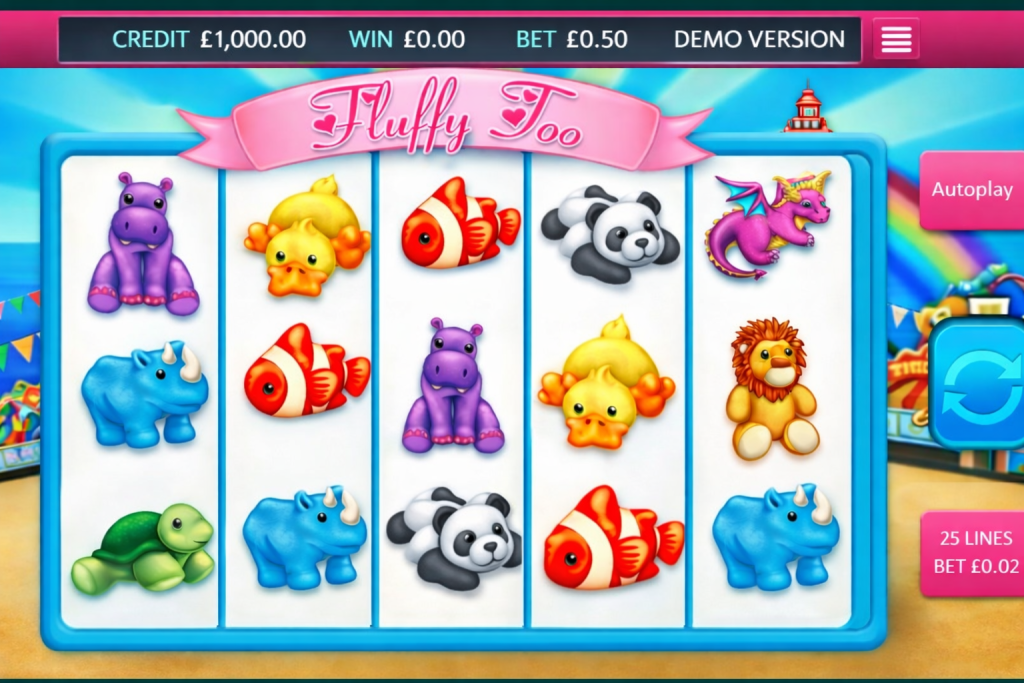
I approach Fluffy Favourites Too from the position that a demo version is not a teaser, not a substitute for play, and certainly not a promise of outcome. It is a method. A controlled environment in which the structure of a slot can be observed without the noise of expectation. In that sense, this page exists to slow the game down and to make its underlying design visible.
Fluffy Favourites Too sits in an interesting place within its own lineage. It looks familiar at first glance, deliberately so, yet it behaves with a patience that many casual players underestimate. This is not a slot that explains itself within a handful of spins. Its logic unfolds gradually, sometimes uncomfortably so, and that is precisely why the demo version matters. Without financial pressure, the rhythm of the game becomes easier to read, and the distance between activity and reward becomes clearer.
What makes this sequel worth examining is not novelty for its own sake, but refinement. The game does not attempt to overwhelm with features. Instead, it leans into spacing, repetition, and delayed resolution. These are design choices, not accidents. In the demo, you begin to notice how often nothing happens, how frequently anticipation is allowed to linger, and how rarely the game rushes to compensate the player for their time.
This page is written from the perspective of observation rather than instruction. There is no attempt here to tell you how to play, how long to play, or what to expect in numerical terms. Those questions tend to distract from what matters more: how the slot behaves when it is left alone to do what it was designed to do. Fluffy Favourites Too rewards attention more than optimism, and the demo environment is the only place where that attention can be applied without distortion.
If you are looking for spectacle, this is not the right lens. If, however, you are interested in how a modern slot balances familiarity with restraint, then the demo becomes something closer to a study than a trial run.
A Technical Snapshot That Prioritises Feel Over Figures
A compact snapshot of how Fluffy Favourites Too feels in demo play
This is the fast read: format, pacing, and what to watch for when the game shifts from quiet base spins into concentrated feature moments.
Note: the demo is best used to understand behaviour and pacing. Exact parameters can vary by operator, but the underlying rhythm and feature logic remain consistent.
Before moving into behaviour and patterns, it is worth establishing the basic shape of the game, not as a list of selling points, but as a framework for understanding its pace.
Fluffy Favourites Too uses a traditional reel-and-line format, one that immediately signals continuity with earlier entries in the series. There is nothing experimental about the layout, and that is intentional. The familiarity of the grid allows the player to focus on timing rather than learning a new visual language. Spins resolve cleanly, animations are restrained, and transitions between outcomes are deliberately unhurried.
The tempo of the game is best described as measured. Spins do not cascade into one another, and wins, when they occur, are allowed to stand on their own without excessive reinforcement. In demo play, this creates noticeable gaps between moments of interest. These gaps are not dead space; they are part of the structure. They train expectation and recalibrate what counts as a meaningful event.
Volatility, in practical terms, expresses itself through scarcity rather than surprise. The game does not rely on sudden reversals or frequent small interruptions. Instead, it builds value slowly and releases it selectively, most often through bonus-driven phases rather than base-game momentum. This is important to understand early, because it shapes how the demo should be interpreted. Long stretches without notable outcomes are not signs of malfunction, but signals of intent.
Key elements such as wild symbols and bonus triggers are present from the outset, yet they operate with restraint. Their appearances are spaced, and their impact is contextual rather than constant. In the demo, this allows you to see how often these elements contribute meaningfully, as opposed to merely appearing as visual reassurance.
Taken together, this snapshot is not meant to impress. It is meant to orient. Fluffy Favourites Too is a game built around delayed gratification and controlled escalation. The demo does not hide this. On the contrary, it makes it easier to see, provided you are willing to watch rather than rush.
The Fluffy Framework: Understanding the Series Before the Sequel
The Fluffy cycle in four steps, designed to repeat
Click any stage to highlight its place in the sequence and reveal the short explanation underneath.
Base Game
This phase sets the slot’s baseline. The point is not constant feedback, but establishing the rhythm that makes later resolution feel distinct.
To understand Fluffy Favourites Too properly, it helps to step back from the individual game and look at the structure it inherits. This series was never designed around spectacle or constant stimulation. Its identity comes from a quieter, more deliberate design philosophy, one that prioritises structure over surprise and rhythm over reaction. The visual tone may suggest lightness, even playfulness, but the mechanical intent is far more restrained.
Across the series, the core idea remains consistent: the base game is not the main source of resolution. Instead, it functions as a preparatory phase, a space in which the player is asked to wait, observe, and tolerate extended periods of low activity. This is not an accidental side effect of volatility; it is the volatility. The Fluffy Favourites formula relies on the tension created by absence rather than the reassurance created by frequent feedback.
One of the defining traits of the series is how it treats anticipation. Rather than escalating quickly, these games allow expectations to plateau. Symbols recur without immediately paying off. Features appear without necessarily leading anywhere. In demo play, this can feel uncomfortable, especially for players accustomed to slots that constantly acknowledge participation. Here, acknowledgement is delayed. The game seems indifferent to whether it is being watched, and that indifference is part of its character.
Another consistent element is the separation between visual charm and mathematical weight. The animal theme, bright colours, and friendly animations act as a kind of camouflage. Beneath that surface lies a structure that is unapologetically demanding. The series does not soften its volatility through presentation. It simply disguises it. The demo version strips away much of that disguise by removing stakes, making it easier to see how little the game is willing to offer in its early stages.
Importantly, Fluffy Favourites games tend to reward endurance rather than engagement. They do not respond to changes in bet size or speed of play in ways that feel immediately noticeable. Instead, they adhere to their own internal pacing. This creates a sense that the game is operating independently of the player, which can be frustrating in real play but illuminating in demo mode. Without pressure, the player can observe how long the game is prepared to remain uneventful before shifting into something more active.
Fluffy Favourites Too inherits all of these traits. It does not abandon the series philosophy, nor does it attempt to modernise it through excess. What it does instead is refine the balance between familiarity and delay. Understanding the series framework makes it easier to recognise what the sequel is trying to achieve, and just as importantly, what it is not trying to fix.
This context matters because many misconceptions about the game stem from treating it as an isolated product. When viewed as part of a broader design lineage, its slower pace and heavier reliance on bonus resolution appear less like flaws and more like deliberate continuity.
Original and Too: Where Continuity Ends and Adjustment Begins
Where the sequel tightens the formula — without changing the face of the game
Use the toggles to focus the comparison. The goal here is quick clarity, not a wall of text.
More frequent micro-events, with gentler pauses between them.
more reassuringLonger quiet phases, with fewer “comfort” moments in between.
more restrainedWilds feel more like small corrections that keep spins moving.
momentum supportWilds land more conditionally, shaping outcomes only when aligned.
situational impactBonus matters, but the base game still carries some visible value.
shared emphasisResolution concentrates more clearly inside bonus-led phases.
feature-centredSmoother flow, with fewer dramatic shifts between states.
steadier feelMore pulse-like: quiet stretches followed by clustered activity.
clustered pulsesLower perceived pressure due to more frequent acknowledgement.
softer tempoHigher perceived pressure because the game offers fewer signals.
less reassuranceTip: if you only read one row, start with rhythm — it explains why the sequel can feel “slower” even when the layout looks familiar.
At first glance, the differences between the original Fluffy Favourites and Fluffy Favourites Too may seem subtle. The layout remains familiar, the thematic language unchanged, and the overall structure recognisable within a few spins. This superficial similarity is intentional. The sequel does not aim to reinvent the series; it aims to recalibrate it.
The most noticeable shift lies in pacing. While the original already leaned toward patience, the sequel stretches that patience further. Base-game activity feels more restrained, with longer stretches between moments of significance. In demo play, this becomes especially apparent. The game seems content to sustain low-intensity cycles for extended periods, reinforcing the idea that the base game exists primarily as a lead-in rather than a destination.
Wild symbol behaviour reflects this recalibration. In the original, wilds often felt like small compensations, appearing frequently enough to maintain a sense of motion even when larger outcomes were absent. In the sequel, their presence feels more conditional. They appear less as reassurance and more as potential. Their impact depends heavily on context, and without the right surrounding symbols, they are allowed to resolve into nothing of consequence. This makes their appearance feel less comforting and more observational.
The bonus structure also carries greater weight in the sequel. While both games rely on bonus phases as key resolution points, Fluffy Favourites Too places more emphasis on what happens once the base game gives way. The transition into bonus play feels less like a reward and more like a shift in rules. In demo mode, this contrast is stark. The game does not gradually build excitement toward the bonus; it simply changes state. That change is where much of the perceived value is concentrated.
Another difference lies in how the game handles repetition. The original often used repetition as a form of familiarity, reinforcing patterns until they felt predictable. The sequel uses repetition differently. Patterns recur, but their outcomes vary more widely. This creates a sense of instability within familiarity. The player recognises the setup but cannot rely on it to resolve in the same way. In demo play, this undermines any early assumptions about predictability.
Volatility, as experienced rather than measured, feels heavier in the sequel. Not because outcomes are necessarily larger, but because they are more unevenly distributed. Long stretches of inactivity are followed by concentrated bursts of resolution, often confined to specific phases rather than spread evenly across play. This distribution makes the demo experience particularly revealing. Without the emotional weight of loss, the structure of scarcity becomes easier to trace.
Perhaps the most significant adjustment is tonal rather than mechanical. Fluffy Favourites Too feels less concerned with keeping the player comfortable. The original balanced its restraint with moments of reassurance, subtle signals that persistence would be acknowledged. The sequel removes many of those signals. It offers fewer hints and fewer concessions. The game appears more self-contained, less reactive, and more willing to let the player disengage if expectations are misaligned.
This is not an evolution toward complexity, but toward clarity. The sequel clarifies what the series has always been about by stripping away some of its softer edges. In doing so, it becomes more honest, though not necessarily more forgiving. The demo version is where this honesty is most visible. Without financial consequence, the design choices stand exposed, and the differences between original and sequel become less about features and more about intent.
Seen in this light, Fluffy Favourites Too is not simply more of the same. It is a narrower, more focused expression of the same philosophy. It asks for more patience, offers fewer distractions, and concentrates its value more deliberately. Whether that makes it more appealing depends entirely on what the player is looking to understand.
Inside the Engine Room: How the Core Mechanics Actually Function
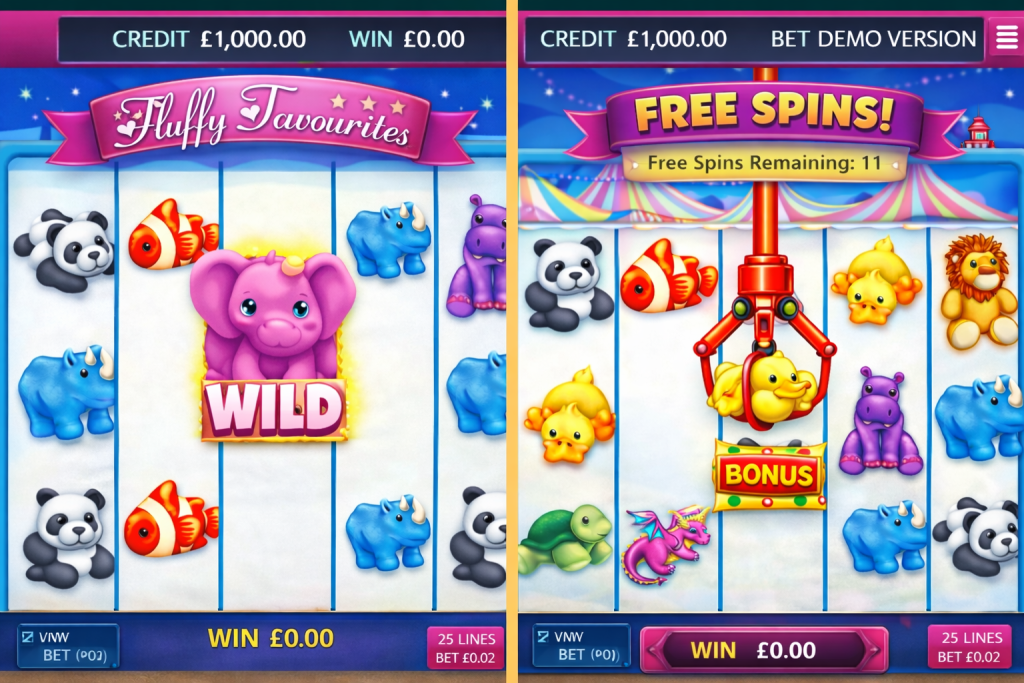
Once the broader context of the series and the sequel’s intent is understood, attention naturally shifts to the internal mechanics. Not as isolated features, but as a system of interdependent behaviours. Fluffy Favourites Too is not mechanically dense in the conventional sense. It does not overwhelm with layers, side-features, or constant modifiers. Its complexity lies instead in how sparingly those mechanics are allowed to act.
The wild symbol is the clearest example of this restraint. On paper, its role is straightforward. In practice, its behaviour is deliberately conservative. Wilds appear often enough to remain part of the visual language of the game, yet infrequently enough that their presence never guarantees momentum. In the demo environment, this becomes particularly noticeable. A wild can land without consequence, not because it is poorly timed, but because the surrounding structure does not accommodate it. This is not a flaw. It is a statement.
Rather than acting as a corrective force that rescues weak spins, wilds in Fluffy Favourites Too behave more like conditional amplifiers. They reward alignment, not persistence. When they contribute, they do so decisively. When they do not, the game offers no apology. This makes their impact feel earned rather than granted, and it also reinforces the idea that the base game is not designed to smooth volatility, only to sustain it.
The bonus and free spins logic follows a similar philosophy. Activation is clear, unambiguous, and relatively rare. There is no prolonged teasing through near-misses or artificial build-up. The trigger either arrives or it does not. In demo play, this lack of psychological manipulation is striking. The game does not attempt to hold attention through suggestion. It simply waits.
Once the bonus is triggered, the mechanics shift noticeably. Free spins do not merely extend play; they redefine it. The pacing changes, symbol interactions feel more concentrated, and multipliers, where present, become central rather than supplementary. This is where much of the game’s mathematical weight resides. The base game prepares the ground, but the bonus determines the outcome. Importantly, the demo makes this distinction clearer by removing the emotional distortion caused by cost.
What stands out most is how cleanly the game separates these states. There is no gradual bleed from base play into bonus resolution. The transition is abrupt, almost clinical. One mode ends, another begins, and the rules change accordingly. This sharp separation reinforces the idea that Fluffy Favourites Too is structured around phases rather than flow.
Crucially, these mechanics do not compete for attention. Wilds do not distract from bonus anticipation, and bonuses do not retroactively justify the base game. Each element has a defined role and a limited window of influence. In demo play, this creates an experience that feels sparse but coherent. Nothing is wasted, and nothing is exaggerated.
The result is a slot that reveals itself slowly, not because it hides information, but because it refuses to repeat it unnecessarily. The mechanics do their work and then recede, allowing the player to observe the space between events. That space is where understanding forms.
From Silence to Resolution: The Game’s Phases in Practice
Four phases, one rising arc — from silence to concentrated resolution
The point of the demo is not constant events; it’s understanding when the game changes state, and how intensity ramps up across the cycle.
Base silence
Intensity: low
This is the slot’s default state. In demo play, it’s where you learn the true pacing: long stretches with minimal reinforcement.
Fluffy Favourites Too is best understood not as a continuous experience, but as a sequence of distinct phases. Each phase serves a specific purpose, and none of them are designed to stand alone. The demo environment allows these phases to be observed without interruption, making their boundaries clearer than they would be under real conditions.
The opening phase is defined by restraint. Base play operates at a deliberately low intensity, offering minimal feedback and limited variation. Wins are infrequent, features are subdued, and repetition dominates. This is the phase most players encounter first, and it is often the point at which expectations are tested. In demo mode, this phase can last longer than anticipated, revealing how comfortable the game is with silence.
This silence is not empty. It is functional. The base phase establishes rhythm, teaches patience, and sets a baseline against which all later activity is measured. Without it, the bonus phase would lose its contrast. The demo makes this clear by allowing extended exposure to the base game without consequence. Over time, patterns emerge, not in outcomes, but in behaviour. The game repeats itself until repetition itself becomes the signal.
The second phase can be described as accumulation. Not in the sense of visible progress, but in the gradual tightening of expectation. Features begin to appear with slightly more frequency, wilds feel closer to relevance, and the possibility of transition becomes perceptible. Importantly, the game does not acknowledge this shift explicitly. There are no alerts, no escalating animations. The change is subtle and easy to miss unless one is paying attention.
This accumulation phase is where many misconceptions arise. In real play, it is often mistaken for momentum. In the demo, stripped of emotional investment, it reads more clearly as preparation. The game is not building toward a guaranteed event; it is aligning conditions under which an event may occur. The difference is subtle but significant.
The resolution phase arrives abruptly. The bonus triggers, and the game changes character. Where the base phase was sparse, the bonus phase is concentrated. Where outcomes were previously spread thin, they are now clustered. Free spins compress time, allowing multiple interactions to resolve in quick succession. Multipliers, when active, amplify this compression, turning modest combinations into meaningful results.
What is striking in demo play is how contained this resolution phase feels. It does not sprawl, and it does not linger. It arrives, resolves, and ends. There is little attempt to extend its impact beyond its natural boundary. Once complete, the game resets without ceremony, returning the player to the opening phase with no lingering advantage or reassurance.
The final phase, often overlooked, is the aftermath. Post-bonus play can feel particularly subdued, almost deliberately so. The contrast reinforces the cyclical nature of the design. Each phase exists to make the next one legible. The game does not evolve across sessions; it repeats its structure with consistency.
Seen as a whole, these phases form a closed loop. There is no escalation across time, no narrative arc beyond repetition itself. The demo version is uniquely suited to revealing this structure because it removes urgency. Without the pressure to recover or capitalise, the phases become easier to distinguish, and the logic behind their sequencing becomes apparent.
Fluffy Favourites Too does not ask to be played quickly or impulsively. It asks to be observed. The phases are its language, and the demo is the only space where that language can be read without distortion.
Reading Between the Spins: Behavioural Patterns Revealed in Demo Play
A rhythm strip: quiet stretches, clustered bursts, and a short bonus spike
This is a non-statistical visual metaphor. Tap any segment to “read” the mood of that moment, or use the filters to isolate one behaviour type.
How to interpret the strip
Tap segments to read a moment
Long runs of small, low segments represent “quiet” time. Short groups of taller segments represent clustered activity. The tallest, tightest cluster suggests a brief bonus-led spike.
Once the structure and phases of Fluffy Favourites Too are clear, attention naturally turns to behaviour. Not behaviour in the sense of outcomes, but in the way the game conducts itself over time. This is where the demo version becomes particularly revealing, because it allows patterns to surface without being obscured by emotional response.
One of the most noticeable behavioural traits is the game’s comfort with extended inactivity. Long stretches without meaningful events are not exceptions; they are a core characteristic. In demo play, this can feel almost confrontational. The game does not attempt to reassure the player through frequent minor wins or visual stimulation. Instead, it maintains a steady, almost indifferent rhythm. This indifference is instructive. It signals that the slot is not designed to reward constant engagement, but sustained presence.
Another pattern that emerges is the uneven distribution of activity. When events do occur, they tend to cluster. Wild interactions, feature-related moments, and transitions into bonus play often arrive close together, followed by renewed periods of quiet. This creates a pulse-like structure rather than a smooth curve. In real play, such clustering can feel dramatic or decisive. In demo mode, it reads as structural intent. The game prefers concentration over continuity.
Cyclical behaviour is also evident. After a bonus phase, the game often returns to a notably subdued state. This is not a cooldown in the conventional sense, nor is it a punitive response. It appears to be a reset. The slot re-establishes its baseline before allowing conditions to align again. In demo play, observing this reset without expectation makes it easier to recognise how deliberately the cycle is enforced.
There is also a distinct lack of adaptive behaviour. The game does not respond to changes in tempo, nor does it appear to acknowledge prolonged observation. Spin speed, session length, and persistence do not seem to alter the underlying rhythm. This reinforces the impression that Fluffy Favourites Too operates according to a fixed internal logic. The player participates, but does not influence.
What is perhaps most revealing is how little the game relies on suggestion. Near-misses are present but understated. Visual cues do not escalate dramatically before features trigger. The game rarely hints that something is about to happen. In demo play, this absence of signalling becomes more apparent, and with it, a clearer understanding of how little the game depends on psychological nudging.
Taken together, these behavioural patterns suggest a slot that values consistency over persuasion. It does not attempt to manage the player’s emotions actively. Instead, it presents its structure repeatedly and allows the player to decide whether that structure is acceptable. The demo environment strips away urgency and reveals this neutrality in full.
Using the Demo as a Tool Rather Than a Trial
A practical way to watch the game — and avoid common demo traps
Tap items to tick them off as you go. This keeps the demo focused on observation rather than expectation.
Phase changes, not individual spins
Look for shifts in intensity: quiet baseline, rising pressure, then a short burst of resolution.
-
Notice how long the baseline stays quiet
-
Watch for clustered moments rather than steady feedback
What actually changes in the bonus state
Treat the bonus as a different rule-set, not simply “more spins”.
-
Compare base behaviour versus bonus behaviour
-
Note whether activity arrives in clusters during the feature
Wilds as conditional impact
Track whether wilds create outcomes or simply appear without changing the spin.
-
Count “meaningful” wilds versus cosmetic ones
-
Watch how often a wild needs alignment to matter
A reliable frequency estimate
Demo play can show structure, not a dependable “how often”.
-
Avoid turning a short demo session into a probability claim
A permanent “hot” state
After a bonus, the game typically returns to baseline rather than staying elevated.
-
Expect a reset rather than continuous momentum
Clear warnings before a feature
The slot often avoids obvious “something is coming” signalling.
-
Don’t rely on near-misses as a meaningful indicator
Chasing “meaning” in short samples
A few minutes of demo play can mislead if you treat it as a measurement exercise.
-
Use the demo to observe phases, not to predict frequency
Treating any wild as “progress”
Wilds can appear without producing a meaningful change in the outcome.
-
Separate “appearance” from “impact”
Skipping the quiet baseline
If you rush, you miss the point: the baseline explains why the bonus feels different.
-
Let the quiet phase run long enough to be felt
The demo version of Fluffy Favourites Too is most useful when approached with the right expectations. It is not a preview of success, nor a simulation of future outcomes. Its value lies in observation, not anticipation. Used properly, it becomes a way to understand how the game allocates attention, time, and resolution.
One of the most productive uses of the demo is to assess tolerance for inactivity. Extended base-game phases are a defining feature of this slot. The demo allows these phases to be experienced without consequence, making it easier to decide whether the rhythm aligns with personal preference. This is not about endurance, but compatibility.
The demo is also effective for distinguishing between appearance and function. Visual charm can mask structural severity. By removing stakes, the demo makes it easier to notice how rarely features intervene and how selective the game is about meaningful interaction. This clarity is difficult to achieve when each spin carries emotional weight.
Another important function of the demo is to contextualise the bonus phase. Without the pressure of expectation, the bonus can be observed for what it is: a concentrated resolution mechanism rather than a guaranteed turning point. The demo highlights how much of the game’s value is deferred to this phase, and how little the base game does to compensate in its absence.
Equally important is understanding what the demo cannot provide. It does not establish frequency in any meaningful statistical sense, nor does it predict session-level behaviour. Patterns observed in demo play are structural, not predictive. They describe how the game behaves, not what it will deliver.
Used this way, the demo becomes a filter. It helps identify whether the design philosophy of Fluffy Favourites Too aligns with the player’s expectations before any commitment is made. It does not encourage optimism, nor does it discourage caution. It simply exposes the game’s rhythm and allows it to speak for itself.
Approached as a tool rather than a test, the demo fulfils its purpose. It replaces assumption with observation and impatience with understanding. For a slot built on delayed resolution and restrained feedback, there is no more appropriate way to engage.
Who This Demo Speaks To, and Who It Quietly Pushes Away
Fluffy Favourites Too does not attempt to appeal to everyone, and the demo version makes this clear with unusual honesty. Rather than broadening its reach through accessibility or constant engagement, the game defines its audience through exclusion. It rewards alignment, not adaptation.
This demo is most suited to players who are comfortable with delayed feedback. Those who can tolerate extended periods without reinforcement will find the experience coherent, even meditative. The game does not hurry, and neither should the observer. If you are inclined to watch systems unfold rather than chase outcomes, the demo provides enough space for that inclination to be satisfied.
It also suits players who value structural clarity over excitement. Fluffy Favourites Too behaves consistently. It does not disguise its intent through spectacle or narrative escalation. In demo play, this consistency becomes easier to appreciate. You begin to see where the game invests its weight and where it withholds it. For some, this transparency is reassuring.
The demo is particularly appropriate for those who already understand volatility conceptually and want to experience how it manifests in practice. Rather than relying on abstract labels, the game demonstrates its character through rhythm and absence. The demo allows this to be felt without consequence, which is precisely where its educational value lies.
Conversely, the demo will likely frustrate players who expect frequent validation. If engagement is measured by constant activity, visual feedback, or steady progression, this slot offers little comfort. The game does not acknowledge effort in real time. It does not reward experimentation or persistence with immediate change. For some, this will feel uncompromising.
Players seeking short, contained sessions may also find the demo unrewarding. The game’s structure does not compress well. Its logic unfolds over time, and brief exposure can misrepresent its intent. The demo does not adapt to shorter attention spans, and it makes no effort to soften its pace for casual inspection.
In this sense, the demo functions as a form of self-selection. It does not persuade. It reveals. Those who remain engaged are likely aligned with the game’s design philosophy. Those who disengage do so early, often without ambiguity. This clarity is rare, and it is one of the demo’s most valuable qualities.
What Fluffy Favourites Too Demo Does — and Does Not — Answer
Quick answers, without losing the nuance
Tap a question to expand the answer. All questions and answers are kept intact.
What Time Spent With Fluffy Favourites Too Demo Actually Shows
Fluffy Favourites Too, when approached through its demo version, reveals itself as a game that is far more deliberate than its presentation initially suggests. Removed from the pressure of stakes and expectations, the slot’s structure becomes clearer, and with that clarity comes a more honest understanding of its intent. This is not a game designed to entertain continuously. It is designed to persist, to repeat itself, and to test the player’s tolerance for restraint.
The demo exposes a slot that is fundamentally uninterested in negotiation. It does not adapt its rhythm to the player, nor does it soften its volatility to maintain engagement. Instead, it adheres to a fixed internal logic built around phases, spacing, and delayed resolution. The base game exists not as a source of value, but as a framework within which value may eventually be released. That distinction matters, and it is one that only becomes fully visible in a risk-free environment.
What stands out most in demo play is the game’s confidence in silence. Fluffy Favourites Too is comfortable offering very little for extended periods, trusting that its structure will speak for itself. This is an unusual choice in a landscape increasingly dominated by constant feedback and stimulation. Here, inactivity is not a flaw to be disguised but a tool to be used. The demo makes this explicit by allowing long sessions of observation without consequence, revealing how central absence is to the game’s identity.
The bonus phase, when it arrives, does not attempt to justify the time spent reaching it through spectacle alone. It functions as a concentrated resolution point, a brief shift in rules where outcomes are allowed to cluster before the system resets. In the demo, this reset is particularly instructive. There is no sense of progression carried forward, no lingering advantage, and no escalation beyond what the structure already permits. Each cycle stands alone, reinforcing the game’s closed-loop design.
From a design perspective, Fluffy Favourites Too demonstrates a refusal to dilute its philosophy for accessibility. It does not attempt to broaden its appeal through reassurance or novelty. Instead, it narrows its focus, offering a clearer, more disciplined expression of the series’ core principles. The demo version does not hide this narrowing; it amplifies it. For some, this will feel uncompromising. For others, it will feel refreshingly transparent.
Ultimately, the value of the Fluffy Favourites Too demo lies not in what it promises, but in what it reveals. It allows the game to be seen without distortion, stripped of urgency and expectation. In doing so, it answers a more important question than whether the slot can reward a player. It shows whether the player is willing to engage with the slot on its own terms.
For those prepared to observe rather than rush, the demo offers a clear view of a game built around patience, repetition, and controlled release. It does not persuade. It does not reassure. It simply presents its structure and waits. Whether that structure resonates is not something the game attempts to decide. It leaves that judgement entirely to the player.